Tuesday, July 15, 2008

Its up to you New Yorker! New Yorker!

"These little town blues, are melting away
Ill make a brand new start of it - in old New York
If I can make it there, Ill make it anywhere
Its up to you - New York, New York."

As Amba at Ambivablog and Ann Althouse said about the New Yorker cover "everyone is talking about it. " So I have no choice but to declare a "Yossarian", as I have periodically done before and paraphrase Joseph Heller's famous protagonist from Catch 22 - "What if everyone was blogging about the New Yorker cover?" I can only respond as did Bomber Pilot John Yossarian: "Then I'd be a damn fool not to".

Since, as usual I am a day late and and a dollar short, I don't have a lot to add to the volumes written about the the cover itself. The cover is exactly what illustrator Barry Blitt intended, a humorous and brilliant slap down of the more inane attacks on Obama by the rabid right. No matter, the cover is not the real story. The real story is the reaction to the cover by Obama, his campaign and his supporters. As always, the tone is set at the top, with staff and supporters taking their cues from the leadership. Obama's reaction:
"ABC News' Sunlen Miller reports that when he was asked about the controversial cover during a press avail today, Obama shrugged and then said, "I have no response to that."
So, Barack Obama is pouting. Think how differently this story evolves if Obama instead looks at cover, laughs out loud, says "That's great. They missed a few points, where is Reverend Wright?"

But he did not say that. Instead we get an official Obama spokesman taking offense:
"The New Yorker may think... that their cover is a satirical lampoon of the caricature Senator Obama's right-wing critics have tried to create," said Obama campaign spokesman Bill Burton. "But most readers will see it as tasteless and offensive. And we agree."
And so the Obama acolytes who understand only too well that electing Barack Obama is much, MUCH too important to laugh about, go into high dudgeon and pile on.

But what do I know. Perhaps the Obama campaign is right. Perhaps it is important for every President and political candidate to immediately respond with righteous indignation on every political magazine cover. Perhaps Hillary Clinton and George W Bush should have responded to previous New Yorker covers in kind. Consider:

Hillary certainly could have sniffed about this New Yorker cover when the Monica Lewinsky scandal was breaking in ...

May 1994
"The New Yorker may think that their cover is a satirical lampoon of the First Lady's presidential ambitions..." said a Clinton spokesman "But during this time of personal family crisis and pain most readers will see it as tasteless and offensive. "
Or when she decided to run for New York Senator in...

July, 1999
"The New Yorker may think that their cover is a satirical lampoon of the caricature that Hillary Clinton's political opponents have tried to create of her Senate campaign." said a Clinton spokesman "But most readers will see thie portrayal of her as a dilettante tourist about to get mugged by tough New York politics it as tasteless, sexist and offensive. "
And if Presidential candidates need to respond to cartoon covers, shouldn't Presidents also respond in kind?

December 2006
"The New Yorker may think that their cover is a satirical lampoon of the caricature President Bush's left-wing critics have tried to create." said a Bush spokesman "But most readers will see the cover's portrayal of President Bush as a meek housewife subservient to a slovenly Dick Cheney head of the household as tasteless and offensive. "
January, 2007
"The New Yorker may think that their cover is a satirical lampoon portraying an out of touch imperial President who is fiddling while the country burns." said a Bush spokesman "But most readers will see it as tasteless and offensive. "
Yeah. That's the ticket.

By the way, the article itself - you know - inside the magazine - is great. I suggest everyone try to get past the cover and read it for real insight into the making of Barack Obama.

And for any who worry that satire is just too sophisticated for your average American, who fear that the great unwashed need to be protected from sophisticated humor, noted conservative blogger Jon Swift has the answer:
"The next time the New Yorker tries to run a satiric cover, they should include a label that says "Satire" in very big letters just as they label all of their advertisements. Although I am not generally in favor of solving problems with legislation, the time may have come when the government needs to mandate warning labels for satire like they do for cigarettes."


Thursday, July 10, 2008

"This really is a black mark, not only on Democrats, but on the Congress, and the history of the United States."

How are you feeling today? I'm not feeling great. I spent three hours at the dentist today, and considered that a welcome respite from the news yesterday.

What news? I understand. You might have missed it. Based on television coverage, it was only the third most important story yesterday. The most important political story yesterday was Rev. Jesse Jackson caught making crude remarks about Obama on an open microphone. The second most important story was John McCain joking about cigarette exports killing Iranians. The third most important story was our elected representatives voting to gut 4th Amendment protections that have been afforded Americans since the founding of the country and the crafting of the Constitution and the Bill of Rights.

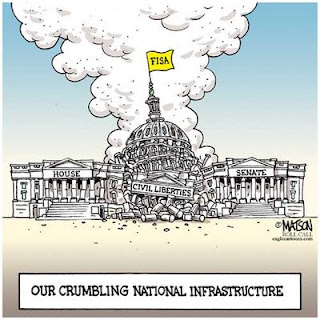
Who cares? After all, what could the Founding Fathers possibly know about the need to protect individual civil liberties against the over-reach of power by a unitary executive? Clearly our Congress and President (and the two senators who want to be our next President) know better than the founders which of our civil liberties we really need today. So protections that have been in place for over two hundred years are now less than they were. Domestic surveillance activities by our government that were illegal yesterday, are legal today (or as soon as GWB signs it into law).

I am not going to belabor this as I have beat this to death in previous posts and comments here, and at Donklephant. I'll make one more point - When smart people on the right, left, and academia agree that this is a very bad bill that erodes our freedom and constitutional protections, it does not mean this is a good compromise. It means this is a very bad bill that erodes our freedom and constitutional protections.

No, I'm not feeling great. I feel about the way the dispirited Senator Russ Feingold looks in this interview on MSNBC's Countdown yesterday, where he says:
"This is a sad moment, it really is a black mark, not only on Democrats, but on the Congress, and the history of the United States. This is one of the greatest assaults on the Constitution in the history of our country."- Russ Feingold
C'mon Russ! Lighten up! It's only the Constitution and the Bill of Rights. Sheesh....

[VIDEO LINK LOST]

Some thoughts on this interview. Feingold expresses a hope that a future Congress will take this up and restore our Fourth Amendment protections. You tell me - What do you think the likelihood that any President or Congress will voluntarily reopen this political can of worms?

Tuesday, July 08, 2008

Mr. Sullivan - May I show you your petard?

UPDATED
Sully and his petardIn the event my title is a bit too obscure, pictured above is Mr. Andrew Sullivan lighting his petard, shortly before he is about to be hoisted by same.

This definition may help:
pe·tard n.
1. A small bell-shaped bomb used to breach a gate or wall.

Word History: The French used pétard, "a loud discharge of intestinal gas," for a kind of infernal engine for blasting through the gates of a city. "To be hoist by one's own petard," a now proverbial phrase apparently originating with Shakespeare's Hamlet (around 1604) not long after the word entered English (around 1598), means "to blow oneself up with one's own bomb, be undone by one's own devices." The French noun pet, "fart," developed regularly from the Latin noun peditum, from the Indo-European root *pezd-, "fart."

The American Heritage® Dictionary of the English Language, Fourth Edition.

The question on the table Mr. Sullivan - In light of your well established and strongly held views about the virtues of divided government during the 2006 midterms and prior to Barack Obama entering the presidential race - to whit:

06-Apr-2006
"In the 1990s, national divided government gave us welfare reform and a balanced budget. Subsequently, one party government has given us massive debt, immense corruption, and a huge expansion in federal power. There's a lesson here. And it's: "Vote Democrat This November." Unless, of course, your specific Democratic candidate is intolerably bad, or your existing Republican is extremely good." - Andrew Sullivan
29-May-2006
"All this is more evidence to me, at least, that divided government is often the best. A Democrat forced to temper and enforce conservative policies can be as effective as a Republican forced to administer and moderate liberal policies. We might even get away with government doing much less. Alas, we have had a Republican lock-hold that has given us the worst of conservatism (executive branch abuse, arrogant war-bungling, Christianist social policy) with the the worst of liberalism (massive increases in government spending, regulation, entitlements and pork). Time for a check and balance, no?" - Andrew Sullivan
31-Oct-2006
"Here's one reason for conservatives not to be afraid sitting out this election or voting Democratic. Gridlock! The best government we've had in recent times was the Clinton-Gingrich face-off. They restrained the worst in each other, brought out the best, and gave us welfare reform, peace, and fiscal surpluses... The great strength of the American system is its capacity for divided government. If there was ever a time for it, it's now. " - Andrew Sullivan
04-Nov-2006
"The Democrats, in a divided government, will also have to take responsibility for the hard choices involved in wartime. So divided government is win-win right now. Vote Democratic next Tuesday, or if you just can't, abstain. For the country's sake - and for the soul of conservatism." - Andrew Sullivan
16-Nov-2006
"I can see, in other words, where I have given too short shrift in the book to the Jeffersonian idea of a nature's God as the source of divided government and individual liberty. I'm grateful for the extra perspective." - Andrew Sullivan
23-Nov-2006
"Things To Be Thankful For (2006 Edition)...Washington has divided government." - Andrew Sullivan
And further, please consider we are looking at: A high probability of a Democratic President, a 100 seat Democratic majority in the House of Representatives under Nancy Pelosoi; A 60-40 filibuster proof super-majority in the Senate under Harry Reid or Hillary Clinton; And the largest concentration of single party federal power in the lifetime of most readers of your blog.

So, in consideration of all that, I was wondering if you thought it no longer important to your readers that the nation is careening at high speed down a highway to single party government hell in 2009?

Searching your site, the only post I can find in the post-Obama presidential candidate timeframe that addresses the issue you found so important in 2006, is this single post:

10-Aug-2007
"Earlier, I quoted political scientist Larry Sabato as saying--correctly in my view--that the American people like gridlock. They don't trust either party to run the whole show. And frankly, the 2000-2006 experience of a Republican Congress and a Republican president is strong evidence in favor of divided party control. Therefore, if Republicans were to run a national campaign reminding voters that the best economic times we've had in living memory came when we had a Democratic president and a Republican Congress, I think it could persuade a lot of voters to split their votes. If, on the other hand, Republicans insist of believing that they can hold the White House and put all their eggs in that basket, then we could have a nightmare scenario where Democrats in Congress are free to enact bad legislation with no restraint." - Andrew Sullivan - Bruce Bartlett [substituting for AS]

[UPDATE I: After reviewing these links I noted that the above quote was not penned by Andrew Sullivan as I mistakenly indicated, but rather by Bruce Bartlett substituting for Andrew when he was on holiday. I should have known this, as I referenced Bartlett's comments in a previous post. Regardless, this actually reinforces the point that there is a stark contrast between the Sullivan the vocal advocate for divided government before Obama entered the race and the Sullivan who apparently doesn't think one party unified government is so bad, or certainly not important enough to write about after Obama entered the race. I can find no posts in Sullivan's blog on divided government since Obama announced his campaign, except for the above mentioned Bartlett post and endorsing reader feedback. In this update I've modified this post to reflect this change. ]
There is a major problem with Bartlett's solution to the "nightmare scenario" of single party Democratic government in 2008 - specifically his suggestion of focusing on Republicans retaking the House of Representatives in 2008 to maintain divided government. The problem with that advice, even when he wrote it last year, is that it is flying in the face of history and willfully ignoring the state of the Republican Party and House elections.

The problem, is that it is impossible for the GOP to retake the House or Senate in 2008. In the 100+ years since we have been electing senators directly, the House of Representatives has never switched majority unless the Senate did also. "Never" as in "not even once". This is a law of politics like gravity is a force of nature. So what about the Senate? As I have been explaining since the week after the mid-terms, there are 33 Senate seats contested in 2008. Of these, 21 are held by Republicans and 12 by Democrats. Simple numbers - the Republicans have a lot more at risk, and will be playing defense. The Democrats have many more opportunities to take seats than Republicans. Advantage Democrats. Big, big advantage. The question is not whether the Democrats will increase their majority in the Senate, the question is whether they will achieve a 60-40 filibuster proof super-majority. Right now, it looks like they have a super-majority in their sights. Since there is no plausible scenario for history to be upended in 2008, the best and only chance for the continuation of the divided government that Sully so admirably supported in 2006, is if the Republicans can hold the White House.

The fact is Mr. Sullivan, that when you argue for the inevitability of an Obama victory, you argue for a massive concentration of single party Democratic power and even fewer fetters on a unitary executive than were on President George W. Bush. That is unlike the soul of any conservative I have ever known.

Regardless of how much you personally like and respect Obama, I have to wonder if this is really what you want? Do you really want to see that much power invested in one man without checks, balances, and a vigorous opposition party?

- or -

Are you going to finally ask your readers (as you did in 2006) to help avert the "nightmare scenario" Bartlett invokes, hold their collective nose and vote for McCain to secure divided government? And to do so as you so eloquently put it - "For the country's sake - and for the soul of conservatism."

I believe the fuse on your petard is lit, sir.

UPDATE II: 09-July-08
Cross-posted at Donklephant. There are some interesting reactions and an entertaining back and forth in the comment thread. Check it out.

Divided and Balanced.™ Now that is fair.


Saturday, July 05, 2008

Carnival of Divided Government - Tres et Vîcênsimus (XXIII)

Special July 4th US Independence Day Edition
Special July 5th UK National Day of Mourning For the Loss of the Colonies Edition.

Okay, so we are a day late. There was just too much "pursuit of happiness" yesterday. Welcome to the 23rd edition of the Carnival of Divided Government. As explained in earlier editions, we have adopted Latin ordinal numeration in order to impart a patina of gravitas reflecting the historical importance of the series. In this, the Tres et Vîcênsimus (XXIII) July 5th 2008 edition, as in all of the CODGOV series, we select volunteers and draftees from the blogosphere and main stream media writing on the single topic of government divided between the major parties (leaving it to the reader to sort out volunteers from draftees). Consistent with this topic, the primary criteria for acceptance in the carnival is to explicitly use the words and/or concept of "divided government" in submitted posts. A criteria that, to our endless befuddlement, is ignored by many of the bloggers submitting posts, which sadly results in DWSUWF reluctantly ignoring their fine submissions.

Independence Day, The Founding Fathers and the Enshrinement of Argument

Joseph Ellis, writing in the Britannica Blog, makes an interesting observation in a series about the Founding Fathers who set our country on an independent course and designed the Constitutional framework for what we have become as a country and a people:
"The highly partisan politics of the 1790s further exposed the several fault-lines within the founding elite. The Federalists, led by Washington, John Adams, and Hamilton, were opposed by the Republicans, led by Jefferson and Madison... The ideological and even temperamental diversity within the elite leadership group gave the American founding a distinctly argumentative flavor that made all convictions, no matter how cherished, subject to abiding scrutiny that, like history itself, became an argument without end. And much like the doctrine of checks and balances in the Constitution, the enshrinement of argument created a permanent collision of juxtaposed ideas and interests that generated a dynamic and wholly modern version of political stability."
What a perfect phrase to describe our Constitution and our national zeitgeist - "the enshrinement of argument". In this political season, with the mind numbing and meaningless appeals to "unity" amid the disparagement of partisanship, polarization, and debate, it is useful to recall that this country was built (and the constitution designed) on the expectation and promotion of continuous conflict and argument. For the founders, "unity" and "government power" was a dangerous mix to be feared and avoided. It smacked of monarchy. Checks, balances, divided government and pitting "ambition against ambition" was exactly the state they sought to enshrine.

Carnival

It has been a long stretch since our last carnival, and we need to catch up on a lot of Divided Government commentary. Without further ado, on this somber British holiday known as the "National Day of Mourning For the Loss the of the Colonies."it seems appropriate to check in with ex-pat Rojas writing at The Crossed Pond, and worrying if "FDR Lives":
"A massive Democratic majority in both houses of Congress appears certain. The question we need to be asking ourselves is whether we want unchecked Democratic rule, under a charismatic leader who will likely be capable of turning the most farfetched liberal economic fantasies into federal legislation... John McCain is not going to deregulate the economy or embark on a Reaganesque quest for a restoration of individual economic liberty. What he CAN be counted on to do is not make the entitlement mentality any worse, including through veto if necessary. McCain’s vociferous objections to agricultural subsidies and to budget earmarks may not in and of themselves point the way to a balanced budget, but that’s not the point. They bespeak a governing ideology that rejects government transfers of wealth and market micromanagement. Whatever other roles John McCain may or may not be suited for, he might prove highly valuable as a speed bump."
Hat tip at to new favorite Laura Ebke at Red State Eclectic for pointing us at the Rojas post. Speaking of which, we are pleased to welcome Laura with a return appearance in the carnival and featuring an interesting dialog underway at Red State Eclectic. Laura announced that in 2008 she will be "Voting for Divided Government - maybe". She crafts her argument with first principles of the Founding Fathers, takes guidance from James Madison, and develops a fully fleshed out case for "Voting for Divided Government", concluding:
"In American politics, the answers to our questions are rarely black or white—indeed they’re often gray, but there can be many shades of gray. Our Constitutional system provides us with the opportunity to minimize the danger of factions to the cause of liberty. Our two party system (to this point) helps to insure the division of interests between the factions. If we can’t win outright, I think the Founders would approve of voting to reduce damage to liberty. They might not like John McCain, but I think Madison and Jefferson would be very concerned with the idea of one faction controlling the whole political process yet again."
Laura's co-blogger Eric Larson is sympathetic to the argument, but thinks that different tactics are required in 2008, as he explains in "Divided Government - A Dissent":
"...the forces of liberty are hopelessly outnumbered and at a severe tactical disadvantage. They have a ruling establishment in bed with the neoconservatives and media. And the only message most Republicans listen to is (re)election. So the only way to convince them to change is to face widespread defeat in their races and philosophy... We must drive a stake through the neoconservative monement, burn it, stomp on it, and shoot its ashes into the sun."
There is indeed a case to be made that we face a unique opportunity to replace one of the two major parties. Now, there is no historical precedent in modern American history for a 3rd party succeeding in anything but being a spoiler. However, there is a precedent for one of the two major parties self-destructing and being replaced by something new (The Republicans replaced the Whigs). I am not sure we truly have that opportunity now, but it merits consideration in a future post. Is it sufficently likely to risk suffering the damage that can be caused by single party government for the next two to four year? TBD. In the meantime, your loyal blogger could not resist weighing in with a few comments at RSE.

Another returning CODGOV carnivalist is the Positive Liberty blog. Jason Kuznicki continues a dialog from the last carnival, responding to DWSUWF with "Divided on Divided Government":
"Divided We Stand supports divided government. I do too — divided government slows things down, and we desperately need to slow down the pace of government encroachment into civil society. But here’s the dilemma... all this ignores an important and maybe decisive issue, regardless of what one thinks about trade — the war in Iraq. I do not think that continuing this war does much to help anyone, whether here, or in Iraq, or anywhere else, except perhaps that it helps the leadership of Iran.The simple answer is that none of the candidates are appealing, that they are bad for different reasons, that to my mind McCain is the worst of the lot, but that we don’t have a Republican-controlled Congress that would make voting for a Democrat the divided-government strategy... And the final verdict is… I’m still undecided. Divided government is a very, very powerful incentive to vote Republican, but it may well be the only one."
I responded in a comment to that post, acknowledging the war in Iraq may be an overarching consideration in this election. However, with recent campaign events, I am more convinced than ever there will be no significant difference in the rate of our military withdrawal from Iraq between a President McCain or President Obama. Certainly, what the candidates say on the campaign trail to placate their base sounds wildly in conflict, but what actually will transpire over the next two years regardless of who is elected will be virtually identical. It is even possible that McCain will be able to effect a quicker withdrawal than Obama as President, simply because he will be more effectively at tamping down the resistance from the right.

Without question, the highest impact MSM column on Divided Government since our last carnival was penned by Robert Samuelson in the Washington Post, where he casts "A Vote for McBama":
"McCain does have one provisional and accidental advantage. By most appraisals, the Republicans will get slaughtered in the congressional elections, and I have a visceral dislike of one-party government. It didn't work well under Bill Clinton or George W. Bush. Divided government doesn't ensure good government, but it may limit bad government by checking the worst instincts of both parties."
Clive Crook at The Atlantic reads Robert Samuelson's column and muses about his own reaction in "The Lures of Divided Government":
The idea is not yet much talked about in 2008. The Democrats seem certain to rule Congress with expanded majorities, yet I don't see many independents (Samuelson aside) arguing that this inclines them to prefer McCain. Come to think of it, why am I not (yet) advancing that argument myself? Good question. I'll have to get back to you."
Clive only thinks that independents are not advancing the argument because he does not read DWSUWF. Welcome to the club Clive.

The Samuelson column sparked another interesting discussion - James Sulak at Indgo Flats is not satisfied with the temperature of the divided government bathwater and worries that messy issues like delayed appointments may create too much heat for the benefits of divided government to be enjoyed in "The District Needs a Bath":
"I'm sympathetic to the principle, but it's a principle that sounds a lot cleaner and loftier as an abstract term than it ends up being in the dirty politics of real life... The fact that the Fed is non-partisan and yet nothing got done for so long is exactly the point — divided government may prevent bad governance, but it too often prevents any governance at all. In any major undertaking, professional or political, participants should disagree. They should call out each other's bullshit. They should question each other's assumptions. But all of this requires a constructive working relationship, and if a private company's leadership had relationships as dysfunctional as our federal government does, the company would have been out of business a long time ago. Of course, whether or not you actually agree with what gets done in a united government is a completely different question. But if you want a divided government, you have be willing to put up with the mess."
Fine and good, but putting up with the mess seems a very small price to pay for the benefits of divided government, as pointed out by Amber writing at Bottom of the Ninth. Also. "the mess" is there by design. Single party rule subverts the design of the founders. Amber likes James headline skills but remains dubious of this argument in "Touche'":
"It’s an excellent point, really, and I suppose that ultimately I do think divided government is the more important principle, if only because I think that, while they have no problem leaving the Fed short-handed, both parties probably would not delay appointments if doing so meant the Fed could not conduct monetary policy."
Touche' indeed. Point to Amber.

Samuelson has more fans around the blogosphere, including Greg Mankiw's Blog, Angus at Kids Prefer Cheese (founding member of the Angus Gridlock Club), Soccer Dad, and Durham's Bull.

Alan Lichtman at Politico is predicting the end of the conservative movement in "Splintered Conservatives Hurt McCain":

"McCain’s defeat by the liberal Obama and the advent of a strengthened Democratic Congress would mark the end of the modern conservative era as clearly as President Franklin Roosevelt’s defeat of President Herbert Hoover in 1932 marked the end of the conservative 1920s. Even if McCain were to win the presidency, he would likely preside over a divided government and become a transitional figure in the evolution of American conservative politics, a Gerald Ford to some future Ronald Reagan."
Right. But even if true, we will be better off with a transitional divided government for the next four years, rather than risk the unfettered power of a single party government with a Democratic President, a Democratic House with an expanded 100 seat majority, and a Democratic Senate with a filibuster proof 60-40 supermajority. A question Alan - While we wait to see what alien-like creatures of hell comes bursting out of the the chest cavity of the dying Republican Party, why not keep the Federal government from spinning completely out of control by voting for John McCain to ride heard on that transitional government?

I have been predicting for a while that the closer we get to the election, the more we will here about divided government from the right, concurrent with the growing recognition that it is the only good argument for winning independents and libertarians. Here we go.

John Fund writing at the Wall Street Journal wants you to know that "No, McCain Isn't 'Doomed'":
"Mr. Clinton's 1996 re-election offers another lesson. Facing a presidential defeat in addition to losses in Congress, Republicans boldly appealed to the public's fondness for divided government. They put out ads featuring a fortune-teller staring into a crystal ball showing over-the-top scenes of Biblical devastation, plague and conflict. An announcer warned: "Remember the last time Democrats ran everything? The largest tax increase in history. Government-run health care. More wasteful spending. Who wants that again? Don't let the media stop you from voting. And don't hand Bill Clinton a blank check. It worked. Republicans kept control of Congress. Haley Barbour, then chairman of the Republican Party and now governor of Mississippi, said at the time that voters responded to the idea they needed an insurance policy against one-party rule. Independent voters may not like the idea of having the government completely controlled by the trio of Barack Obama, Nancy Pelosi and Harry Reid."

Daniel Larison at Eunomia quantifies the risk, but sees a silver lining for McCain in "Goodbye Filibuster":

"Count ‘em: the GOP is likely to lose Senate seats in New Hampshire, New Mexico, Virginia, and Alaska, will have a hard time defending Oregon, Minnesota, North Carolina and is suddenly faced with competitive races in Mississippi, Kentucky, Nebraska and even Texas. That’s eleven, and that still doesn’t take into account the trouble Collins may have in Maine. If the GOP somehow lost all eleven, they would have the fewest Senators in the chamber that they have had since the 95th Congress (1977-79). Even without losing the safer seats of Nebraska and Texas, the GOP will still be reduced to 40 seats and lose the filibuster. This is actually terrible news for Obama, because it will make it very easy for McCain to warn against the dangers of unified government and increased Democratic majorities in Congress as a reason to vote for him. "
From the left, Jason Zengerle at the New Republic blog "The Plank" is dubious and responds to John Fund saying"Vote McClain, Vote Gridlock."
"I think Fund is suggesting that McCain run on a platform of divided government, since I don't think anyone believes the GOP has a prayer of winning back either the House or the Senate. But it doesn't seem like a divided-government appeal could really work for a presidential candidate. Voters might be willing to hold their noses and vote for a politician of a party they don't like if they think that politician will be one of 535. But will they really do that for a presidential candidate? I don't see it. But, hey, if McCain wants to try it, I don't think any Democrats are going to complain."
Michael Preston is equally dubious responding to Daniel Larison in the sarcastically titled "Everything is always good for Republicans":
"Now, I’m not going to dismiss his point out of hand, because there’s certainly some truth to it…but come on, now…with the Republican brand in such a state of disgrace, Obama could just as easily argue that tossing all the bums out might be a good bit of spring cleaning that the country needs to right itself. There are some tangible benefits to divided government, but I just don’t think this argument will have the traction with the general public that Larison thinks it will."
Look, advocating a vote for John McCain only to maintain divided government may indeed be a weak reason to vote for John McCain, but... It is the best and may be the only effective argument the Republicans have to woo independents and libertarians. Even though some like Zengerle and Preston are dismissive, and quite correct that the divided government argument cannot save McCain from himself in this campaign, if McCain can find a way to keep the contest close, then this argument could be sufficient to move the libertarian swing vote and make a difference in 2008, just like it did in 2006.

Philadelphia Inquirer columnist Dick Polman has advice for presidential candidate John McCain in the column "What will it take?":

"Preach the virtues of divided government. Since the Democrats are a cinch to retain or expand their control over the House and Senate, he needs to sell himself as the guy who'd check and balance their excesses. Independent swing voters, who are wary of one-party rule and who tend to like McCain anyway, might warm to that pitch. McCain needs to run against the Democratic Congress (giving him an "outsider" argument) and suggest that Obama, with his liberal Senate voting record, would conspire with lawmakers to provide (in McCain's current words) "the wrong kind of change."
Amen. Preach it brother. Preach it good.

Denny Clements of the Sun News Opinion Blog agrees and quotes Froma Harrop saying "McCain should sell himpelf as the divided government guy""

"Divided government -- that is, the Congress in the hands of one party and the presidency in another -- does have many fans among conservative Democrats, liberal Republicans and, above all, independents. It stops radicals in either party from running government on the fumes of their ideology. "He'll save you from their excesses'' may not make a zippy bumper sticker, but that message could work for a lot of voters, and in McCain's favor."
The Whited Sepulchre presents The Whited Sepulchre: Anarchic Hand Syndrome posted at The Whited Sepulchre, exploring a medical metaphor for dysfunctional government, but mistakenly applying the label to divided government: "Anarchic Hand Syndrome - what happens when the Divided Government concept goes a little too far...."

Finally, Aaron Brazell, blogging at TechnoSailor is conflicted in his "Presidential Endorsement". While he clearly appreciates the value of divided government...

"I believe a McCain administration actually would be highly centrist but his ability to work with a Democratic Congress would be stunted by the perceptions of a McCain presidency as a Bush third term. That said, I’m always a fan of divided government and things not getting done in Washington. History shows that government involvement in things better left to the citizenry or private sector is usually problematic in the long run... On the Obama side, I’m concerned by the sense that there would be a single party ruling Washington. I’m also concerned by the cost of programs like universal health insurance that would put the weight of a multi-trillion dollar program on the backs of taxpayers who are cash-strapped from war, rising oil prices and unemployment. I’m concerned about a lack of any real plan on Iraq."
...Aaron still concludes his post by endorsing Obama for President because of his understandable concern about McCain's support for the FISA bill. Aaron's decision is informed by his "moral opposition to contraconstitutional governmental behaviors" like warrantless wiretapping and abrogation of rule of law in the FISA compromise bill. He wrote this endorsement before Obama announced his support for "contraconstitutional government behavior" and abrogation of rule of law by supporting the FISA compromise bill. So now his rationalization for supporting Obama does not hold up, as there is no practical (voting) difference between Obama and McCain on this issue. However, there would be a difference in an Obama and McCain presidency - McCain would be leading a divided government - Obama would be leading a single party government with a likely 100 vote majority in the House, a potential 60-40 filibuster proof supermajority in the Senate, and have more concentrated unfettered single party power power than we have seen in generations. Methinks this is not a good thing for a President willing to embrace "contraconstitutional" government authority. You might want to rethink your endorsement Aaron.

Miscellany

Traditionally, we conclude this Carnival by including one "off-topic" submission as a grudging acknowledgment and proxy for the many off-topic submissions received. This month we received a number of submission from what I lovingly refer to as the vast right-wing nut bag lunatic asylum. Apparently, because I have been critical of Barack Obama, they thought I might be sympathetic to promoting the idea that oh... Barack Obama is the Anti-Christ, or Barack Obama was raised a Muslim, or that we should find dark portents in the good luck charms Barack Obama carries in his pocket. Well, I'm not. No links for you.

And with that we conclude this edition. Thanks for stopping by, and thanks for all of the submissions (on-topic or not). The next edition will be the Carnival of Divided Government Quattuor et Vîcênsimus (XXIV) - Special "Lost At Sea" Edition, which we will be floating on or about the 3rd of August, shortly before embarking on a Pacific passage sailing adventure from Hawaii to San Francisco crewing on a friend's boat. Submit your blog article at carnival of divided government using our carnival submission form.

Carnivalingus

Finally, some other recent carnivals and compilations of note:
Divided and Balanced.™ Now that is fair.

Thursday, July 03, 2008

Polarized Partisan Politics Promotes Popular Participation

Early American political bloggers Aaron Burr and Alexander Hamilton were active participants in a polarized political discussion.

For political bloggers and readers, there are few things as interesting as an analysis of umm... political bloggers and readers. In recent weeks three studies have been getting attention from bloggers, focusing on the polarized political web, polarized political book buyers, and polarized political blog readers.

Presidential Watch 08 is showcasing their latest Map of the political blogosphere:

"Our new map... will reveal:- the 500 most influential websites of the U.S. political webosphere;- the newcomers to this online territory;- the locations of the candidates’ websites;- a refined categorisation of websites that abandons traditional media categories (Mainstream Media vs. Social Media) to offer an accurate view of this territory as one of mainly partisan websites..."
The map is automatically generated based on links between political websites, and includes news organizations and candidate websites as well as blogs. However, the website labels (conservative, progressive, independent) are manually assigned, which introduces opinion and the possibility of bias and distortion in the graphical display. It also certainly gives short shrift to independent and centrist blogs (Moderate Voice and Andrew Sullivan are labeled as Progressive, Memeorandum and Cato are labeled Conservative and the only sites to be labeled Independent are Roll Call and FactCheck.) The bias against Independent/Centrist blogs may be an artifact of their selection algorithm which determines influence by mutual links. One might posit that Independent/Centrist blogs will link to partisans of both sides, but partisan blogs of either stripe are less likely to find independent blogs worthy of links. The study is also sadly deficient in that DWSUWF is inexpicably not included in the data or the map.

Still,the partisan polarized nature of the political blogosphere clearly emerges in the map and the interactive nature of the presentation makes it the coolest of the three studies and the biggest potential time sink.

Vlaldis Krebs, blogging at The Network Thinker looks at political readers of political books, and produces visual maps of their purchase patterns. He compares past and present clusters in his recent post "New Political Patterns":
"In the past we saw a divided nation in our book buying data. We saw then a distinct red cluster and a distinct blue cluster with very little holding them together in terms of cross-links or books in common. Now, in June 2008, after the major party candidates have been selected via the long primary season, we again probe the predictive patterns of political polemics..."
We learn from Vladis that there is as pronounced a clustering in 2008 political book buyers as there was in in 2004, but with a wrinkle. While the polarized clusters are similar, they split on a distinctly different fault line. In 2004 book buying patterns clustered around a traditional red/blue Republican/Democrat fault line. This year the cleanest split is between the books that are for and against the War in Iraq.

Henry Farrell (blogging at Crooked Timber), Eric Lawrence, and John Sides (blogging at The Monkey Cage) are distributing a draft paper, entitled “Self-Segregation or Deliberation? Blog Readership, Participation, and Polarization in American Politics.”[PDF] and soliciting comments. The study shares the same deficiency as Presidential Watch '08, shockingly excluding DWSUWF from the data. While the paper presents the most visually boring graphics of the three, it has the most interesting conclusions. From the abstract:
"...we find strong evidence of polarization among blogreaders, who tend to be more polarized than both non-blog-readers and consumers of various television news, and roughly as polarized as US Senators. Blog readers are also substantially more likely to participate in politics than non-blog readers. However, in contrast to previous research on offline social networks, we do not find that cross-cutting exposure to blogs of different ideological dispositions lowers participations."
And their conclusion:
"... there is a general tradeoff between deliberation and participation among blog readers, an increasingly important group of highly politically aware individuals. Blog readers are more likely to participate in politics than non-blog readers, but also very likely to read only blogs whose political leanings accord with their own."
James Joyner at Outside the Beltway is not surprised by the results, observing in "Blog Polarization and Self-Segregation":
"After all, we’re a polarized polity right now, so it stands to reason that we’d see the same in the blogosphere. Given that the mass media outlets to which blogs are compared in the chart above are ostensibly “neutral” whereas the blogs are openly biased, it’s remarkable how polarized the audiences of the former are."
I agree with Joyner that the blogosphere is a reasonable reflection of the political sphere at large, so the finding that political blog readers (like political book readers) are also polarized is perhaps a blinding flash of the obvious. Still, the degree to which blog readers are polarized is surprising, as the authors find that 94% of blog readers are classified as "Carnivores" seeking primarily sites in agreement with their views, leaving only 6% omnivores that seek a more balanced diet of political perspective.

Joe Windish at The Moderate Voice worries in "Study: there aren’t many blog readers in the ideological center" that this polarization "makes us a niche read here at TMV!"

I am among the 6% omnivores as I do read blogs from both the right and left. However, as some of the Crooked Timber commenters point out, the source data is from 2006, and the results could be highly time and context dependent. Since I advocate for divided government on my blog, in 2006 I spent more time flocking with left of center blogs who at the time were big fans of the divided government meme. Now, not so much. I find myself now spending more time on right-of-center blogs, who are in the midst of an epiphany about the wisdom of voting to maintain divided government into 2009. Funny how that works.

Andrew Sullivan at The Daily Dish laments the author's findings in "Bloggy Homophily" saying "A new study of blog readers finds a depressing amount of polarization..."

By focusing primarily on the polarization of blog readers, both Joyner and Sullivan overlook an equally important point in the paper. Blog readers are much more likely to be active participants politically. This is not new. I’ll note this historic parallel to the authors’ conclusions, linking increased participation and polarization as going hand in hand:

“The period from 1840 to 1890 has been labeled “the party period” and “the golden age of parties” because the major political parties (Democrats and Whigs until the mid-1850s, then Democrats and Republicans) were the strongest they have been in American history. Party leaders used patronage and campaign practices that aroused partisan enthusiasm to gain wide membership and keep them loyal and active. It worked. Voter turnout during this period was the highest in American history: between 70 and 80 percent for presidential elections and sometimes higher in state and local contests.”

Different self-selection and organizing principles, but the more things change, the more they remain the same. Point being, when you lament political polarization, you are lamenting political participation. In American politics, polarization and participation are not just linked, they are one and the same. When you argue against "bad" political polarization, you argue for decreased political participation - you argue, in effect, for political apathy.

NOTE: The title of this post is DWSUWF Rule #1 (we never got around to writing rule #2), cribbed from the last time that DWSUWF was compelled to rise in defense of the great American tradition of political polarization: "Fellow travellers Tony Snow and David Gregory promote Un-American activities."


Tuesday, July 01, 2008

Olbermann Agonistes

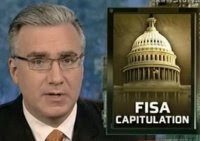
I have expended more than a few words criticizing Keith Olbermann for his kid-glove (fawning? sycophant?) treatment of Barack Obama, particularly his coverage of Obama's flip-flop on opposition to the very bad FISA compromise. Last night Olbermann reversed himself (sort of) and expressed some mild criticism of Obama's position on FISA (sort of) in a "Special Comment", so I thought it fair to include it here.

But first, let us recap - A brief outline of the story so far:


Frankly, I found this Olbermann "Special Comment" to be somewhat incoherent, as he apparently feels compelled to wrap superfluous caveats and insert two shots at Republicans for every mild criticism of the Obama flip-flop. That said, he explicitly urges Obama to take a "second chance to make a first impression", do the right thing and either - join the opposition planning to filibuster the bill -or- explicitly state that an Obama administration will pursue a criminal prosecution of the Bush administration and Telco companies for violations of the original FISA law.

Olbermann makes much of the fact that the bill - (both the version that Obama opposes and the version that Obama supports) only provides immunity from civil lawsuits. Greenwald maintains that the possibility of criminal prosecution under this bill to be a fantasy, and remains focused on the bigger issue of stopping the expansion of executive power. In any case, I expect Obama to embrace neither of Olbermann's suggestions. Having already flip-flopped once on the issue, it just would not be politic for him to flop-flip back.


More important, Olbermann's commentary and the Olbermann/Greenwald debate has helped keep a spotlight on this important issue and the impending vote. This has all been made possible because a few Senators like Feingold and Dodd (and unlike Obama) were willing to show real leadership on this issue and keep principle ahead of politics. They succeeded in delaying the FISA vote until after the Independence Day holiday, allowing time for opposition to build. Stopping or modifying the bill still seems unlikely, but this is politics, and... who knows? Our elected representatives might even decide to defend and protect the Constitution. It could happen.

X-posted at Donklephant.