Friday, September 03, 2010

Good News, Everyone!


OK, I couldn't resist the title & pic combo. But it IS nice to finally see a small suggestion of a bright spot in the employment situation. Below is a chart from the Mercatus Center at George Mason U. regarding temp staffing contrasted with payroll employment.


While the short text implies the fall in temp staffing is a bad sign, I have a somewhat different take seeing the two stats together*. The fall-off in temps staffing coincides with a positive uptick in payroll hiring, which strongly suggests that an equilibrium is being reached in payroll staffing. To wit, it suggests that employers have reached a point where they have quit downsizing and insuring against further decline, and for the moment are feeling comfortable with fully staffing at their current levels of production.

That's a far cry from actual growth, mind you, but given the very expensive mandates already shoved down their throats (ObamaCare, new taxes and regs), the threat of more to come (more tax hikes and even more burdensome regs), the weak economy and ongoing workout of bad assets from the real estate and financial bubble-bursts, amd the enormous uncertainties associated with all of the above, it's a positive indicator of equilibrial stabilization, perhaps due to watchful waiting ahead of the elections. Which beats the hell out of further decline and IMHO is a positive indicator of reduced "double-dip" potentials.

If the "watchful waiting" hypothesis is correct, evidence of it will be found in market trends tracking the polls the closer we get to the elections, and in the election-reaction market movements the first week of November, as election results are confirmed.

[*--Pay attention to the somewhat different scales so as to not get the two levels confused as being the same. Also, for those not used to reading such things, please note that positive/negative is where the lines cross their respective 0.0% lines, not where the trend direction changes. Payroll jobs did not start upticking in early-'09, for example, that's where the rate of losses started reducing. But increases in payroll employment do not begin until the 0.0% point was reached in the uptick of the trend, roughly May '10. And temp staffing did not hit 0.0% until July '10.]

Thursday, September 02, 2010

The question facing libertarians...

...is not the question debated in the August-September issue of Reason - "Where do Libertarians Belong?".

That debate featured Cato Kauffman Foundation scholar Brink Lindsey, Conservative columnist Jonah Goldberg and Tea Party organizer Matt Kibbe. An interesting read, but more than a little frustrating. They re-litigate the same hand-wringing debate I first noted and commented on at the beginning of this blog, over four years ago. In particular, Jonah delights in beating Brink about the head and shoulders with the "Liberaltarian" trope that Brink enthusiastically supported a few years ago. Brink is decidedly less enthusiastic now. Perhaps he read this sad account of my own failed liberaltarian affair.

For those who don't have the time or inclination to read the entire article, I offer this debate summary:
  • Shorter Brink Lindsey: Libertarians should forget the right and aim for the center. BTW the Tea Party also sucks.
  • Shorter Jonah Goldberg: Libertarians should forget the left, and stick with the right.
  • Shorter Matt Kibbe: Libertarians should forget the right and left, and work with the Tea Party to find a new path. BTW - Fuck you Lindsey and the horse you rode in on.
Brian Moore has an even shorter version. No real conclusions were either expected or found by the paticipants. But at least there was one amusing answer to the question offered by a commenter at Reason.com: "Where Do Libertarians Belong? - In the camps, silly."

More interesting than yet another futile attempt to answer this unresolvable question, are the questions that the debate spawned around the blogosphere -

Clive Crook
thinks the question should be phrased "What Use Is a Libertarian?" Nick Gillespie answers his question with another question - "Are Libertarians Really as Useless as a Bucket of Armpits? Or Do They Just Smell That Way?" Black Jesus worries "Is Libertarianism Dead?" Ilya Somin wonders if Brink is moving "From 'Liberaltarianism' to Libertarian Centrism?" Noah Millman asks "Whither Libertarians?" Mollie Hemingway invokes the "The death of liberaltarianism?" Stackiii wants to know "Can These Groups Win Without Each Other? Heather Horn finds even more posts with even more questions and finally asks one herself "Should Libertarians Ditch the Republican Party?

So many questions. And yet, no one is asking the right question:

How can libertarians become politically relevant?

Back to Clive Crook:
"I cannot see what purpose is served by worrying about which of these unappeasable opponents would make the better partner."
Exactly. Aiming for the middle does not cut it. Nor aiming to shoot the right as Lindsey advocates, nor aiming to shoot the left as Goldberg advocates, nor aiming at both as Kibbe advocates.

From a practical perspective, asking rhetorically whether libertarians have a "use" or "where they belong" is less important than understanding how they can be politically relevant. One key to political relevance is simple - a predictable centrist libertarian swing vote. The rub - for a swing vote to be predictable it has to be organized. And nobody yet has figured out how to herd these cats. This is sometimes referred to as the "Hot Tub Libertarian" problem.

There is an answer. There is a way to herd these cats. There is a path to imbuing libertarians with policy shifting power and political relevance. Paraphrasing from an earlier post "Curing Libertarian Electile Dysfunction":
A libertarian swing vote organization is going to have to look different than traditional political organization. After all, it is something we will have to accomplish while sitting in the hot-tub. What is needed, is an organizing principle. Ideally, a principle that is so obvious, so logical, and so clear-cut, that no leadership is needed, no parties are needed, no candidates are needed, and no infrastructure is needed. Ideally it is this easy: You think about the principle, and you know how to vote.

That organizing principle exists. It is voting for Divided Government. It is absolutely clear-cut and easy to understand. Divided Government is documented by Niskanen et.al. to work in a practical real-world manner to restrain spending and the growth of the state. As a voting strategy it can be implemented immediately. More importantly, it can collectively be implemented individually as we sit in our hot tubs and ponder the sorry state of the world. Whatever the percentage of the electorate that a libertarian/Tea Party represents, whether it is 6% or 20%, if they vote as a block for divided government, they immediately become the brokers of an evenly split partisan electorate. They arguably become the single most most potent voting block in the country, specifically because they are willing to vote either Democratic or Republican as a block. Specifically because they are not fused to one party or the other. Specifically because they are not trying to figure out "where they belong".

If a libertarian/Tea Party divided government vote is shown to swing elections for two or three cycles, then libertarians will no longer be inchoate, their message no longer diffused, and their political clout no longer flaccid. As long as the bulk of the electorate remain polarized and balanced, even a small percentage libertarian (or Tea Party) swing vote organized around divided government will be enough for those Tea Party libertarians to proudly display the biggest swinging political "hammer" in town.
It could happen.

Addendum:
The Reason cover has an image of some of our favorite pols on a Nolan Chart. This quick quiz plots your political proclivity on such a two dimensional political chart, with the four corners defined as liberal (L), conservative (R), libertarian (U), statist (D). I hadn't taken the test in a while, and the result is unsurprising - this is where The Dividist belongs...

As a libertarian dividist, I'll be voting straight Republican for federal office this year. Should the GOP take the majority in either house of Congress, I'll be voting for the re-election of Barack Obama in 2012.

Divided and Balanced.™
Now that is fair.


Saturday, August 28, 2010

Ten in Ten

Wherein we explore the prospects for restoring divided government by means of the GOP winning the Senate

NOTE: Prognostications in this post updated on 10-10-10 post [LINKED HERE]

Labor Day is fast approaching, bringing the unofficial end of a long hot summer and the official start of a short hot fall political election season. As a political blogger, the sun never sets on the election season. Time to take another stroll down the Dividist beach to see if that beautiful object of our affection, Divided Government, is drawing any closer.

Last time we looked for her the answer was "no", the same answer we found shortly after the election in 2008, and when we looked again in 2009. Conventional wisdom still says "no", but conventional wisdom has taken some surprising turns in 2010.

Conventional Wisdom
In January, the expectation was that the GOP would make gains in both houses of Congress, but fall short of retaking a majority in either. It just looked like the GOP was buried too deep in the sand to dig themselves out in one cycle. The Scott Brown "Massachusetts Miracle" eclipsed that particular ray of conventional wisdom, and since then CW has cautiously has settled on a partly cloudy forecast with a chance of heavy Republican rain. The current political weather report gives the GOP a good chance to retake the majority in the House of Representatives, but the Senate is still considered by most to be out of reach. Conventional wisdom is not unanimity, so you can find some grasping at straws, others fearing the worst, and a few wondering how bad it could get. To the center right, it looks like a done deal. We'll start our analysis by narrowing down the range of possibilities.

Every Possible Scenario
The entire universe of possibilities can be distilled to these four outcomes - listed in order of Current Conventional Wisdom:
  1. Democrats retain Senate, Republicans win House
  2. Democrats narrowly retain House and Senate
  3. Republicans win House and Senate
  4. Republicans win Senate, Democrats retain House
The best way to evaluate this would be a bottoms-up analysis looking at detailed polls and statistically correlating demographics and voting history on a district by district, state by state, and election by election basis. I'm not going to do any of that. For one thing, it is beyond my ken, for another, I can get all that from the usual suspects doing the polling and Nate Silver's blog doing the quant work. Instead, I’m going to look at the election through the prism of two "rules of thumb" and look for similarities and differences to historically analogous elections. And steal from Nate.

Maxims and Thumbs
The first rule of thumb does not get much publicity, but is an interesting fact that I've dubbed "The 100 Year Rule". In the almost 100 years since we have been been electing Senators directly (only since the 17th Amendment was ratified in 1913) the House of Representatives has never flipped majorities unless the Senate flipped first or at the same time. If conventional wisdom is correct and the Republicans take the House but not the Senate, it would be an historic first. So my first prediction is to go out on a limb and say this is not going to happen. Conventional wisdom is wrong and this scenario is the least likely of the four.

The second rule of thumb is Tip O'Neil's maxim "All politics is local." To the degree that O'Neills maxim is true, it is true about the House. This is just another way of saying (as is the first rule) that it extremely difficult to flip majorities in the House of Representatives. House incumbents, (frequently aided by gerrymandered districts) enjoy extraordinarily high re-election rates. Even when voters tell pollsters they despise Congress in general, they'll say they love their specific representative who is often the conduit by which federal services are delivered or expedited to individuals, municipalities, and businesses in the district. House elections are almost always "local." Almost.

Looking Back
1994 and 2006 were two midterm election cycles where elections were decidedly not local. They turned on national issues and the House of Representatives flipped majorities simultaneously with a flip in the Senate. These two mid-term elections shared several characteristics: We were under One Party Rule (Democrats in '94 - Republicans in '06); There was widespread dissatisfaction with the party in power; The opposition party was energized; The base of the incumbent party was disillusioned with a palpable lack of enthusiasm; There was a widespread perception that the party in power was arrogantly pursuing policies opposed by a majority of Americans; Major corruption scandals were in the headlines for the party in power throughout the election year (Rostenkowski in '94, Abramoff and Foley in '06).

Now, without a doubt, all of these elements are present in 2010. However, I don't believe the 2010 corruption stars (Maxine Waters and Charlie Rangel) rise to the level of the corruption superstars we had in '94 and '06. In both of those elections, the corruption scandals were the last straw and triggered the "throw the bums out" gag reflex in the voters. Unless there is an October surprise and more corrupt Democratic pols make into the headlines, I just don't believe there is enough animus to overcome the huge House of Representatives incumbent advantage to get the massive 40 seat shift. Plus, one should not underestimate Nancy Pelosi. My conclusion on the House: Close, but no cigar. 2010 will not be quite like 1994 or even like 2006.

Miracles Happen
So if we are to see divided government restored in 2010, the best chance will be the Senate. In January this looked like an impossible hill to climb. The Democrats held a 60-40 super majority and the tie-breaker in the person of Joe Biden. To gain the majority the Republicans would have to win 11 seats. Nobody in either party considered that realistic. But - then something remarkable happened. Republican Scott Brown won Ted Kennedy's Senate seat. You might not think that one seat would change the complexion dramatically, but it does.

Thanks Nate
Time to rip Nate Silver's work. His chart on the left is remarkable. It shows Nate's stack ranking of the Senate seats most likely to change parties. Of the top 12 seats most likely to switch parties, 11 of them are currently held by Democrats. All either have the Republicans leading in the polls or are within the margin of error. The one seat of the top 12 currently held by a Republican is the Florida Senate, and it is only there because Independent Crist is in a dead heat with Republican Rubio. The Democrat has no chance in Florida. And if Crist were to win, he would likely caucus Republican for reasons that I'll outline shortly. Now - this still appears to be a very tough climb as the Republicans need 10 of the 11 Dem seats in play to secure an outright majority. But wait! - there is another scenario - they may need to win only 8 or 9 of the 11 seats to take control of the Senate. How? the answer can be discerned by looking to the 2012 election.

2012 effect on 2010
This year the structural playing field is even. There are 37 Senate seats yet to be decided, with 19 currently held by Democrats and 18 held be Republicans. In 2012 the Republicans will have a huge structural advantage in the Senate elections. Of the 33 seats contested, 23 are held by Democrats and 10 by Republicans. The Democrats will be on defense with many more seats to defend, the Republicans will have a target rich environment. If they don't already have the majority, it it is a lock the GOP will take the majority in 2012.

Why is this important in 2010? Because Senators Ben Nelson and Joe Lieberman can count. If the GOP gets within 1 or 2 seats of an outright majority, Nelson and Lieberman will be in play. They'll have one shot to cut a deal to guarantee their committee chairmanships for at least another 4-6 years (if re-elected), whereas they will be out as Committee chairs after two years if they continue to caucus Democratic. This also applies to Crist should he knock off Rubio in Florida. My take - these guys like the power and perks that come with committee chairmanships and will not be inclined to give them up too quickly. It just would not be as much fun for them, being in the Senate without that chair. And lets be honest - its not like you liberals have been particularly nice to either of them over the last couple of years.

The Dividist Prognosticates
The Dividist 2010 election prediction: The GOP wins 8 or 9 more Senate seats outright, then takes majority control by flipping Lieberman and/or Nelson. They fall a few seats short in the House and Nancy Pelosi continues as Speaker of the House.

Stack ranking of all possible election scenarios in order of likelihood:
  1. Republicans win 8-9 seats flip Lieberman,/Nelson take Senate, Democrats narrowly retain House
  2. Democrats narrowly retain House and Senate
  3. Republicans win House and Senate
  4. Republicans win House, Democrats retain Senate
We'll be tracking this dirty dozen of Senate races in posts between now and the election to monitor our last best chance of restoring a perfect "10" in '10 and once again gaze upon a beautiful, desirable, smoking hot divided government in 2011.

Takeover Chances

Race

Margin
N. Dakota
Hoeven v. Potter +40
Arkansas
Boozman v. Lincoln +32
Indiana
Coats v. Ellsweorth +14
Delaware
Castle v. Cook +9
Pa.
Toomey v. Sestak +8
Colorado
Buck v. Bennet +5
Nevada
Angle v. Reid +1
Florida
Rubio v. Crist +1
Illinois
Kirk v. Giannoulias +0
Wash.
Rossi v.Murray -1
Calif.
Fiorina v. Boxer -2
Wisconsin
Johnson v. Feingold -3
Kentucky
Paul v. Conway +4
(chart from Nate Silver's 538)

Ok - I actually listed a baker's dozen. Rand Paul's race in Kentucky is included in the watch list, as his lead is barely out of the margin of error. It'll be an interesting race to watch. Like Sharon Angle in Nevada, Rand Paul was a tea party favorite that knocked off the GOP establishment candidate. In both cases, media gaffes prompted unfavorable polls and a lot of chortling from the left. The left-o-sphere was confident that the Tea Party had torpedoed GOP chances in Kentucky and Nevada. I checked in with Moonage, a Kentucky blogger who always has his finger on the pulse of local politics. He is calling Kentucky for Rand Paul. Take it FWIW, but I think Moon's got it right.

Nevada? Another matter. Frankly I am astonished that this race remains a virtual dead heat, and it is prompting signs of panic on the left. The Nevada race may be the single clearest indicator that this may be a bigger GOP tsunami than Conventional Wisdom has yet to acknowledge.

Divided and Balanced.™
Now that is fair.


Wednesday, August 18, 2010

Of Maxims and Mosques and Monticello and Mojo


I was recently contacted by the blogging authorities, demanding to know why I have yet to post about the Mosque/Cultural Center to be built/not built in a location somewhere near/not near ground zero in New York. I have no excuse. I cannot plead ignorance, as I have been cognizant for some time that this was a Mandatory Blogging Topic - yet I failed to act.

I have avoided my blogging obligations because, on this issue, I feel a lot like this guy - or this guy - or perhaps like William Shakespeare "It is a tale told by an idiot, full of sound and fury, signifying nothing." I see this as little more than a excuse by partisans and bloggers on both the right and left to flog their favorite bogeymen in the hope of securing a minor political advantage. The significance of this story is not worth the ink and electrons spilled on it.

But, I don't want to risk my blogging privileges, so let me make my position on this question perfectly clear - This blogger stands firmly with Michael Bloomberg, Grover Norquist, Chris Christie, Joe Scarborough, Michael Gerson and Barack Obama (Friday, 8/13/10 version) in support or indifference to the location of the Cordoba project mosque - and stand in opposition to Harry Reid, Howard Dean and Barack Obama (Saturday 8/14/10 version) who do not support the location of the Cordoba project mosque.

In America, in matters of religious tolerance there are no close calls, there is no qualification of first principles, and the first amendment is not location dependent. I hold no quarter with the distinction of "rights" vs. right which seems to be the Clintonian parsing of choice among those looking to rationalize making the Cordoba Project move the mosque.

I''m going to make this easy on myself and crib extensively from a previous post invoking the views of a founding father whose quote is the source of the name of this blog and speaks directly to this issue.

Thomas Jefferson writing in the third person, in a letter to Dr. Jacob De La Motta on the occasion of the 1820 dedication of a synagogue in Savannah, Georgia:
."Th. Jefferson returns his thanks to Dr. De La Motta for the eloquent discourse on the Consecration of the Synagogue of Savannah, which he has been so kind as to send him. It excites in him the gratifying reflection that his country has been the first to prove to the world two truths, the most salutary to human society, that man can govern himself, and that religious freedom is the most effectual anodyne against religious dissension: the maxim of civil government being reversed in that of religion, where its true form is "divided we stand, united, we fall." He is happy in the restoration of the Jews, particularly, to their social rights, and hopes they will be seen taking their seats on the benches of science as preparatory to their doing the same at the board of government. He salutes Dr. De La Motta with sentiments of great respect."
His short letter speaks to both the intent and core convictions of a key founder and architect of our country and constitution. Consider the pride and importance that Jefferson invests in the principle of religious freedom and diversity in this letter. He finds it "gratifying" that our country was the "first to prove to the world" the "two truths" that are the most beneficial to human society - "that man can govern himself", and absolute "religious freedom" is the only answer to "religious dissension".

Andrew Sullivan reminds us that Islam was explicitly included in Jefferson's message of tolerance. He quotes from Jefferson's autobiography where Jefferson expands on the intent of the Virginia Statute For Religious Freedom - "Jefferson On The Toleration Of Islam":
Where the preamble declares that coercion is a departure from the plan of the holy author of our religion, an amendment was proposed, by inserting the word 'Jesus Christ,' so that it should read 'a departure from the plan of Jesus Christ, the holy author of our religion.' The insertion was rejected by a great majority, in proof that they meant to comprehend, within the mantle of its protection, the Jew and the Gentile, the Christian and Mahometan, the Hindoo, and infidel of every denomination."
Finally in a letter to Moredcai Manuel Noah, Jefferson reminds us that protection of religious freedom under the law, while necessary, is not sufficient to ensure tolerance and the fair and equitable treatment of all religious belief.
"Our laws have applied the only antidote to this vice, protecting our religious, as they do our civil rights, by putting all on an equal footing. But more remains to be done, for although we are free by the law, we are not so in practice. Public opinion erects itself into an inquisition, and exercises its office with as much fanaticism as fans the flames of an Auto-da-fé. The prejudice still scowling on your section of our religion altho' the elder one, cannot be unfelt by ourselves. It is to be hoped that individual dispositions will at length mould themselves to the model of the law, and consider the moral basis, on which all our religions rest..."
The work of religious tolerance was incomplete in the time of Jefferson, and remains incomplete today. Religious intolerance is an issue that every generation of Americans must face anew for themselves. As Americans of good will fought for the principle of religious freedom at the beginning of the American experiment, it falls to Americans of good will in each generation, of every religion, race and creed, to ensure that in their own time their generation remembers and understands that - as regards religion - “divided we stand.

To wrap this up I will invoke a poet/philosopher of our own time - Mojo Nixon. While these lyrics were written in response to another civil libertarian challenge, I don't think Mojo would mind my applying them here...
"You know - Thomas Jefferson
Is gonna be mighty pissed
When he finds out about this,
I say - Come back from the dead Tom,
Sock ‘em in the head."
- Mojo

Monday, August 16, 2010

The Carnival of Divided Government
Triginta Undêvîgintî (XXXIX)
Summer of Our Discontent Edition

Welcome to the 39th edition of the Carnival of Divided Government - The Special Summer of Our Discontent Edition.
Pass the Prozac

With the primaries wrapping up and Labor Day fast approaching, the mid-term election lollapalooza is about to kick into high gear, but few seem happy about it. This year's extravaganza features a Democratic administration kicking it's base, liberals bitterly complaining about the Democratic Party, Tea Party Conservatives attacking establishment Republicans, and Ivory Tower conservatives decrying the hoi-polloi that energize the Republican base. Independents and libertarians have decided the only thing worse than voting for the GOP, is leaving the Democrats with all the keys to the castle. Surely....

Now is the summer of our discontent
Made inglorious winter by this "post-partisan" pretender
And all the clouds that sullied our representative house
In the deep bosom of the speaker lay buried.
- not William Shakespeare

Carnival of Divided Government

As explained in earlier editions, we have adopted Latin ordinal numeration to impart a patina of gravitas reflecting the historical importance of the series. In this the Carnival of Divided Government Triginta Duodêvîgintî (XXXIX), as in all of the CODGOV editions, we select volunteers and draftees from the blogosphere and main stream media writing on the single topic of government divided between the major parties (leaving it to the reader to sort out volunteers from draftees). Consistent with this topic, the primary criteria for acceptance in the carnival is to explicitly use the words and/or concept of "divided government" in submitted posts. A criteria that, to our endless befuddlement, is ignored by many of the bloggers submitting posts, which sadly results in The Dividist reluctantly ignoring their fine submissions.

First up, Michael Gershon writing at the Washington Post analyzes the Democrat's tactics for the midterms and finds them lacking in "Democrats tactics worsen their problems":
"Democrats see the House slipping away, their Senate majority threatened and a president now too divisive to profitably appear in many districts. So how have national Democrats decided to respond? With a series of tactics that make their worst problems worse.

First is the depiction of Republicans as the "party of no," populated by obstructionists blocking needed measures to create jobs and improve the economy. Vice President Biden recently applied this critique to the stimulus package. "There's a lot of people [who] at the time argued it was too small," he said. If it had not been for Republican opposition, "I think it would have been bigger." No doubt it would have been.

This is Biden's response to American economic anxiety: If Democrats had even greater control in Washington -- even larger influence than holding the presidency and both houses of Congress -- they would have spent more than $862 billion on the stimulus. Rather than allaying the fiscal concerns of independents, Biden is actively feeding these fears -- thereby making the case for the moderating effects of divided government."
Exactly. "It's the spending, stupid."

David Harsanyi of Reason Magazine agrees, finding the Democratic Party tactic of painting Republican candidates as crazy extremists to be a bit absurd considering their record of the last two year. He asks the question "Who's the Radical":
"First, the GOP should concede that it does have a few quirky candidates running around the country who lack the political sophistication of, say, an Alan Grayson or a Maxine Waters. Are these Republican oddballs a bit batty? For sure. But unlike, say, the "stimulus" legislation, a plan to uncover the Hawaiian bunker with the president's Indonesian passport probably won't cost taxpayers $1 trillion and millions of jobs. What's worse, after all, suffocating the economy or being a bit cautious? Also, please keep this in mind: Nationalizing health care is not radical. Tripling the budget deficit in two years isn't, either. Republicans also can—if they stick to free-market rhetoric and stay away from any insinuation of armed insurrection—continue to be seen as the more moderate party. "
David correctly identities the operative question - "What's Worse?" - Electing a few incompetent and potentially batty Republican legislators to the mix? - Or - Permit One Party Rule by the Democrats to continue batshit insane out-of-control levels of government spending and debt? Clearly, the moderating influence of divided government is the more rational choice.

Billy Hollis at Questions and Observations does not think it matters whether Republicans or Democrats are behind the wheel as we drive headlong over the cliff - "The Republicans Are Lost: A Continuing Saga":
"For establishment Republicans, the name of the game is not leading the country. It’s gaining and holding onto power. That, of course, is why so many of us see so little difference between the parties – the Democrats have the exact same goal. The time is almost certainly coming when that game makes our economic and political system so unstable that establishment politicians get their playing field yanked out from under them...

Until then, enjoy the football game this November, and cheer for your team as you watch the election returns, but understand that we won’t get any difference that really matters. Yes, Obama’s hard left ideology will be blunted, and I also prefer divided government to what we have now. But the big goal is reversal, and we’re just not yet in bad enough shape for that to happen. A GOP victory this fall just means a small delaying action against the coming reckoning."
Billy is a bit too pessimistic - even for me. Sure, we don't know if our injured patient is going to survive. But the wounds will not have a chance to heal unless we first slow or stop the bleeding. Divided Government is a tourniquet. Let's apply the tourniquet in 2010, then we can focus on curing the patient.

Mark Thompson, a member in good standing in the Coalition of the Divided, strikes a similar note of disgust with the current incarnation of the GOP in a comment on his own comment which was commenting on another comment on his post at The League Ordinary Gentlemen - "While Engaging in Spittle-Flecked Rants":
"I’m under no illusions that the Democrats are firm believers in my understanding of limited government. But if you want me to think of the GOP as anything other than a foil in a blessedly divided government, then the GOP will have to explain exactly how it intends to limit government. Otherwise, I’ll just continue to look at the years 2000-2008 (not to mention 1981-1992, and definitely not to mention Wage and Price Controls Nixon) and at the refusal to touch Medicare, and at the insistence on increasing the size of the defense budget and at the insistence that the federal government has the right to arbitrarily violate property rights of politically unpopular groups and at the insistence that we should, like, totally start a new war against Iran, and at the refusal to find ways to pay for any of this whatsoever and think: they have not learned, they really have not learned."
I agree with everything that Mark says about the GOP, but the simple fact remains - voting for a "foil in a blessedly divided government" is a good enough reason to vote Republican in 2010.

Karl in the Hot Air Green Room nicely distilled both the problem with and the polling evidence against the Democratic election strategy succeeding in 2010, while also noting "Dems still blaming Bush, everyone else is moving on":
"The Democrats’ message of “We May Be Incompetent, But They’re Crazy” may work in provable cases (and perhaps depress indie/moderate turnout) but not in general. Some voters seeking a divided government won’t care if the GOP candidate is “crazy,” “extreme,” etc. Others want to believe things can get better, and will convince themselves the GOP is a suitable alternative. "
How absurd is the Democratic claim the Republicans are " unfit to lead" by pointing to fiscal irresponsibility with unfunded profligate spending and fighting two wars resulting in doubling the budget deficit over eight years, wehn they then ask voters to ignore their one party rule with even greater unfunded profligate spending and expanded war efforts tripling the budget deficit in two years. This is delusional thinking.

Scott Galupo, writing at U.S. News Politics & Policy invokes Ross Douthat, and concludes the mental dysfunction is not with Republicans or Democrats, but with the voters - asserting that "Vacillating Voters Lean GOP? They'll Like Obama Again in 2012":

"The generous interpretation is that voters subconsciously function like a Keynesian thermostat: ensuring that federal lawmakers are neither too hot nor too cold. George Will has made this argument for years. Americans, he says, actually prefer divided government, which is in keeping with a Madisonian system’s purposefully slow-moving constitutional machinery. I think I used to believe that. But then I look around: Are voters, who possess astonishingly little civic knowledge, really that canny? Or are elections driven by short-term, what-have-you-done-for-me-lately factors like disposable income and unemployment?"
The answer is "yes". Voters are that canny, and elections are driven by factors like disposable income and unemployment. As Scott notes, the hypothesis that voters subconsciously vote for divided government has been around for a while. However, the intellectual foundation for that hypothesis comes not from George Will, but political scientists like Morris Fiorina, David Mayhew, and economists like William Niskanen. The one contribution to the dialogue contributed by your humble blogger (in fact the raison d'etre for this blog) is that the independent, moderate, libertarianish swing vote in the middle should consciously embrace a divided government voting heuristic. Contrary to Scott's thesis - voters who choose to vote this way will be rocks of intellectual consistency and rationality by voting for Republicans in 2010, and if the GOP takes either house of Congress, voting for Barack Obama in 2012.

With all this talk of conscious and sub-conscious voters, batty candidates, insane policy, delusions, and crazy, spittle-flecked rants. I am beginning to think we could use some professional help around here. Fortunately....

The Psychoanalyst is In at Shrink Wrapped Blog and has diagnosed the problem - "STUPID POLITICAL TRICKS: REPUBLICAN EDITION":
"Both Democrats and Republicans have failed us in the last 10 years. They have failed on securing our borders and bringing order and rudimentary fairness to the immigration mess; they have failed to bring our fiscal house in order; they have failed to articulate and define the major struggles of our generation between freedom and tyranny. It is likely that in November we will be left with a divided government. Paralysis is certainly preferable to the further damaging of our country's institutions and erosion of our freedoms that are part of a one party government, but will also leave us poorly able to respond to emerging problems. I suppose that is the best we can hope for at this point."
Certainly divided government is the best we can hope for out of the 2010 election, but why so dour Doctor? In point of fact, David Mayhew has shown empirically and convincingly that in the modern era, there is no discernible difference in legislative productivity during times of divided versus one party rule. A far more significant factor in our governments ability to solve problems is something Mayhew calls "pervasive public mood" to solve the problem. We are getting there. And when we do get there - a divided government will ensure a better solution when all parties have a seat at the table.

Perhaps the good doctor can take comfort when candidates characterized as "extreme" look forward to solving one of our biggest problems in a bi-partisan manner under a divided government - for example:

Mark Levy interviewed über-conservative Senate hopeful Pat Toomey for AP and the story was picked up by the MSM: "Toomey calls for cooperation on debt":
"Buy-in from both parties will be needed to reform huge programs, and there’s no way one party can ram through the kind of change that the country needs to deal with a record-high $13 trillion national debt, he said. “It probably will happen under divided government, to be honest. When one party has complete control, it’s tempting to just ignore the other guys,” Toomey said. But, he continued, “when both parties have a seat at the table, then you sometimes get some real progress. I think that’s the environment we could be moving into. I think Republicans are going to make huge gains this fall. And after that happens, hopefully there’s an opportunity for real bipartisan progress with President Obama."
I don't understand why would anyone expect Democrats (or Republicans) controlling both the legislative and executive branch to ever cooperate or compromise on anything meaningful with other party if they don't have to. The simple reality is that with a super-majority in the Senate, control of the White House, and a large plurality in the House, only Democrats could obstruct the Democratic Party agenda.

Ed Morrissey quotes Byron York and schools Al Franken on congressional constitutional responsibilities, asking - "Why does Franken fear oversight?":
"In fact, what York describes is exactly why divided government is as popular among independents as it is. That’s not a Constitutional function, of course, as the Constitution makes no mention of political parties. They designed the federal government with three coequal and competing branches that would guard their prerogatives jealously in order to prevent a tyranny with an over powerful executive, or mob rule through an over powerful Congress. That effort is predicated on both branches watching the other, but as York points out, neither party does it well (or at all) when they control both ends of Pennsylvania Avenue. The best way to make the balancing act successful has been to ensure that a President faces a Congress controlled by the opposing party.
This is similar to the point made by Norman Ornstein (historian and author of "Broken Branch") on Hardball in 2006, when we were living under the yoke of Republican One Party Rule. It is pretty simple really - if you want effective congressional oversight, at least one house of Congress must be held by a different party than the president.

Speaking of hypocrisy and short memories, Steve Benen at the Washington Monthlyhas a question -"WILL VOTERS RESPOND TO A PRO-GRIDLOCK MESSAGE?":
"As Democratic strategists continue to push various campaign narratives to undercut Republicans ("Party of No," "Bush Republicans," "BP Republicans"), the congressional minority has a few ideas of its own.
GOP leaders are expanding their calls for repeal of the new health care law into a broader campaign theme that electing Republicans will provide the "check and balance" needed to parry Democrats and the Obama administration on an array of topics, with few specifics attached. [...] Republicans hope to make the case to independent voters in particular that casting a ballot for the GOP is the way to restore balance and rein in Washington.
Funny, these folks didn't seem to think "checks and balances" were necessary when there was a Republican Congress and Republican White House through most of the Bush/Cheney era."
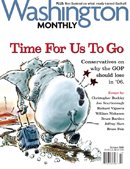
That is not the really funny part, Steve. The funny part is that you either have a short memory or do not read the magazine that you write for. Some prominent conservatives and Republicans were so unhappy with the Bush administration that they were calling for Democratic victory in the midterms and restoration of divided government. I know this, because I posted highlights from the cover story of the Washington Monthly article entitled "Time for us to go." Apparently, memory is fleeting at the Washington Monthly. Steve's article also begs the question - What happened to the Democrats who thought divided government was a good idea in 2006? Well, at least one of them still thinks it is a good idea. That would be me.

Miscellany

Traditionally, we conclude this Carnival by including one "off-topic" submission, as a grudging acknowledgment and proxy for the many off-topic submissions received. Off-topic in this context meaning - no mentions of "divided government" or gridlock.

For this edition we again offer Madeleine Begun Kane (who practically owns this spot) as she presents Open Limerick To Robert Gibbs and President Obama posted at Mad Kane's Political Madness.

Open Limerick To Robert Gibbs and President Obama
By Madeleine Begun Kane

Mr. Gibbs is thin-skinned, it appears.
From the left, he wants only big cheers.
But lefties just seek
A Dem Prez who ain’t weak.
White House courage is deep in arrears.

This verse is for Robert Gibbs’ boss.
Ignoring the left is your loss.
And a loss for the nation.
Our former elation
Is gone with your liberal gloss.

I found the ham-handed Gibbs/Axelrod/Rahm attempt at Clintonian triangulation to be a topic of great amusement and posted about it both here and at Donklephant. Madeleine 's limerick inspired me to pen a verse of my own:
Limerick for the Lackey Left
by The Dividist

Said Gibbs “The left is on drugs.”
Rahm agrees: “Just pull out the rug!”
“They’ve nowhere to go...
They’re retarded you know...
“In the end they’ll come back to ‘O’”
With that, we''ll wrap up this edition. Thanks for stopping by, and thanks for all of the submissions (on-topic or not).

Look for the next edition of The Carnival of Divided Government Quadrâgintâ (XL) - Special Labor Day/ Fight Procrastination Day Edition a week or so late on 09-10-2010. Submit your blog article at carnival of divided government using our carnival submission form.

Divided and Balanced.™
Now that is fair.


Carnival of Divided Government

Tuesday, August 10, 2010

Robert Gibbs gives me an excuse to use my Obama morphing into Bush graphic again.

This is kind of fun...

First - Press Secretary Robert Gibbs tees off into the left rough:

"I hear these people saying he's like George Bush. Those people ought to be drug tested," Gibbs said. "I mean, it's crazy."

Glenn Greenwald takes it personally, almost as if Gibbs is aiming directly at him:

"Robert Gibbs -- in one of the most petulant, self-pitying outbursts seen from a top political official in recent memory, half derived from a paranoid Richard Nixon rant and the other half from a Sean Hannity/Sarah Palin caricature of The Far Left -- is here to tell you that the real reason you're dissatisfied with the President is because you're a fringe, ideological, Leftist extremist ingrate who needs drug counseling...

The Democrats have been concerned about a lack of enthusiasm on the part of their base headed into the midterm elections. These sorts of rabid, caricatured, Fox-News-copying attacks on the Left will undoubtedly help generate more enthusiasm -- more loud clapping -- for the Democrats. I know I'm eager to go canvass and clap for Democrats after reading Gibbs' noble, inspiring vision. If it were Gibbs' goal to be as petulant and self-pitying as possible, what could he have done differently?...

I hope there are enough drug testing facilities to accommodate Talking Points Memo reporters, Charlie Savage, the lawyers from EFF, Bob Herbert, Anthony Romero, Russ Feingold, and The New York Times Editorial Board. I don't know anyone who asserts that Obama is the same as Bush -- I don't believe that and never asserted that -- but if anyone needs to be "drug tested," it would be those denying that many of Bush's most controversial policies and actions have been embraced in full by Barack Obama."
Ok - Gibbs really is aiming at Greenwald.

Finally, the voice of Reason - Matt Welch weighs in:
"And though the existence of progressive-left criticism of Obama has been one of the few heartening things about political discourse these past 19 miserable months, I wish more lefties were making the George W. Bush comparison on things like bailouts and spending binges and military surges and WoT detentions and entitlement expansion and Old Europe-tweaking and drug raids and obscenity prosecutions and general bullshittery."
Hey Matt - I'm doing my part.

Although - strictly speaking - I guess I am not a lefty now.

But I was in 2006, and hope to be again in 2012. Does that count?

UPDATE:
Mister Gibbs sheepishly "walked back" his earlier statement, describing it as "inartful".

My question is not why his liberal base is frustrated, that is pretty obvious. My question is what exactly was Gibbs trying to do? The initial rant was not "off the cuff". Lets get real. Gibbs is a Press Secretary. He serves up exactly nothing that is not first chewed, digested and excreted by Axelrod and Rahm. Then I read this in his artful walk back from the interview:
“In November, America will get to choose between going back to the failed policies that got us into this mess, or moving forward with the policies that are leading us out.”
Now I get it. They want to run against GWB again in 2010 because – you know – it worked last time. I mean - Bush was not running then... Bush is not running now... What's the difference?

But they really can’t run against Bush if the best and brightest in their base keep saying that Obama is acting just like Bush.

This was all about getting them to stop making that comparison. At least until after the election.


cross-posted at Donklephant

Divided and Balanced.™
Now that is fair.