After a two year hiatus, the Dividist blog is back. Our last post was after the 2020 Presidential election but before the inauguration, before the January 6th Capitol Hill insurrection, and before the Georgia runoff. In that post we discussed and analyzed how the Georgia results would determine partisan control of the Senate and the consequences in future elections.
Here we are, two years later, days before the midterm election, and we are again discussing and analyzing how the Georgia results will determine partisan control of the Senate and the consequences for future elections. It's "Deja Vu all over again."
Strap in. We've got a lot to catch up on. We'll be pulling from relevant past work and predicting the future. This will be a long post.
Apologies in advance for utilizing the same overused "Georgia On My Mind" cliché title used by everyone else opining on the Georgia election. But, to paraphrase Yossarian in Catch-22, "If everyone else is doing it, I'd be a damn fool to do anything else."
We're less than a week until the Georgia Senate runoff. No telling how long before we know the results. The election will determine partisan control of the Senate and whether we will have a Divided Government or a Unified One Party Rule Democratic Government for the next two years. The Dividist prognosticates and the Dividist has preferences. Sometimes they align. Sometimes they don't. First our preference...
Welcome to our eighth election eve "Just Vote Dividist" post. This blog started in 2006 to advocate a divided government voting heuristic. Every election eve since, the Dividist has published a Divided Government voting recommendation (see addendum below). This could be the last of this series as, thanks to COVID-19, our country's voting dynamic has changed dramatically and possibly permanently. As the Dividist writes this, somewhere close to 100 million votes have already been cast through mail-in ballots or early voting. This compares to approximately 130 million total votes cast in the 2016 presidential election. Which begs the question: What's the point of doing an election eve closing argument if 70% of the vote is already counted? And the answer is: The Dividist has no friggin' idea. So we'll do this out of tradition tonight and figure it out next time.
There are even more cries, lamentations, rending of garments and gnashing of teeth than usual this cycle. Partisans insist on characterizing this "most important election of our lifetime" as the Fascism vs. Socialism election. Both partisan tribes are in rare agreement that if the other tribe wins it will be The End of Democracy In America.
Spoiler Alert: We won't fall into fascism or socialism no matter who wins. Moreover, our democracy will be fine regardless of the outcome. You're welcome.
Additional Spoiler Alert: In previous editions, we've teased the Dividist recommendation and buried our preference deep in the post. But everyone has already voted, so WTF? Here it is:
The 2016 presidential election stunned pundits and voters alike (including the Dividist). But, as surprising as the electoral victory of Donald Trump was in 2016, a case can be made that the 2016 Senate election results were even more shocking. And therein lies a lesson for 2020.
The Dividist was enthralled to discover the phrase "Congnitive Madisonianism" and eager to put it to use. As he explained then, it is a political science term for the simple concept that American voters, in their collective wisdom, prefer and vote for divided government. That concept being the raison d'etre for this blog, the reader can appreciate the Dividist's enthusiasm.
In that post we assessed the current state of the election and made some predictions about the likelihood of maintaining our happily divided government across the new year:
"In 2016 the GOP will keep the House majority, the Democrats will keep the Executive branch and our government will stay happily divided regardless of what happens in the Senate. The dividist voting heuristic strives to Keep It Simple Stupid and walk the simplest path of least resistance to keeping the government divided. In 2016, that path is to vote Clinton for President (or - at the least - not vote for Trump), and vote to reelect your Republican Congressman. For the Senate - vote your conscience."
In 2016, the Dividist could see a rationale to vote for either party gaining majority control in the Senate:
"The best dividist reason to support a Democratic Senate is based on the fear that some "Black Swan", "October surprise" event (e-mails, Wikileaks, Clinton Foundation, Trump quitting the race, etc) will derail the Clinton campaign juggernaut sufficiently to let the GOP nominee be elected President. A Democratic Senate is a backstop to prevent Unified One Party Republican Rule.
The best dividist reason to support a Republican Senate is based on moderating Supreme Court picks. If the Democrats win the Senate there is a real possibility they will implement a "Nuclear Option" rule change for Supreme Court nominees. That means a Clinton Presidency and Democratic Senate could steamroll a GOP minority and confirm anyone Clinton nominates for the Supreme Court. They might even withdraw Garland to nominate and confirm a more reliably liberal judge.
Given the continuing catastrophe of the Trump campaign, the Dividist thinks hoping for a GOP Senate and moderation of Clinton picks for the Supreme Court is the better choice."
You win some. You lose some. For a current comparison, our 2020 prediction is that the Democrats will keep the House majority, Joe Biden and the Democrats will win the Executive Branch, and the best way to keep the government divided will be for the GOP to hold a slim Senate majority. But, as in 2016, the outcome of the Senate races in 2020 are very much in doubt.
Dear Senators Lisa Murkowski, Joe Manchin, Mitt Romney, Doug Jones, Susan Collins, Krysten Sinema,
I am writing in regard to your imminent role setting the ground rules for and rendering a verdict in the Senate impeachment trial of President Trump. You've each publicly stated your intent to live up to the oath required of all Senators prior to the trial:
“I solemnly swear, that in all things appertaining to the trial of the impeachment of President Donald Trump, I will do impartial justice, according to law.”
As regards the pending impeachment trial you've shown restraint in your public comments, expressed a willingness to keep an open mind on the proceedings, and a desire to treat the trial with a serious consideration of the facts.
In your respective careers in the Senate you have shown a pragmatic willingness to compromise on legislation with your counterparts across the aisle without compromising your Democratic / Liberal Republican / Conservative principles. That does not mean you don't support most of the partisan policies promoted by your party. You do. Presumably you choose to run as a Republican or Democrat because those party policies predominantly reflects your views and those of your constituents. That's expected.
Because of who you are, because of your willingness to compromise, because of your respect for the Constitution and the institution of the Senate, you are uniquely positioned to provide an extraordinary service to Americans, the institution you represent, and the country you love - Right Now. I propose you form an Impeachment Gang of Eight.
Welcome to the seventh election eve "Just Vote Dividist" post. This blog was started in 2006 to advocate a divided government voting heuristic. Every election cycle since we've posted a closing argument how and why to vote for divided government.
In this post you'll find our recommendations for the 2018 midterms. It doesn't take a lot of analysis. President Donald Trump in only half way through his term. Dividing this government requires Democrats winning the majority in either one or both legislative branches. The 2018 Divided Government vote is for a straight Democratic ticket.
In previous election eve editions we've painstakingly summarized and recycled our previous votes and general arguments for divided government. We'll include that in an addendum at the bottom of this post, and get right to the meat of why and how you should vote for divided government.
First an elementary civics lesson that far too many Americans fail to fully appreciate.
The President of the United States is not the government of the United States.
The President of the United States is not even necessarily the leader of the government of the United States. The executive is one of three co-equal branches of government. The actual government of the United States is led by the Speaker of the House and Senate Majority Leader representing their respective democratic institutions in concert with the President of the United States. The personalities, interpersonal relationships, communication skills, ideological motivation, partisan loyalties, personal ambitions, institutional obligations and dynamic interactions between those three leaders determine the domestic policy and international posture that governs the United States.
Co-Equal Means Co-Equal
The President is not the leader of the government but is the leader of a political party. In a unified one party government, the President may function as the leader of of the United States government if the president's party in Congress put partisan discipline and loyalty above their constitutional responsibilities. When we have a divided government, leadership of the United States government is just as likely to reside in the Congress as it is in the Executive branch.
Did I Mention The POTUS Is Not The Government Of The United States?
This is not to minimize the role of the President. The President is the putative "Leader of the Free World" and "Commander in Chief" of the most powerful military in the history of the world. The "Unitary Executive" has extraordinary, almost monarchical latitude over United States foreign policy. However, United States domestic policy is forged primarily in the House of Representatives, by design.
In Divided Government - The Speaker of the House Calls the Domestic Shots
The "People's House" - the most democratic of our government branches, is where the Framer's intended and expected domestic policy to be created and shaped. This is why the House is the first branch codified in the first article of the Constitution. This is why the Speaker of the House is second only to the Vice President in succession to the Presidency. The Senate - representing the semi-sovereign state governments - was intended by the framers to be a moderating influence over both the majoritarian domestic policies of the House and the foreign polices of the President.
A Co-equal Triumvirate Governs The United States.
This structure is unique. This structure is exactly what the framers intended. This structure is what makes our system exceptional. The point is this - given that this power sharing triad is the essence of our elected government, perhaps we - as voters - should focus less on the singular office of the President and more on the combination of leaders that will run our government.
With that in mind, we are pleased to present the three actual, realistic 2019 - 2020 United States Government choices you will be voting for Tuesday November 6. To simplify, we've eliminate the inprobable Democratic Senate, Republican House possibility. If there is a big enough Blue Wave to overcome the monumental Democratic map disadvantage in the Senate, the House will have to fall with it. One of the following three options will be elected on Tuesday to govern the United States for the next two years. Stack ranked by Dividist preference from worst to best.
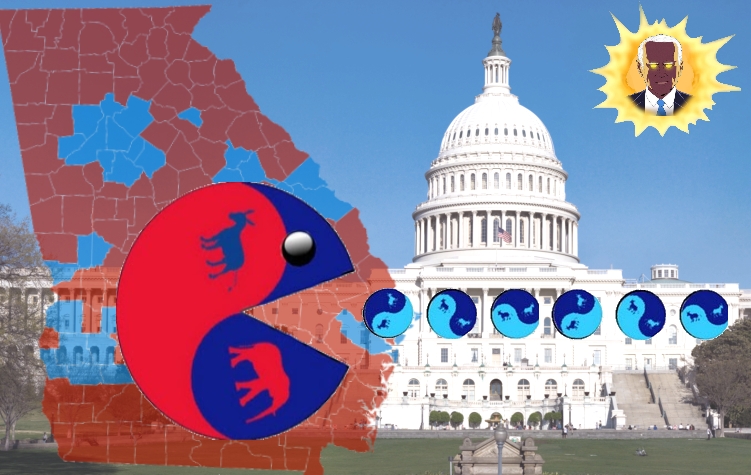
We're bored with the "Blue Wave" metaphor. We'll go with "Dividist Pac-Man"
Outside of the Mueller investigation, the biggest political question of 2018 is whether Democrats can ride a widely anticipated Blue Wave into a majority in Congress and divide the government. There are similarities to the mid-term wave elections that flipped Congress in 2006 and 2010.
In both cases, the long shot won with the help of a seriously flawed opposition candidate. In Alabama Roy Moore was accused of sexual impropriety with minors, and in Massachusetts Martha Coakley called Curt Schilling a "Yankee fan." This is, of course, not a fair comparison. Coakley's faux pas was far more egregious to the citizens of Massachusetts and more damaging to her candidacy than Moore in Alabama. Still the similarities are striking and the punditocracy at MSNBC are positively giddy in anticipation of surfing the blue wave they see on the horizon. Prospects for Democrats flipping the Senate - Less Than Zero
With Jones in the Senate, the GOP is barely afloat with a 51-49 Senate majority. It doesn't seem a massive political tsunami should be necessary to flip a leaky Republican rowboat with a mere two seat majority. An energetic GOTV ripple or two might do it. But those numbers are misleading.
There are 33 contested Senate seats in this election cycle. Twenty four of those seats will be defended by Democrats, only nine by Republicans. This class of Democratic Senators were elected on the coattails of Barack Obama's re-election in 2012, and a number of them are in states carried by Donald Trump last year. Only two Republican seats are considered toss-ups and the other six are either leaning or strong Republican. The Democrats would have to take both toss-up seats and defend 100% of their own. It's just not going to happen.
In the 2010 Red Wave Republicans picked up six seats, but still fell three short of the majority. Unlike 2018, the 2010 election was an even playing field with Democrats defending 19 seats and Republicans 18. The 2006 Blue Wave was also contested on a relatively even playing field, with Democrats defending 18 seats and Republicans defending 15. Democrats picked up six seats and took the majority.
The wildcard for Senate predictions in this election is whether either the moonbat left or wingnut right successfully primary establishment candidates and run clown candidates that scare the electorate. As Republicans found in the 2010 and 2012 Senate races and again this year in Alabama, there are limits to what even partisan voters will accept in a candidate. We assume that voters from both parties have learned that lesson, but we could be wrong. If the parties avoid that mistake and the candidates fall into the normal politician range our Dividist 2018 Senate prediction is that Republicans pick up 1 or 2 seats and retain the Senate majority [Nailed it.*]. Prospects for Democrats flipping the House - Pretty Darn Good
The House of Representatives is notoriously difficult to flip. Tip O'Neill's famous dictum "All Politics is local" is generally applied to House elections. Historically, incumbent representatives enjoy 95%+ reelection rates with strong local support, even if Congress is wildly unpopular. For whatever reason, voters who hate Congress still love their representative, particularly if they bring home the bacon, which they all do.
Despite the entire House being up for reelection every two years and only 1/3 of the Senate at risk each cycle, for over 100 years, the House never flipped unless the Senate flipped first or concurrently. That changed in 2010 when the GOP flipped the House but fell short in the Senate. This was widely attributed to Republicans undermining their electoral advantage by posting a slate of un-electable clown candidates. They did the same in 2012. Eventually they figured it out and took the Senate majority in 2014.
Any rule is only true until it is not. Tip O'Neill's maxim "All politics is local" was not true in 2006 and 2010 when nationalized wave elections made politics decidedly not local and flipped House majorities.
What does history tell us?
A few years ago, we started looking at the history of flipping House elections, hoping to glean some insight into what nationalizes the electorate sufficiently to throw their local heroes out of office. We first looked at recent elections, then over the modern era, then at the previous century. Now we'll finish the job by looking at every single time the House flipped majorities since Republicans and Democrats first faced off in 1856:
In 1856 the Whig Party disbanded and the Republican Party was born. That year Republicans and Democrats faced off for the first time and Republicans won 37 seats. Democrat James Buchanan won the Presidential election, Democrats retained their majority in the Senate and secured a majority in the House with 133 seats. Two years later, in the 1858 mid-terms, Republicans picked up 90 seats and won a majority in the House against the previously unified Democratic government. That was the first flip of a House majority when Democrats and Republicans were the dominant political parties.
Since then, including 1856, there have been 8081* Republican vs Democrat elections for control of the House and Senate. Over that period of time the House has flipped majorities exactly 1718* times - in 1858(R), 1874(D), 1880(R), 1882(D), 1888(R), 1890(D), 1894(R), 1910(D), 1918(R), 1930(D), 1946(R), 1948(D), 1952(R), 1954(D), 1994(R), 2006(D), 2010(R) and maybe2018(D).
A necessary but not sufficient condition.
Here is the interesting bit. Of those 17 18 flips over 160 162 years only three elections, 1880, 1888 and 1948 flipped against a divided government. All of the other 14 flips were against unified one party rule of the opposition party. Exactly like we have now had in 2018*. In addition, the three exceptions of 1880*, 1888*, and 1948* all occurred during Presidential election cycles. The House has never flipped majorities in a midterm election against a divided government. In the entire history of Republican vs Democratic elections, the House has only flipped against unified opposition party governments in a midterm election. Moreover, the House has never flipped against a divided government in the Modern Era since 1948. We call this electoral phenomena...
The O'Neill Exception:
The House majority never flips against a divided government in a midterm election. Most of the time unified one party government is a necessary (but not sufficient) condition to flip majorities in the House of Representatives and is always a necessary condition to flip during midterms.
This may be the most reliable rule of thumb in politics that no one knows. Historically speaking, the table is set for the Democrats to take the House majority in 2018. But, as noted, the O'Neill Exception is a necessary but not sufficient condition. Other elements must also be in place to nationalize the election and flip the House. As I explained in a previous post about this phenomena:
"The interpretation of this phenomena is pretty clear. A nationalized i.e. - not politics is local - election requires a national focus to energize the voters. A sufficient "wave" election needs an organizing principle to power the kind of tsunami that can flip the House. Focused anger/blame on a unified party in power does the trick. A divided government distributes the blame and blurs the electoral focus. A divided government cannot drive a sufficient nationalized election groundswell to overcome local favorites and local politics.
We conclude that, as we've stated repeatedly, a one party unified government is a necessary but not sufficient condition to flip the House majority. Still, a unified government can remain in place for many years without a reaction against the concentrated one party rule. Additional factors, above and beyond one party unified government rule, must come into play to precipitate a wave election. In general it takes an additional combination of corruption, overreach and/or arrogance on the part of the unified party in power to align voters in opposition and nationalize the House election."
Because Trump won, and because the Democrats managed to snatch Senate defeat from the jaws of victory when the Senate playing field was slanted decidedly in their favor, we now have Unified One Party Republican Rule. And because we have Unified One Party Republican rule, the conditions now exist for Democrats to flip the House in 2018. The Democrats need to gain 25 seats to flip the House in 2018. Not as many as the 2006 Blue Wave when they picked up 31 seats. Not as many as the 2010 Red Wave when Republicans picked up 63 seats. Not as many as 1858 when Republicans flipped the House against Democrats for the very first time with a pickup of 90 seats. Doable, even likely.
What are the sufficient conditions to flip the House?
The most popular test for the prospect of a nationalized wave election flipping the House, is the generic partisan poll. Decision Desk HQ has a great detailed analysis of the prospects for a Democratic flip in 2018 utilizing a variety of analytical techniques, including an average of the Generic Polls:
On the basis of an average ~9% Democratic edge in the Generic Poll, they are currently forecasting the Democrats to net 32 seats and a narrow majority. That is encouraging for Democrats and Dividists, but we must strike a cautionary note. The Generic Poll is not a good forecasting tool, particularly this far out from the election.
Late in 2013, the Democrats also had a ~9% lead in the generic poll, prompting a lot of triumphalist tweeting about the prospects of Democrats reclaiming Congress. One year later the GOP picked up 9 Senate and 13 House seats in the 2014 midterms. That said - it's different this time. In the 2014 midterms, the Democrats were up against a divided government and the historical precedence of the "O'Neill Exception." In the 2018 midterms the Democrats are facing a unified one party rule Republican government, and the "O'Neill Exception" has their back.
Above and beyond the necessary condition of running against a Unified Government to nationalize the election, history offers additional conditions common to prior House flips that sufficiently offend the electorate to vote against the party in power. In short, the unified party in power has to cooperate by demonstrating some combination of egregious legislative overreach, blatant corruption, and/or arrogant abuse of power. This is the Trump One Party Rule Unified Republican Government - so no problem. Those conditions are met.
The Dividist 2018 House of Representative prediction is the Democrats will pick up around ~35 seats and take majority control of the House [Democrats picked up 40 seats to take the majority*].
Another key for Democrats will be forging a nationalized campaign organized around a unifying message in opposition to Trump administration overreach. Just like they did successfully in 2006 against the Bush/Cheney administration. And they should avoid running the kind of brain dead, electorate fracturing, identity politics campaign that so many of them love. It would also help to replace polarizing leadership that may deter independent and moderate voters. We are looking at you, Nancy Pelosi.
If they do that, Democrats can wrest majority control of the House of Representative from the GOP, restore divided government, moderate government policy, and provide real oversight for the balance of the Trump (or Pence) administration.
Hope Floats (on a Blue Wave).
Cross-posted on Uniters.Org: The Dividist is pleased to participate in Solomon Kleinsmith's ambitious new venture to organize Centrists, Moderates and Independents. Check it out.
*ADDENDUM - The "O'Neill Exception" exceptions:
Three exceptions that prove the rule.
The 1880 election for the 47th Congress of coincided with the presidential election between Democrat Winfield Hancock and Republican James Garfield when Republican President Rutherford Hayes declined to run for reelection. Going into the election the government was divided. Democrats held a 42-32 seat majority in the Senate. Republicans controlled the White House and a 148-132 seat majority in the House of Representatives. James Garfield won the Presidency, Republicans picked up 5 seats in the Senate to create a 37-37 tie (broken by Republican VP), and took control of the House by flipping the majority to 151-131 with a net gain of 19 seats and a unified Republican government. One interesting sidelight - 78% of the electorate turned out to vote in one of the largest turnouts in American history, and this was the closest popular vote in U.S. history with the presidential candidates separated by less that 2,000 votes.
The 1888 election for the 51st Congress coincided with the presidential election between incumbent Democrat Grover Cleveland and Republican challenger Benjamin Harrison. Going into the election the government was divided. Republicans controlled a narrow 38-37 seat majority in the Senate. Democrats controlled the White House and a 167-154 seat majority in the House of Representatives. Benjamin Harrison won the Presidency, Republicans maintained their one seat majority in the Senate, and Republicans took control of the House by flipping the majority to 179-152 with a net gain of 25 seats and a unified Republican government.
The 1948 Election for the 81st Congress coincided with the presidential election between incumbent Democrat Harry Truman and Republican Thomas Dewey. Going into the election the government was divided. Republicans controlled a 51-45 seat majority in the Senate and a 246-188 seat majority in the House of Representatives. Thomas Dewey - I mean - Harry Truman won the Presidency. Yeah, there was a lot of confusion about that election, and the electorate might have been anticipating a Dewey victory, as was the Chicago Daily Tribune. Regardless, Democrats flipped the Senate gaining 9 seats with a 54-42 majority and the House gaining 75 seats to a 263-171 majority and a unified Democratic government.
It happens every election year. As the Halloween electoral landscape comes into focus, Republicans and Democrats stake out their positions on the prospect for a divided federal government. The usual partisan hypocrisy abides. Partisans who see an opportunity for Unified One Party Rule will decry the evils of divided government. Partisans who fear their party being shut out of power will extol the virtues of checks, balances, and the restraint on power found in a politically divided government. Neither party exhibits any shame when flip-flopping their feelings about divided government from one cycle to the next.
This year there is less partisan clarity about the prospects of either party regaining One Party Rule than is usually apparent this late in the election cycle. Some of this is fueled by delusions of grandeur on the part of Democrats indulging in Nancy Pelosi's bi-annual fantasy of retaking the House majority (see 2014, 2012 & 2010 prognostications of the Once And Never Again Speaker).
"In 2016 Democrats will enjoy many of the structural advantages that favor Republicans in 2014. There is a high probability that a Republican majority in the Senate will not last beyond the 2016 election. If we go into that election with Republicans in majority control of both legislative branches, it makes the divided government vote easy to determine. There will be a greater risk of Single Party Republican Rule, so the 2016 Dividist vote will be for the Democratic candidate for president. A strong Republican presidential candidate could have the coattails to retain the Senate and usher in another era of One Party Republican rule. Even with a strong Democratic presidential candidate in 2016, the Republicans will be likely to retain the House and we get divided government for another 2 to 4 years. QED ... And yes, under those circumstances, the Dividist will gladly support and vote for Hillary Clinton for her third term as President."
Under these circumstances, we would normally expect Democrats to be waxing eloquently on the virtues of divided government. We would expect Republicans to be fear-mongering the prospect of gridlocked government unable to deal with the dire threats posed to the American way of life by the Democratic Party. To some extent, this is exactly what is happening. But, like in so many aspects of this election cycle, Donald Trump changes the game. So instead, we now see principled Republicans and libertarians arguing against voting for Trump, preferring a vote for a Clinton presidency shackled by a divided government. And we see some deluded Democrats arguing for an implausible return to One Party Democratic Rule hoping that Trump blowback will nationalize the House elections in their favor. In this case, it is the principled Republicans who are grounded in electoral reality.
Do you ever wonder what would have happened if Neo took both the red and blue pills? What if I told you that you do not have to choose between red or blue? What if I told you that you can choose both? Let's take a trip to political Wonderland and see "how deep the rabbit hole goes."
Voters Don't Like Their Choices
Amidst the Sturn und Drang of the 2016 presidential election, the dominant complaint is about choice. Many voters are profoundly unhappy with the binary choice they have been offered by our red and blue political parties. Part of the reason for this election malaise is that partisan voters feel compelled to vote for their party's standard bearer regardless of whether they like the nominee. The partisan voter's choice in a federal elections is always preordained.
Partisans Don't Have a Choice
The vast majority (80% +) of the American electorate are "light switch" partisan voters in all federal elections. Regardless of whether they identify as partisan Republicans, partisan Democrats, or whether they delude themselves by claiming to be "Independent", most Americans always vote a straight partisan ticket. They always vote the same party for President, Senator and Representative - without exception - every single time - over decades.
The only real choice for partisans (and leaners) is not who they vote for, but whether or not they choose to vote. They can only turn the switch on or off. Since partisans have limited choice, they can become particularly frustrated when the partisan options selected by their partisan tribe are not particularly likable, trustworthy, qualified, or even remotely competent as candidates. Like, for example, the nominees in the 2016 presidential election.*
In a presidential year, the crisis of partisan choice becomes even more acute. This, in no small part, due to the identity voters invest in, and the importance voters attach to the role of President. The President is, after all, "Leader of the Free World" and "Commander in Chief" of the most powerful military in the history of the world. But voters investing their ideological hopes in a Presidential candidate tend to overlook an important aspect of the role. To whit - The President of the United States is not the government of the United States. The President is not even necessarily the leader of the government of the United States. The President is the leader of a political party. When we have a unified one party government, the President may function as the leader of of the United States government if the president's party demonstrate sufficient partisan discipline. But even under unified government, it is not always clear exactly where the seat of the United States government leadership resides.
The Dividist's new favorite phrase is "Cognitive Madisonianism." It's just another way of saying that American voters, in their collective wisdom, prefer and vote for divided government.
Based on election results in the modern era, the assertion would seem to be unassailable. Since the end of WWII there have been 34 federal elections in the United States. In 22 of those elections, Americans elected a divided government. We chose divided government for 44 of the intervening 71 years or 62% of the time. We are currently in the 6th consecutive year of our most recent iteration with indicators pointing to divided government extending it's winning streak for at least two and probably four more years.
Wait. Do We Do That On Purpose?
That is the question. It's a simple fact that we vote for divided government far more often than not. It's that "cognitive" part that political scientists and pundits have a hard time swallowing. They just can't believe we are doing this deliberately.
The Donald and The Hillary - with apologies to Lewis Carroll
We've postponed this too long and can can no longer avoid the inevitable. The next presidential election is only one year away. The Dividist needs to stop procrastinating and post something about the frightening possibility that one among this herd of candidates will be elected President. Still, there are advantages to neglecting the blog and ignoring all the political permutations to date.
If the Dividist had gotten around to posting a prediction in the spring when the the campaigns were kicking off, he would have confidently stated that a Bush vs. Clinton dynastic rematch was a lock. He might have even suggested the matchup was a win-win for America. Yeah... that's not happening.
The Jeb was moping sulkily,
when Marco started to run.
He had no business to be there
After the debate was done -
"It's very rude of him," he said
"To spoil all my fun!"
"I'll win for you," The Donald said:
"I deeply sympathize."
With snark and boasts he sorted out
Polls of the largest size,
And holding his bulging wallet,
Kept voters hypnotized.
"Oh voters," said the Hillary,
"Shall the White House be our home again?"
But answer came there none -
And that was scarcely odd, because
She'd lied to every one.
In 2007, as a blogging toddler, the Dividist despaired at finding a unique approach to the SOTU when so many other bloggers would be traversing the same ground. The answer came from Bob Woodward. In an on-line Washington Post forum the Dividist asked whether the SOTU had any real relevance. Woodward responded by saying it was "mostly theater." Genius. That was the answer. What better way to frame the SOTU, media and blog reactions than within the lyrics of a Broadway show tune?
An now, here we are in 2015, with not just any divided government, but the very best kind of divided government. With fears of a lame duck President locked into a frozen block of icy gridlock with a Republican Congress, what could be more appropriate for the State of the Union than President Obama choosing to empower himself with "Let It Go" from Frozen?
Nate Cohn's enthusiasm for this election notwithstanding, the big decision to come out of the midterms is a foregone conclusion. After four consecutive and six of the last eight years, the midterms will lock and load at least two more years of divided government. The Republican hand will be strengthened in both the House and Senate, but there is still some drama in determining whether the GOP will take over majority control of the Senate. Most pollstersare giving it to them...
... but the Dividist never underestimates the Republican's capacity to snatch defeat from the jaws of victory. Our best bet is that the Senate will finish close to 50-50, and the GOP will flip a couple of Independents to take control. If the Republicans do take narrow majority control of the Senate in 2014, the recommended Dividist vote for 2016 will be to elect the Democratic candidate for President, as it is unlikely the GOP will lose control of both the House and Senate in 2016.
With divided government a fait accompli through 2016, both new and main stream media are weighing in on what we can expect from our divided leadership over the next two years. For your reading enjoyment the Dividist has assembled recent wit and wisdom of the punditocracy on the subject of divided government. To bring some semblance of order to this compilation, we've divided our selections into a Sergio Leone taxonomy - The good, bad, and the ugly.
Nate Silver has long been the darling of progressive poll watchers as he wears his liberal sensibilities on his sleeve. However, he does not let his personal political preferences affect his quantitative analysis. His accuracy in predicting political outcomes in recent cycles has been nothing less than exemplary. Which explains the cries, lamentations and rending of garments among Democrats when, last March, he predicted that Republicans had a 60% chance of taking the Senate. Notable among the critical cognoscenti was Paul Krugman, who is the opposite of Silver in the sense that he never lets facts, rationality or reality get in the way of his particularly progressive view of the world.
"Democrats are at risk of losing control of the Senate this November, after a new poll found that voters prefer a Republican-controlled Congress to check President Barack Obama's agenda when his approval rating is at its lowest point ever."
Democrats are looking for a silver lining, but with no "wave" election in sight, we're likely to have a classic Tip O'Neill "all politics is local" midterm. This is good news for dividists like your loyal blogger, but there may be even better news lurking in another finding from the poll:
"Democrats, however, do enjoy an overall advantage on voter trust. Voters say they prefer Democrats' stances on health care (43-35), immigration (40-34), and the economy (41-38), among others. By a 40-34 margin, voters also say they trust Democrats to "coping with the main problems the nation faces over the next few years."
The Dividist interprets this apparent contradiction as indicating voters are no more inclined to trust Republicans with all the keys to the castle than they are Democrats. Which implies that losing the Senate in 2014 will actually help position Democrats to keep the White House in 2016 and extending divided government into the next administration. It's a good thing.
But perhaps we are getting ahead of ourselves. Some Democrats are thinking about what the post mid-term environment on Capitol Hill might look like if the Obama administration is faced with a Republican majority in both the House and Senate. While Republicans in the House usually get the majority of the blame in mainstream media for obstructionism and the "least productive Congress in history", it's instructive to take note of which party is in a panic that Congress might actually "get things done" in the waning years of the Obama administration:
Sen. Angus King (I-Maine), who caucuses with the Democrats, will decide after the midterm elections whether to switch sides and join the Republicans. He is leaving open the possibility of aligning himself with the GOP if control of the upper chamber changes hands. “I’ll make my decision at the time based on what I think is best for Maine,” King told The Hill Wednesday after voting with Republicans to block the Paycheck Fairness Act, a measure at the center for the 2014 Democratic campaign agenda. King’s remarks are a clear indication that congressional leaders on both sides of the aisle will have to woo the 70-year-old senator in order to recruit him to their side.
That lobbying battle could be especially intense if King’s decision determines which party will control the chamber in the next Congress If Republicans pick up six seats this fall, they will be running the Senate in 2015. But a pickup of five would produce a 50-50 split and Democratic control, with Vice President Biden breaking the tie. King could tip the balance..."
Where have I read this before? Oh yeah. It was me:
FiveThirtyEight Senate Forecast: GOP Is Slight Favorite in Race for Senate Control
"When FiveThirtyEight last issued a U.S. Senate forecast — way back in July — we concluded the race for Senate control was a toss-up. That was a little ahead of the conventional wisdom at the time, which characterized the Democrats as vulnerable but more likely than not to retain the chamber. Our new forecast goes a half-step further: We think the Republicans are now slight favorites to win at least six seats and capture the chamber. The Democrats’ position has deteriorated somewhat since last summer, with President Obama’s approval ratings down to 42 or 43 percent from an average of about 45 percent before. Furthermore, as compared with 2010 or 2012, the GOP has done a better job of recruiting credible candidates, with some exceptions."
Given we are still early in the primary season... Given the Republican penchant for nominating clown candidates in winnable Senate races... Given the hole the Republicans dug for themselves in the Senate in 2012... the Dividist is a bit dubious of Nate Silver's prediction. We'll come back to that. But first, let's consider one 2014 outcome that is not at risk in any meaningful way - the continuing status quo of our happily divided government.
Someone on my twitter feed described Rand Paul's epic 13 hour filibuster as "libertarian porn". Not sure if I would go that far, but given we are talking about a CSPAN feed of a man talking at a podium for 13 hours, it was far more engrossing and entertaining than it had any right to be. I watched much of it live. Really. I actually did. I reluctantly tore myself away at the nine hour mark to keep an evening engagement, and was sorely disappointed to learn it was over when I returned.
Rand Paul was ostensibly using the filibuster to block a vote on John Brennan's nomination to run the CIA, but he made it clear the nomination confirmation was not his primary reason for the filibuster. Rather it was administration evasion on a simple question - Does the President think he legally has unilateral authority to launch a drone strike on an American citizen in America? During the filibuster Rand Paul referenced several articles and read them into record. They encapsulate the issue that prompted the filibuster better than I can:
"Any thinking person can see that Holder's letter is non-responsive, evasive, and deliberately manipulative in its sly reassurances, right down to the rhetorically powerful but substantively nonsensical invocation of 9/11. (Being more subtle about it than Rudy Giuliani doesn't make it right.) To credulously accept this sort of response, on an issue as important as this one, is behavior unfit for any citizen of a free country, where safeguarding the rule of law is a civic responsibility. Rand Paul deserves tremendous credit for eliciting this response. In its wake, he needs help from his colleagues and his countrymen. The time to discuss the appropriate scope of the president's authority is now, not in the aftermath of a catastrophic attack on the nation, as Holder suggests. The fact that he disagrees speaks volumes about Team Obama's reckless shortsightedness."
"Republican Senator Rand Paul of Kentucky, who sent three letters to CIA director nominee John Brennan requesting an answer on “whether the president has the power to authorize lethal force, such as a drone strike, against a US citizen on US soil,” finally received an answer from Attorney General Eric Holder. The answer indicates the administration of President Barack Obama does, in fact, believe it has the power to assassinate US citizens on US soil with lethal force.... There may never be a targeted killing of a US citizen on US soil and the question of whether a US citizen could be targeted and killed on US soil may remain a hypothetical question for some time, but the fact that the Obama administration has told a US senator there is a circumstance where the government could target and kill someone, who is a citizen, on US soil without charge or trial is a stark example of the imperial presidency. It is an example of how there is, for the most part, no power to violate civil liberties or human rights the president won’t claim in order to respond to “threats” however it chooses."
As interesting as the filibuster itself, was the reaction from the punditocracy. Rand Paul received positive commentary on the filibuster from across the political spectrum. The most withering criticism came from his fellow Republicans.