Showing posts with label Bill Clinton. Show all posts

Thursday, June 08, 2017

What it takes to impeach a President & why we're not remotely close to impeaching President Trump. [UPDATED 08/21/18*: It's getting close.] [UPDATED 02/27/19**: We're there.]

UPDATED: 02/27/2019**
What it takes to Impeach a President
 Graphic Updated after Michael Cohen Hearing 2/27/2019* 
To Impeach or Not to Impeach...
Conventional wisdom informs us that impeachment proceedings against a sitting President will not happen while the legislative branch is in control of the same party as the President. History bears this out, as impeachment actions against Andrew Johnson, Richard Nixon and Bill Clinton were all initiated when the House of Representatives was controlled by the opposition party. But with President Trump, history and conventional wisdom may be steering us in the wrong direction, as many establishment Republicans would far prefer Mike Pence as President. Regardless, it is certainly true that divided government would make impeachment easier and the 2018 midterm election looms large.

The unfolding James Comey testimony, and in particular his opening statement published a day earlier, has precipitated predictably contradictory analysis of whether the threshold for impeachment has been crossed or not.

That is the Question
For those of us of a certain age, the question of what it takes to impeach a sitting President, or force a President to resign under threat of impeachment, is not a hypothetical historical exercise. We've seen it twice in our lifetime. We saw President Clinton impeached but not convicted. We saw President Nixon resign under threat of impeachment. In both cases, congressional leadership from the party of the President calling out the President were critical factors.  In both cases, there was an evidentiary Rubicon that had to be crossed before impeachment became a realistic possibility.

Monday, October 20, 2014

Divided Government With Unified GOP Congress -
The Good. The Bad. The Ugly.

The Good Bad and Ugly of Divided Government

Nate Cohn's enthusiasm for this election notwithstanding, the big decision to come out of the midterms is a foregone conclusion. After four consecutive and six of the last eight years, the midterms will lock and load at least two more years of divided government.  The Republican hand will be strengthened in both the House and Senate, but there is still some drama in determining whether the GOP will take over majority control of the Senate.  Most pollsters are giving it to them...

Will GOP take the Senate


... but the Dividist never underestimates the Republican's capacity to snatch defeat from the jaws of victory. Our best bet is that the Senate will finish close to 50-50, and the GOP will flip a couple of Independents to take control. If the Republicans do take narrow majority control of the Senate in 2014, the recommended Dividist vote for 2016 will be to elect the Democratic candidate for President, as it is unlikely the GOP will lose control of both the House and Senate in 2016.

 With divided government a fait accompli through 2016, both new and main stream media are weighing in on what we can expect from our divided leadership over the next two years. For your reading enjoyment the Dividist has assembled recent wit and wisdom of the punditocracy on the subject of divided government. To bring some semblance of order to this compilation, we've divided our selections into a Sergio Leone taxonomy - The good, bad, and the ugly.

Thursday, January 02, 2014

Can we do tax reform and immigration reform in an election year with a divided government and a lame duck president?

Why Yes! Yes We Can! 
There is only one catch...

We could do it in 1986, and maybe in 1998, but not in 2014. That's the thesis of  John Harwood's article in the New York Times: "When a 2nd-Term President and a Divided Congress Made Magic".

First Harwood explains why it worked in 1986:
"In 1986, President Ronald Reagan sat in the White House. Fellow Republicans controlled the Senate but not the House — a mirror image of the alignment President Obama governs with today. That September, strong bipartisan majorities in both houses of Congress passed a drastic revision of the tax code that eliminated valuable tax breaks while lowering the top rate to 28 percent from 50 percent. The following month, less than three weeks before Election Day, bipartisan majorities transformed the federal immigration code as well, with amnesty for some already in the United States, penalties for businesses hiring illegal immigrants, and more money for border enforcement...  All of them accepted two stipulations that, by narrowing the range of disputes, made getting to yes easier. They agreed that the new tax code would raise the same amount of money as the old one (making it “revenue neutral”), and that it would get that money from the same groups of earners (making it “distributionally neutral” as well)."
Then Harwood explains why it won't work in 2014:
"Mr. Obama and his party want more tax revenue and more progress against income inequality, which has widened since Mr. Reagan’s time. Republicans have more difficulty selling reductions from a top rate of 39.6 percent than from 50 percent as in 1986...  What controlled the action was what the congressional scholar Norman Ornstein called “the problem-solving caucus” — driven more by issues than partisan imperatives. Today, Mr. Ornstein said, that caucus “has dwindled dramatically.” That’s in part because the number of truly competitive districts — where voters selected a member of Congress from one party and a presidential candidate from another — has dwindled from 45 percent of all House seats in 1986 to only 6 percent, or 26 seats, today.  The crucial ingredients for bipartisan action, former Senator Bradley said, are “independence of thought and capacity to listen.”
A good article, but I think Harwood missed a couple of points. President Reagan prioritized doing a deal ahead of ideological or partisan concerns. Don't get me wrong. Reagan was a partisan and an ideologue. But he made doing deals a priority and was willing to suffer the slings and arrows from his own party to get a deal done. As Harwood points out in the article "Republicans like Phil Gramm of Texas... called granting permanent residency to some immigrants who had crossed the border illegally “outrageous.” Nevertheless, Reagan got the immigration bill passed.

Wednesday, October 10, 2012

Bill Clinton Rips Mitt Romney For Being Too Much Like Bill Clinton

Bill Clinton, arguably the most popular pol in America today, is stumping with and for Obama on the campaign trail this week. From the LA Times:
"Nearly a week after President Obama stopped his campaign's momentum with a lackluster debate performance, former President Clinton sought Tuesday to help him recover by offering a withering new critique of Mitt Romney. "I had a different reaction to that first debate than a lot of people did," Clinton told nearly 2,000 supporters at a campaign rally for Obama and other Democrats. "I thought, 'Wow, here's old moderate Mitt. Where ya been, boy?' "
Team Obama has turned to Bill Clinton as they continues to struggle with the most predictable and telegraphed "pivot to the center" in the history of politics.  Many of the President's supporters are adopting the "Moderate Mitt" label that Clinton uses here as a pejorative, and outlining Romney's new moderate positions to prove that he has changed positions. Think Progress is a case in point:
"In a last ditch effort to win over undecided moderates, Mitt Romney is finally fulfilling his adviser’s prediction that he would become the “Etch-a-Sketch” candidate. During the first presidential debate, Romney started reversing positions he espoused all year while he was trying to placate the Republican base. Since the debate, he’s continued to shed his hard-line stances that alienated moderates. Here are 5 examples..."
It may or may not be "last ditch", but it appears to be working for Romney. Does it not occur to Obama supporters that promoting this moniker and Romney's new moderate positions make it much more likely that undecideds, centrists, independents, and moderates will vote for him? That the fact that he changes positions to adjust to the prevailing political winds and public polls is exactly what they want to see in a President?

Thursday, December 23, 2010

Bill Clinton endorses divided government. Sort of.

The December 10 Multi-President Press Conference

While preparing our latest divided government compilation, the Dividist found a prominent divided government reference that previously escaped his notice.

The December 10 White House press conference was notable for a lot reasons, but mostly for the sublime weirdness of watching the embattled current President handing the popular former President off to the White House press corp as if it was a tag team professional wresting match. Depending on partisan proclivity, perception of the multi-president press conference performance ran the gamut including: helpful, awkward, bizarre, a mistake, weird, show-stealing, an abdication, an education, nostalgic, and awesome.

As usual the most perceptive and entertaining coverage of the event was found on the Daily Show and from Taiwan's Next Media Animation studios - The two media outlets now setting the Gold Standard for political journalism:

Who is that crawling under the desk?

The Daily Show With Jon StewartMon - Thurs 11p / 10c
Obama Leaves Bill Clinton in White House Briefing Room
www.thedailyshow.com
Daily Show Full EpisodesPolitical Humor & Satire Blog</a>The Daily Show on Facebook
Obi-Wan is back.

Lost in the spectacle and general bemused astonishment - this common sense explanation by the former President outlining why divided government works as well as it does:

Q: "Thank you, Mr. President. Beyond this pending tax deal, there are enormous issues of importance that are unfinished, from education to energy, the deficit. And this is still a very divided country. Do you think the American people want a President to compromise with the opposing party? And is that a message that you think Democrats are going to have to accept?"

FORMER PRESIDENT CLINTON:
"Yes, but I also believe that it’s a message Republicans are going to have to accept. Keep in mind that many of the -- the really interesting thing was -- is that a lot of the hardcore conservatives think the Republicans gave too much. Read Charles Krauthammer’s column in the Post today. He’s a brilliant man, and he pointed out that they got the divisive tax cuts, but most of them were targeted to middle-class working people -- that's what the payroll tax cut is -- that the unemployment benefits were extended, which some of them did not want to do, and that the American people, by two to one, support them both.

So there are some conservatives who don't believe in the economic theory I just advanced to you; who believe that the President and Democrats got more out of this than the Republicans did.

So I think that's healthy, too, because everybody has got to give a little.

Yes, I think the one thing that always happens when you have divided government is that people no longer see principled compromise as weakness. This system was set up to promote principled compromise. It is an ethical thing to do. In a democracy where no one is a dictator, we would all be at each other’s throats all the time, and we would be in a state of constant paralysis if once power is divided, there is no compromise."
Well said Mr. [ex-]President. If the electorate truly wants the moderating influence of bi-partisan compromise in our federal government, they can get it it by never giving either party all the keys to the castle. Pretty simple really. But then... is it ever really that simple with Bill Clinton?

In 2012, the Republicans are likely to maintain their majority in the House of Representatives, and will be in a strong position to retake the Senate majority. Barring some unforeseen circumstance, the divided government vote in 2012 will be a vote to reelect Barack Obama. You don't suppose that Obi-wan is already preparing the ground for Obama's 2012 campaign do you???

Divided and Balanced.™
Now that is fair.


Tuesday, July 13, 2010

Gridlock Is Good

UPDATED: 15-July-10

Doyle McManus at the LA Times considers the challenges the GOP must face to press their advantage in November, and the challenges facing the country should they prevail and restore divided government:

A post-November congressional outlook: partisan gridlock
"But there's at least one potential problem for the Republicans: They haven't settled on a unified national message yet — and a quiet civil war is brewing over what, if anything, it should say. In one camp are House conservatives, led by Rep. Eric Cantor (R-Va.), the House minority whip, who argue that Republicans won in 1994 because the Contract with America laid out by then-Rep. Newt Gingrich (R-Ga.) articulated a coherent message around which candidates and voters could rally... Republicans, reportedly including Senate Minority Leader Mitch McConnell (R-Ky.), worry about finding a tent large enough to include all GOP viewpoints. Trying to come up with a single platform, they believe, could be divisive, and the party should simply embrace a few broad issues such as cutting taxes and spending. We're already winning, they argue; why get too specific and give Democrats a clearer target to shoot at?"
While messaging is important, McManus overstates the significance of the problem. There is simply not a tent big enough to encompass the full spectrum of policy positions held by those opposed to our One Party Democratic Rule, including: fiscal conservatives; social conservatives; Republican partisans; libertarians; independents; and the tea party movement. But there does not need to be a unanimity of policy preferences for the GOP to prevail. All they need in November is a common objective and general agreement that a key issue takes precedence over all others. My take -
  • The objective is restoring balance and restraint in our federal government.
  • The key issue is restraining the insane growth of spending and curtailing the fiscal irresponsibility exhibited by the Democrats and this administration.
The Tea Party movement is a microcosm of the opposition coalition, willfully misunderstood and mis-characterized by Democratic Party partisans. So far, the Tea Party has shown considerable political acumen and understand that social issues must take a back seat to economic issues in this election. In a nutshell - "It's the spending, stupid" - (Thank you again James Carville).

Thursday, May 01, 2008

Barack Begets Boomer Backlash

UPDATED: 02-May-2008
Why don't you all f-fade away
And don't try to d-dig what we all s-s-say
I'm not trying to cause a b-big s-s-sensation
I'm just talkin' 'bout my g-g-generation
This is my generation
This is my generation, baby
My Generation - The Who

I was not going to post about Democratic campaign for a while. One, I am among the 60%, and two I thought it was time to try to get this blog re-focused on the divided government meme. But just when I thought I was out of it, they pulled me back in. The Obama/Clinton contest is just too darn entertaining.

First, I have said before, and I'll say again - I like Obama. I like his intelligence, I like the way he talks, I like the way he thinks, I like his 20o2 position on the war and I particularly like the fact that he is a Bear fan. It is easy to feel good about Barack Obama. That does not change the fact that a prospective Obama presidential administration is a cipher. There is simply not enough resume' or experience to see an Obama Presidency as anything but an unbreakable code whose meaning is fundamentally unknowable now. No one can know what an Obama presidency will be like. He might be a great president. He might be a disaster. He might even be... Jimmy Carter. Personally, I'd rather see him seasoned as VP for four or eight years before I could vote for him. Yes, I like Obama, but the nonsense coming from Obama supporters who project their hopes and dreams onto the Obama blank slate is another matter all together. Most entertaining of all, is the earnest outrage/righteous indignation/and the audacity of wishful thinking on the part of Obama acolytes.

Lets talk about Jeremiah Wright.

The Difference Between Wright and Wrong.
I am not a very religious person, and that may be the reason I have never really understood the level of intense media coverage given to Reverend Jeremiah Wright's comments. My view is that a pastor like Jeremiah Wright (or Billy Graham or Jerry Falwell or Ted Haggard) are all in the entertainment business. I am not questioning their religious beliefs or those of their followers, I am just saying there is no denying the importance of the performance aspect of what they do. If they know their audience, and are sufficiently entertaining while fulfilling the spiritual needs of their parishioners, they are rewarded with a growing ministry and expanding contributions. It's a show. As such, I don't think it makes any more sense to hang the quotations or views of a Jeremiah Wright performance standing at the pulpit on Barack Obama sitting in the pew watching it, than it does to hang the political views of Arnold Schwarzenegger or Jane Fonda on anyone who has sat in a theater and watched "Conan the Barbarian" or "Barbarella" (their respective finest efforts). But that is just me. Obviously, I have a minority view on the subject, since that the media punditry and blogosphere cannot seem to get enough of the story and are continually trying to make exactly that connection between Wright and Obama.

To his credit, Obama made it clear from the beginning that his campaign was not about race. Still, he ha not ignored race as an issue, and has arguably done more to build bridges across the racial divide than any candidate in recent history. At the same time, Obama makes no bones about driving a wedge dividing the electorate along generational lines. Attacking the values of the baby boomer generation has been a core theme of his campaign, since before he was a declared candidate. The theme was outlined in his book, "The Audacity of Hope" and in this January, 2007 New York Times story:
"Mr. Obama calculates that Americans of all ages are sick of the feuding boomers and ready to turn to the generation that came of age after Vietnam, after the campus culture wars between freaks and straights, and after young people had given up on what überboomer Hillary Rodham Clinton called in a 1969 commencement address a search for “a more immediate, ecstatic and penetrating mode of living.” In his second book, “The Audacity of Hope,” Mr. Obama is critical of the style and the politics of the 60s, when the psyches of most of his potential rivals for the White House were formed. He writes that the politics of that era were highly personal, burrowing into every interaction between youth and authority and among peers. The battles moved to Washington in the 1990s and endure today, he says. “In the back and forth between Clinton and Gingrich, and in the elections of 2000 and 2004,” he writes, “I sometimes felt as if I were watching the psychodrama of the baby boom generation — a tale rooted in old grudges and revenge plots hatched on a handful of college campuses long ago — played out on the national stage.”
When he announced his campaign in February, 2007, he explicitly called for "a new generation of leadership" and used the word "generation" 12 times in a 20 minute speech. He has reinforced this theme ever since, including this interview last November:
"I think there is no doubt that we represent the kind of change that Senator Clinton can't deliver on, and part of it is generational," Mr. Obama told Fox News yesterday about the difference between himself and Hillary Rodham Clinton of New York. "I mean, Senator Clinton and others, they've been fighting some of the same fights since the '60s, and it makes it very difficult for them to bring the country together to get things done."
Driving this generational wedge is both a strength and weakness of the Obama campaign. When he announced his candidacy, I wrote sarcastically that Obama was declaring "war on Boomers" but there may be more truth than sarcasm in that observation. Certainly, it is easy to find a deep well of resentment among post-boomer generations, whether you want to call them Gen-X, Gen-Y, Gen-Z, Whining Crybabies, or whatever.

They are tired of reading about boomers, living in a culture shaped by Boomers, and hearing about how Boomers invented sex, drugs and rock & roll. For some reason, they seem particularly bitter about having to financially carry the aging Boomer population on their back for most of their working life. They think of the boomer generation as narcissistic and self-indulgent. Who knew? Frankly for Boomers like myself, it is hard to understand this attitude, as they do not seem to appreciate that we are, in fact, the only generation that matters, and how truly fortunate they are to experience our era with us.

Be this as it may, Obama exploiting this generational divide has manifested in odd ways. For example, Obama has no problem giving a speech lumping the eight years of the Clinton administration with eight years of the Bush43 administration as one big undifferentiated status quo to be discarded into the dustbins of history:
"How many years – how many decades – have we been talking about solving our health care crisis? ... In every election, politicians come to your cities and your towns, and they tell you what you want to hear, and they make big promises, and they lay out all these plans and policies. But then they go back to Washington when the campaign’s over. Lobbyists spend millions of dollars to get their way. The status quo sets in."
Now, there is no conceivable common thread between the Bill Clinton administration and the Bush43 administration, except that they are both Boomers. Interestingly, Obama has also seen fit to praise Reagan, Bush41, and JFK in another speech, while ignoring Bill Clinton. The common thread - Obama is rhetorically pitting Presidents of the "Greatest Generation" vs Boomer Presidents Bill Clinton and Bush43. It is kind of pincer movement with pre-boomers and post-boomers out-flanking the boomers. And it is an effective working strategy. At least it was, until the .Jeremiah Wright Comeback Tour over the weekend.

A few weeks ago, I compared Jeremiah Wright's statements to some of Geraldine Ferarro's controversial comments. Then I was focusing on the disparity of coverage by Obama campaign strategist Keith Olbermann who had lambasted Clinton in a"special comment" for not sufficiently denouncing Ferarro, but then gave Obama the kid glove treatment over Wright's statement a few days later. I didn't realize it then, but in the context of the latest Wright kerfluffle, the generational nature of the divide is coming into clearer focus:
"[Cinton's] core support comes from feminists and professional women who lived and fought the good fight against real hard-core sexism in the 60’s and 70’s. It was a different kind of sexism than we see today. Much more blatant. Impenetrable glass ceilings and widespread legal exclusion from many professions and career opportunities was the norm. Sexual harassment and a hostile workplace for women was an accepted work environment. The women who fought to change these conditions are women who have seen a lot, and done a lot, and made a real difference in our country. Women like Diane Feinstein, Gloria Steiman, and Geraldine Ferraro. So... Geraldine Ferraro makes a comment about Obama in support of Clinton and is slapped down by Keith Olbermann and others. Gloria Steiman makes a comment about Obama in support of Clinton and is slapped down by Keith Olbermann and others. Diane Feinstein makes a comment about Obama in support of Clinton and... so it goes. These are women who have earned our respect, and are just not getting it from the Obamites and pundits like Olbermann. It is women like these, who - right or wrong - believe that this is their time - their one shot to see a culmination of a lifetime of struggle for women’s rights - and, right or wrong, have a sense of entitlement in this presidential race."
What was true for the feminists, is also true for those, like Jeremiah Wright, who fought against racism for their entire lives, whether they took that fight to the streets, the courts, or the pulpits. You don't have to agree with their words (which I don't) or try to justify their statements (which I won't) or even understand their views. But they are fighters one and all, and deserve some measure of respect for a lifetime of struggle against injustice. One does have to wonder how the former parishioners of the Chicago Trinity Church, or the Detroit NAACP members who applauded Wright's speech and gave him an award, now feel about Obama after he throwing Wright overboard. Perhaps Obama has been targeting the wrong generation all along. Both Wright and Ferraro (and McCain), fall into the generational group identified as The Silent Generation, which pre-Boomer and post-"Greatest Generation". Let me take this opportunity to nominate the Silent Generation as Worst-Name-Ever.

Some bloggers, like Digby take a personal, almost Shakespearian view, of what they consider to be Wright's betrayal, a view reinforced by the New York Times story. Others, such as Kyle Moore followed John Kerry's lead and took an easy shot at the media. Andrew Sullivan reports on generational angst in letters from readers. AJ Strata, expressed a similar generational view that reflects this angst and Obama's generational campaign theme. I am not sure whether AJ is an Obama supporter, but I suspect his perspective is shared by many who are:
"How much longer do the delusions of an aging and wailing generation have to poison this country? My generation and my kids generation don’t see races, they see people, friends, neighbors who happen to have different genetic codes. I am blessed to live in a neighborhood which is richly diverse, and we respect each other based on where we have come to be - Americans living the American dream and raising our families amongst some of the best people on the planet... Thankfully what my kids and their friends see is a dinosaur who is bleating out his tired cries as he prepares to leave this world to their generation - who are going to simply look upon him as that crazy uncle who never did find a way to live in, and enjoy, the modern world. Reverend Wright may be stuck in the middle of the last century, but out children are building the world of the 21st century and have interest in moving backwards. Their friends are too dear to them to give them up for Ol’ Jeremiah and his disconnected rants."
It is interesting that while AJ asserts that he and his kids "don't see race" but just "friends and neighbors" they do see "the delusions of an aging and wailing generation.." with that entire generation characterized and generalized as "dinosaurs" that are poisoning the country. There also does not seem to be any acknowledgment that these "dinosaurs" may have had something to do with creating that modern diverse tolerant neighborhood that AJ's kids so enjoy today.

Look I'm not saying that AJ is wrong. There is certainly an element of truth in what he is saying. But if AJ, or Keith Olbermann, or Barack Obama, or the Huffington Post, or Markos Moulitsas or anyone else, think that people like Jeremiah Wright or Geraldine Ferraro or or for that matter, Hillary Clinton - are going to stop fighting or sit by the sidelines and be quiet because Obama supporters think it is time for them to step aside and shut up... well there is some delusion going on there, but it is certainly not on the part of Jeremiah or Geraldine or Hillary.

It very well may be time for Barack and the next generation to take the reigns of power. But not if he or his supporters expect Boomers to step aside and hand it to him. If he wants the reins now, he is going to have to rip it out of their hands.

UPDATE: 02-May-2008

I cross-posted this at Donklephant. Karl at Protein Wisdom linked to it with some observations on generational politics in his post"Election 2008: Don’t try to d-dig what we all s-s-say":
"I have also noted a 16-year cycle of “change” elections since WWII that may be a related phenomenon. Reading the complaints of Andrew Sullivan’s Gen Y readers, it is slightly amusing that they think the “old farts” don’t get Obama’s appeal to their idealism about politics. In reality, the “old farts” get it, but have seen versions of this movie before, per the 16-year cycle. "
An interesting and amusing comment thread ensues, including some back and forth on who really is or is not a "Boomer" and interesting related links on generational politics, including Joshua Glenn's Brainiac post "Obama: boomer or post-boomer?":
"The Globe was way ahead of Sullivan on this point, actually. Back in February, Peter Canellos, the paper's Washington bureau chief, argued that "much of what's striking about Obama's campaign ... can be better read in generational, rather than racial, terms." I applauded Canellos's perceptivity in a series of Brainiac posts."
Joshua the proceeds to develop a new generational dating scheme based on a 10 year cycle, placing your loyal blogger at the end of the Boomer cycle, and Obama firmly in Generation X.


Monday, April 07, 2008

Embracing Billary

BillaryImage source: freakingnews.com

It is 3 AM. In the White House, a phone is ringing.

Last week Clinton released a new "3 AM" ad, this time targeting the economy and McCain. Taking a page out of the Obama campaign, the McCain counter-ad was released before most people had seen the original. They complement the previous "3 AM" Clinton ad targeting Obama and Obama's quick response counter ad. Of course, none were as good as the SNL version.

What is this 3 AM ad really all about? What does the "Clinton is ready on day one" meme really mean? The Clinton campaign code word is "experience". The McCain campaign uses the same word while the Obama campaign prefers "judgment". But neither the words "experience" or "judgment" capture the gestalt of that ad or its meaning.

The ad is being repeated because it is effective. It is effective for the simple reason we know exactly what we are getting with a Clinton administration. Net, net - it is not Hillary Clinton's experience we are talking it about. It is our experience with Team Clinton. We have already experienced eight years of a Clinton administration, and for most Americans, it was a good thing. Even more so in contrast to the subsequent eight disastrous years of the Bush administration. We had more peace, more prosperity, more rationality, better currency, better economy, and a better standing in the world. What's not to like?

After eight years of the mind numbingly incompetent, anti-intellectual, disingenuous, and incoherent Bush administration, it is easy to be nostalgic for a competent, smart, predictable, and articulate Clinton Redux. Even if it is a team effort. Especially if it is a team effort. And if a little bit of ruthless, cutthroat duplicity is part of the package? I am good with that. A far more dangerous delusion, is that there will be no duplicity in an Obama administration.

In contrast to the Clintons, a prospective Obama administration is a cipher. There is simply not enough experience there to see it as anything but an unbreakable code whose meaning is fundamentally unknowable. Now I like Obama. I like the way he talks, and I like the way he thinks. It is easy to feel very good about an Obama presidency. That does not change the fact that no one can know what an Obama presidency will bring. He might be a great president. He might be a disaster.

Now, I can hear the objection - "That is not a fair comparison, you are conflating the Bill Clinton administration with a prospective Hillary Clinton administration." Yes I am. I am doing that, because I prefer to deal in something I like to call "reality". And here we get to the source of the rampant delusion and schizophrenia infecting so many Obama supporters.

Let's use Shaun Mullen, a columnist at The Moderate Voice. as an example. I enjoy Shaun Mullen's work, particularly when he is writing about Iraq. His work is well researched and insightful. I always appreciate it, even if I disagree with it. But he is so in the bag for Obama, that like Markos Moulitsas Zuniga, like Andrew Sullivan, like Keith Olberman, or other Obamites, he has completely lost his critical faculties when writing about either Obama or Clinton.

On March 20 Shaun Mullen wrote on the subject of Clinton experience in this post "The forest, the trees, and the blue dress":
"... Her claims that her years as First Lady are "a key element" of her 35 years of experience are not borne out by the thousands of pages of records released yesterday by the National Archive in response to a lawsuit. In fact, the records show just what you would expect: The First Lady was only tangentially involved in domestic policy making, not involved at all in foreign policy making and wasn't even in Washington when many of the key events of the Clinton era transpired."
Only four days later Shaun contradicts himself in his post "Why Hillary Must Come Clean About Bill:
" There are concerns that a John McCain administration would be a continuation of the George Bush administration. But no less concerning is that a Hillary Clinton administration would be a continuation of the Bill Clinton administration, a third and possibly fourth term, if you will. The release last week of thousands of pages of Hillary Clinton’s personal records as First Lady confirms that while she did not necessarily help make major policy decisions, she certainly was a co-president to an extent that First Ladies since Eleanor Roosevelt have not come close to replicating."
Now, it is not hard to understand why Shaun, as an Obama sycophant (using the word he uses to describe Clinton supporters), feels compelled to attack the notion that Clinton has far more experience than Obama to be Commander In Chief.

Once you accept Team Clinton as the practical reality if Hillary were to win, it does completely blow out of the water any notion whatsoever that Obama (or McCain) has anything that remotely approaches the CIC experience of Team Clinton. It is not even close. The Clinton's were, by Shaun's (and others) argument - Co-Commander In Chief. Obama does not have that experience. McCain does not have that experience. To make the argument that either Obama or McCain have as much experience as Team Clinton, you must invoke a make-believe world where Bill Clinton does not exist, their marriage does not exist and further tell people that it is only fair to vote as if everyone lives in that make-believe world.

Shaun continues this convoluted rationalization of why eight years of Team Clinton experience in the White House is a bad thing:
"It is time for Mrs. Clinton to drop the blather about her independence and explain how a co-presidency is something that the American people should welcome since they will in effect be voting for two people should she survive the primaries and convention."
Nonsense. Blather is the right word, Shaun, but only by reference to your assertion. There is nothing to explain, because there is nothing mysterious about a husband and wife being each other's closest adviser. It is perfectly obvious to everyone (except possibly Shaun and other Obamites) that she has a unique close family relationship with a former Commander In Chief. This relationship is called a "marriage". Many Americans understand the concept. There is not a thing wrong with it, and it is completely clear to voters regardless of whether Shaun understands it. People can and should legitimately vote for Team Clinton rather than Hillary in vacuum, since it is perfectly clear that Hillary has no intention of locking her husband in an isolation chamber while she is President. Nor should she.

In fact, this is a great advantage for any voters (like me) who would prefer an experienced known quantity in the White House, vs. a complete unknown quantity like Obama. Bobby Kennedy was Jack Kennedy's closest adviser. If they both had lived, Jack might have been the closest adviser for Bobby's Presidency. God knows I wish that Bush43 had taken advantage of his close family relationship with former CIC Bush41 and listened to his advice before investing a trillion dollars of our treasure and tens of thousands of American lives and limbs in Iraq.

Now, some Obamites have been making the preposterous argument that a Clinton Presidency is an end-run around the 22nd Amendment to the Constitution. Some examples are Stephen Kaus at Huffington Post, Alan Moses at the American Chronicle, diarist Kid Oakland at Daily Kos, Andrew Sullivan at The Atlantic. They have been joined by right of center pundits like David Boaz at the Cato Insitute, and one can even find some extreme right wing rants like this Jayson Quigham screed at The Bald Eagle making the same point. When the extreme right and extreme left agree on anything, I usually find that I am on the other side.

The 22nd amendment was passed in 1951 to limit Presidents to two terms in office. It was ratified in response to Franklin Roosevelt's incumbency as the first, and now only President to seek and serve in a third and fourth term in office. Roosevelt breaking with tradition opened the door to a permanent presidency, and the 22nd amendment slammed it shut.

Here is the problem with invoking the 22nd amendment in the context of the Clinton candidacy. The 22nd Amendment is written in simple easy to understand language, and it does not prohibit a husband wife team running for four terms as President. You can argue that it is a bad idea, in which case you can work to get 2/3 of both houses of Congress and 3/4 of all the states in the union to pas the 28th Amendment and prohibit it. Until then, the 22nd Amendment and the U.S. Constitution is perfectly fine with the concept of a husband and wife standing for four terms as president. Full stop. Nothing more to be said. Done.

As I said before, there is a lot to like about Obama. I am open to the possibility that he might be a great president. But it is equally likely, based on what we know from his experience, that he might be an academic, easy to like, but completely ineffectual disappointment like Jimmy Carter. Given the primary demographic of your typical Obamite (young), it is likely that many of his supporters do not recall the last Presidential candidate who was nominated and elected based on his likability and intelligence. Jimmy Carter's campaign theme was based on this oft-repeated stump speech assertion:
"We need a government that is as good and honest and decent and competent and compassionate and as filled with love as are the American people."
It was a considered a rare and ground-breaking campaign, and it made us all feel so good to hear a politician with a big smile, and intelligence and personal charisma talking about "love". If Obama wins the nomination, he may want to consider cribbing from Carter's acceptance speech:
Barmy Cartoma"[This] ...will not be a year of politics as usual. It can be a year of inspiration and hope, and it will be a year of concern, of quiet and sober reassessment of our nation’s character and purpose. It has already been a year when voters have confounded the experts. And I guarantee you that it will be the year when we give the government of this country back to the people of this country. There is a new mood in America. We have been shaken by a tragic war abroad and by scandals and broken promises at home. Our people are searching for new voices and new ideas and new leaders." - Jimmy Carter - Nomination acceptance speech July 15, 1976
We felt so good about Jimmy Carter, and he made us feel so good about ourselves, that we elected him president. Later we learned we had elected an intellectual who was subject to the congenital academia disease of "analysis paralysis." We elected a president who gave us - not a government "as filled with love as the American people" as he promised, but a government as filled with malaise as the American people. I didn't even know what the word "malaise" meant before Jimmy Carter was elected.

Perhaps most frightening - we knew more about Jimmy Carter's experience and ability to lead in 1976, than we know about Barack Obama's today. I will feel much better about an Obama presidency, after he has served an apprentice for 4-8 years as Vice-President.

But maybe I'm wrong. Maybe we don't really need a team in the White House that is willing to fight domestic political battles with arm-twisting hardball tactics. Perhaps the Republicans will also feel so good about Obama that they will simply be swept along by his oratory into a bi-partisan love fest and that is how we are going to get out of Iraq and fix the damage done by the Bush administration. Maybe foreign leaders will look into the eyes of our President, and instead of seeing a dangerous simpleton like Bush, may find a foreign policy neophyte like Obama more comforting. Maybe.

It is 3 AM. In the White House, a phone is ringing...
And I, for one, will be very happy to know that - if President Hillary Clinton so chooses - she can easily find Bill wandering around the White House in his bathrobe looking for cigars or... whatever. And we will have two good minds with a combined sixteen years of co-Commander In Chief experience to bring to bear working on that 3 AM problem. And that is indeed something to feel good about.


Tuesday, July 03, 2007

Punishing Prevaricating Politicians & Parsing Partisan Perspectives

Not a pardon, but a sentence commuted. For convicted felon Scooter Libby there will be no time served, but he will continue to carry the burden of a guilty verdict (assuming no subsequent pardon). A decision was granted not at the end of the President's term, but now. Truth be told, I take no satisfaction in the President's decision, nor am I gnashing my teeth. Last March, when the Libby verdict was read, DWSUWF offered this "Partisan Hypocrite Test" in the post "Looking Glass Liars" :
"The Test. One question. It is multiple choice.

Which of the following choices do you believe? Chose only one:
  1. It was right for both Clinton to be impeached and Libby to be prosecuted for lies under oath, even though there was no underlying crime.
  2. It was wrong for both Clinton to be impeached and Libby to be prosecuted for lies under oath, since there was no underlying crime.
  3. It was right for Clinton to be impeached but wrong for Libby to be prosecuted for lies under oath, even though there was no underlying crime.
  4. It was wrong for Clinton to be impeached but right for Libby to be prosecuted for lies under oath, even though there was no underlying crime.
If you answered "1" or "2" - Congratulations! You are not a partisan hypocrite.
If you answered "3" or "4" - there is no point in continuing to read this blog. You should go listen to podcasts of Anne Coulter or Bill Maher. Enjoy.

Full Disclosure: DWSUWF agreed with both prosecutors, both prosecutions, and chose "1". I don't care which political party they are in. If a high-ranking official lies under oath, you take that official to the wall. No one is above the law. No one has the option of lying under oath without paying the consequences.

An identical rationale was used for impeaching Bill Clinton and prosecuting Scooter Libby. Clinton lied under oath during an investigation. He was impeached for lying under oath in an investigation into a blowjob. Libby was tried and convicted for lying under oath in an investigation about the leak of the identity of a CIA operative. It is completely irrelevant if the underlying reason for the lie under oath was a crime or not a crime."
Now the other shoe has dropped. George Bush commuted Libby's sentence. His felony conviction remains on the record, his fine, and consequent likely disbarment remains in force, but he will do no time. Not my preferred outcome, but by the standards of the Partisan Hypocrite Test, reasonable.

Bill Clinton lied under oath. As a consequence he suffered the humiliation of being impeached and tried in the Senate. He narrowly avoided being the first President in history to be removed from office as a result of an impeachment. Although he was disbarred and precluded from practicing law, he did not face a criminal trial and potential incarceration. His partisan supporters have largely absolved him of all guilt, his reputation is intact in their eyes, and he has profited handsomely since leaving office.

Scooter Libby lied under oath. As a consequence he was tried and convicted of a felony and forced out of office. Although his sentence was commuted, his felony conviction stands and he is likely to be disbarred and precluded from practicing law. He has extensive legal bills and was fined $250,000 but is unlikely to suffer financially. His partisan supporters have largely absolved him of all guilt, his reputation is intact in their eyes, and they will continue to support him. Quite probably, his loyalty in politically protecting the uber-rich Cheney will not be forgotten.

I would have preferred to see Libby do some time, but fully expected to see him pardoned before Bush left office. On balance, I am not going to cry out in lamentations and rend my garments over this outcome. In my mind, in both cases, the extenuating consideration is motivation. I ascribe an understandable motivation to both Clinton and Libby. Clinton lied to protect his reputation, his marriage, and his family from a perceived partisan witch-hunt. Libby lied to protect Dick Cheney out of a misplaced sense of loyalty and misguided sense of patriotism from a perceived partisan witch-hunt. He is not a bad guy. Neither is Clinton. Both suffered consequences from their actions, but jail time was not required for the integrity of legal system to be preserved.

Now Dick Cheney is another matter altogether ...

Vote for this post at Real Clear Politics.

Divided and Balanced.™ Now that is fair.

Thursday, March 08, 2007

Looking Glass Liars & The Partisan Hypocrite Test

UPDATED: Wednesday, June 6, 2007

I am in Cabo San Lucas waiting for Morpheus, apparently becalmed about 100 km off-shore. I didn't bring the laptop, thinking this would be good time to take the blogging "needle" out of my arm for a few days. As it turns out, "cold-turkey" is not a viable option for me. I am taking one shot of blogging "methadone" at an internet cafe, and probably compromising my blogger password in the process. Just one quick post, and I am sure I will be able to hold out until returning on the 18th.

The Libby verdict precipitated a surprising reaction from right-of-center blogs and pundits. At least from those with selective or short memories. The apparent "argument" being that that Libby's lies should not have been prosecuted, since there was "no underlying crime." The argument triggered a Deja Vu moment - Where have I heard this before? Ah yes, I remember now. I think we can use this as an aid to help bloggers understand themselves better.

DWSUWF submits for your consideration: The Partisan Hypocrite Test.

The Test

Consider these quotes from two special prosecutors in two high profile investigations into high ranking members of the executive branch of government.

"Any lie under oath is serious. Any prosecutor will tell you... we cannot tolerate perjury. The truth is what drives our judicial system. If people do not come forward and tell the truth, we have no hope of making the judicial system work. If someone knowingly tells a lie under oath during any investigation, it is every prosecutor's duty to respond by investigating and proving that if you can. That is a serious matter in any case. It is obvious it is a serious matter here in a case here where there is a national security investigation. The nature of any person telling a lie under oath to a grand jury is a serious problem. Having a high level official do that under oath under a national security investigation is something can never be acceptable. And that just made it mandatory that we pursue it. " -Patrick Fitzgerald - Press Conference after verdict - March 6, 2007
"The whole idea of equal justice under law means that you've got to play by the rules. It has nothing to do with the underlying subject matter. You just tell the truth. "Lying under oath, and encouraging lies under oath, does go to the very heart and soul of what courts do. And if we say we don't care, let's forget about courts and we'll just have other ways of figuring out how to handle disputes," he said. "There is no excuse for perjury -- never, never, never," he said. "There is truth, and the truth demands respect." - Ken Starr -Time Interview - Nov. 25, 1998
Now The Test. One question. It is a multiple choice.

Which of the following choices do you believe? Chose only one:

A) It was right for both Clinton to be impeached and Libby to be prosecuted for lies under oath, even though there was no underlying crime.
B) It was wrong for both Clinton to be impeached and Libby to be prosecuted for lies under oath, since there was no underlying crime.
C) It was right for Clinton to be impeached but wrong for Libby to be prosecuted for lies under oath, even though there was no underlying crime.
D) It was wrong for Clinton to be impeached but right for Libby to be prosecuted for lies under oath, even though there was no underlying crime.
If you answered A or B - Congratulations! You are not a partisan hypocrite.
If you answered C or D - there is no point in continuing to read this blog. You should go listen to podcasts of Anne Coulter or Bill Maher. Enjoy.

Full Disclosure: DWSUWF agreed with both prosecutors, both prosecutions, and chose "A". I don't care which political party they are in. If a high-ranking official lies under oath, you take that official to the wall. No one is above the law. No one has the option of lying under oath without paying the consequences.

So for all you non-hypocrites who are still with us, some other items we might agree on:

An identical rationale was used for impeaching Bill Clinton and prosecuting Scooter Libby. Clinton lied under oath during an investigation. He was impeached for lying under oath in an investigation into a blowjob. Libby was tried and convicted for lying under oath in an investigation about the leak of the identity of a CIA operative. It is completely irrelevant if the underlying reason for the lie under oath was a crime or not a crime. The blowjob was also not a crime. Clinton was still impeached for the lie about the blowjob. It is true that Cheney authorizing the public identification of Plame as a CIA operative was not a crime. It was not a crime since the President gave Cheney the authorization to disclose any secret information he deemed neccessary. No matter that his reason was to cover his ass politically and hide his role in selling the war to the American public under false pretenses. It was still not illegal. Just like Clinton's blow job was not illegal. But the lies under oath are another matter.

We also know from the trial that the release of Plame's identity was authorized by Dick Cheney, We know that Plame and Wilson's trip to Niger was a direct consequence of President Cheney pushing the CIA for follow-up on the uranium yellow-cake story. We know that Cheney was obsessed with the coverage that Wilson got on his report that the the yellowcake story was wrong. We know that he instructed Libby to attack Wilson in the press.

Libby is guilty. He perjured himself. He lied. No one else is going be convicted because Libby is taking the fall for others in the administration. Does he deserve it? Is he really a criminal? I don't think he is a bad guy. He is loyal and he thinks he is being a patriot by protecting Cheney. I feel sorry for him. But he made a choice. He chose to protect the Vice President and probably Karl Rove's politically, while keeping the American people in the dark about what really happened. You can admire his misguided loyalty to the people he worked for (who clearly don't deserve it). But he owed that loyalty to the American people. He made that choice.

He might spend a year in jail for that choice, before Bush pardons him on the way out of office. So it goes.

UPDATE: Wednesday, June 6, 2007
Libby is sentenced to 30 months in prison. The same night as the sentence is handed down, during the third Republican debate, moderator Wolf Blitzer opens the door for pandering politicians to reanimate the nonsensical, putrefying "there is no underlying crime" meme which rises zombie-like from the grave:
MR. BLITZER: So yes or no, would you pardon him?
MR. GIULIANI:"...and ultimately, there was no underlying crime involved."
MR. ROMNEY: "...in this case, you have a prosecutor who clearly abused prosecutorial discretion by going after somebody when he already knew that the source of the leak was Richard Armitage."
SEN. BROWNBACK: "Yes. The basic crime here didn’t happen."
DWSUWF welcomes the opportunity to once again pound a stake into the heart of this argument by updating and republishing this post.

Judge Reggie Walton said it best as he handed down the sentence (from the Wahington Post):
"Individuals should understand that when you transgress the law, there are consequences," Walton said. When those in high positions "step over the line," he continued, "it causes people to lose faith in our government."
It's a good thing.

Divided and Balanced.™ Now that is fair.

Carnival of Divided Government

Sunday, October 15, 2006

Impeach Bill Clinton Now!

I saw this yesterday in the San Francisco Chronicle "Letters to the Editor" section. It cracked me up, had to post it here.


The man to blame
Editor -- It pains me to say this, but it's time we impeached Bill Clinton. We now know that he's responsible for 9/11, our failure to catch Osama bin Laden, and allowing the North Koreans to obtain nuclear weapons. We can be pretty sure he's responsible for the mess in Iraq, our problems with Iran, the disaster in New Orleans and virtually everything else that's gone wrong during the last six years. He must be removed from office!

Dave P. -
Napa
Thanks for the chuckle, Dave.

Divided and Balanced.™ Now that is fair.

Just Vote Divided.


Tuesday, September 26, 2006

Clinton grades himself: "I Failed"

We are passing out Presidential grades at the Univeristy of DWSUWF in the undergraduate class: Fighting Al Queda 101.

First, Mr. Clinton, your grade. Do you have anything to say?

CLINTON: "... at least I tried... They had eight months to try. They did not try. I tried... So I tried and failed. When I failed, I left a comprehensive anti-terror strategy and the best guy in the country, Dick Clarke, who got demoted... "

Thank you Mr. Clinton for your frank opinion, and I can certainly appreciate why you think you deserve an "F", but we grade on a curve in this class. And since there are only two Presidents in the class, I cannot give you both failing grades. You are right, you did not do enough to fight Al Queda before 9/11, but the attack actually occured nine months into the Bush adminsitration. And is is quite apparent, that despite explicit warnings and briefings, the Bush administration did little in the time leading up to the attack to act on the warnings of the Intelligence community, Richard Clarke and others to avoid it. So, President Clinton - you get a D minus. President Bush, you get the F.

A few more thoughts. Olberman's "Special Comment" was umm... "special" in the "special needs" meaning of the word, and completely over the top. Chris Wallace asked a legitimate journalistic question, and Clinton lost his temper. But Clinton was right. He tried to kill OBL, and the Bush adminstration was too busy rewarding political patrons, moving and filling boxes on the org chart, and building layers of organizational insulation around the POTUS, to worry about the threat.

I was particularly intrigued by Clinton repeatedly invoking Richard Clarke in the interview: "All I’m asking is, anybody who wants to say I didn’t do enough, you read Richard Clarke’s book."

Fair enough. I read Richard Clarkes book when it was released in 2004. Richard Clarke was one of a very few to be in the unique postion of actually working in the heart of the anti-terrorism efforts of both administrations leading up to 9/11. He was in a position to know in detail exactly what both administrations did and did not do. One interesting element of the world of political blogs and bulletin boards, is that if you have been doing this long enough, you don't get the luxury of a selective memory about what you thought two, three or four years ago. I was not blogging in '04 but I was active on a political bulletin board since 9/11. I posted a report on Clarke's book on that board in '04 and dragged it back out of the archives for your reading enjoyment here. Both the review and the book hold up very well. This is edited slightly to remove irrelevant reference to that board, but otherwise is a snapshot of my thoughts at that time, about Clarke, Clarke's book, Bush, Clinton, terrorism and Iraq:

---------------------------
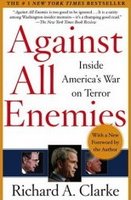
Posted 3/28/04 - Saw the interview, listened to the testimony, read the book, been mulling it over for a couple days, decided to post my thoughts ...

First, a comment on what this book is and what it is not: Clarke says it best in the preface:
"I began to feel an obligation to write what I knew ...This book is the fulfillment of that obligation. It is, however, flawed. It is a first-person account, not an academic history. The book, therefore, tells what one participant saw, thought and believed from one perspective. Others who were involved in some of these events will, no doubt, recall them differently." Richard Clarke – AAE preface page xi.
This should look familiar to all of us, the entire book is essentially what we do posting on blogs or political discussion boards, an extended personal perspective/rant on current events based on what we know and believe. In this case, the current event is specifically about the 10 year battle with Al Queda, the roots of the conflict, and the impact of the decision to liberate Iraq. There are, of course, some differences between the book and a blog post. The book is a little longer read than most posts, and Richard Clarke, with his 20 years service watching from "courtside", both on the bench and in the game, has a unique and important perspective on these events, unlike those of us limited to the view from the cheap seats in the nosebleed section.

To begin, a comment on the controversy of the day. Is Richard Clarke:
  1. A dedicated and respected patriot and public servant, committed to fighting the terrorist threat and sounding the alarm about how that war is and was being prosecuted.
  2. An opportunistic partisan, who has timed the release of the book, related interviews and charges to coincide with the 9/11 committee and have a maximum political impact on the Presidential election.
Afer reading the book, IMO, the answer is decidedly "Yes". These are not mutually exclusive views of Richard Clarke. He is both. Does he come across as biased, as a partisan in the book? Absolutely, but it is a uniquely Richard Clarke brand of partisanship. Not Republican/Democrat but rather a black/white distinction between those fighting with us and those fighting against us. And that line is drawn in the sand demarcating those who (in his view) understand the nature of the battle when fighting Al Queda, and those who do not. Very similar in spirit to GWB's "You are with us, or against us" ultimatum. Clarke arrives at a conclusion that the Bush Administration simply does not "get it". As a consequence, he feels that for the battle to be won, the administration must go. From this perspective, seeing this book as a partisan attack on the Bush administration is completely accurate. But from Clarke's perspective, the fact that this administration is Republican is irrelevant. He is seeing them simply as one more in a series of obstructions to fighting the real enemy. And just like he has spent 10 years bulldozing bureaucratic obstacles and clearing away policy obstructions to prosecute the battle against Al Queda, he will do everything he can do now to remove this perceived obstacle (the administration) to get the counter-terrorism fight back where it belongs. He is motivated by love of country, hatred of Al Queda, and a consuming guilt that he could have and should have found a way to stop 9/11. He fought this battle with his heart and soul for 10 years. Writing this book was cathartic for him, and gave him a chance to see his battle from a broader perspective. He obviously came to a realization, that through the book, he can still contribute to the fight. This emerges clearly in this comment from the epilogue:
"This book is, as I said in the Preface, my story, from my memory. It has helped me to tell it. I needed to tell you that we tried, tried hard to stop the big al Queda attack, that the professionals who sat at the Counterterrorism Security Group table cared, and would have given our own lives if that could have stopped the attacks. I had to admit that, strident as I was about the al Queda threat, I did not resign in protest when my recommendations to bomb the al Queda infrastructure were deferred by the Clinton administration or my appeals for "urgent" action were ignored by the Bush administration. Perhaps I should have. I needed to tell you why I think we failed and why I think America is still failing to deal with the threat posed by terrorists distorting Islam." RC - AAE (page 289)
So having covered the preface and epilogue, what about all that stuff in the middle. Clarke describes the roles he played for the Reagan, Bush(41), Clinton, and Bush(43) administrations, and the significant terrorism events that transpired during that time. All four administrations are praised and damned for their handling of the war. On balance, though, the Clinton administration clearly is portrayed in the best light. I see this as a consequence of the role that Clarke filled in that administration, and the unique working relationship he had with Clinton, one that was unusually close for someone who was essentially in a staff position. It is instructive to see how Clarke describes the "National Coordinator for Security Infrastructure Protection and Counterterrorism" role that was created, and held by him in the Clinton and early Bush administration:
"It had become pretty clear to Sandy Berger that terrorism and domestic preparedness were major problems, presidential priorities and should be among the very few growing budgets in Washington ... Berger thought we needed a "terrorism czar" and he wanted it to be me... I did not want to repeat that [Drug War Czar problems] and feared that the departments would see a czar as a challenge to their authority. Nonetheless, Berger floated the idea of a "National Coordinator" for counterterrorism ... Finally, just to make it clear that the National Coordinator was just a White House staff job, the directive contained language noting that he could not order law enforcement agents, troops, or spies to do anything, only their agencies could. Some czar. On balance, however it was a slight improvement to have a National 'Coordinator for Security Infrastructure Protection and Counterterrorism. With a title that long, however, it quickly became "Terrorism Czar" to the media. It was clearly an improvement to have ten programs with clear accountability and responsibility focused in the departments and agencies, but the notion that there was a Terrorism Czar, was misleading. In fact, what the departments had insisted on, and the White House had acquiesced to, was that there would not be a czar, with a staff, budget or operational decision making. I now had the appearance of responsibility for counterterrorism, but none of the tools or authority to get the job done." (pages 166-170)
I am a private sector guy, but I have seen jobs like this in large corporations with mixed results. At a large software company where I was once employed, we called it a "designer job". An overlay responsibility, but without direct lines of management authority to the "feet on the street" that were actually doing the work. These roles usually ended up being an ineffectual and impotent joke. But, with the right personality and strong support from the boss, this kind of role can occasionally be spectacularly effective in cutting through entrenched bureaucracy to advance a focused objective. Clarke had, by all accounts, an extraordinary level of interaction and support from President Clinton. He had deep relationships in all the relevant agencies, he was respected, had "friends in high places", and he was as knowledgeable about the Al Queda threat as anyone in government. Under Clinton, it all clicked. He forged the job into being a "go-to guy" for the President with a reputation as someone who could get things done. With his obsessive personality and the force of the POTUS behind him, he could twist arms, step on toes, and do whatever was needed to get action, Whether it was getting predators deployed in Afghanistan, appropriate measures taken in the Atlanta Olympics, or preparing for Millennium attacks, he was the man to get things done. But it is also clear, that the authority and effectiveness of the position flowed from relationships and personalities, and was not inherent in the role itself. Should it be any surprise then, that the role changes dramatically when you have a new president, a new administration and new staff in the beginning of 2001? It apparently was a surprise to Clarke.

Here are the simple facts. Al Queda was not a primary issue in the 2000 campaign. Bush and Gore were debating about which ABM system should be built, whether the US should be in the "nation-building" business, and whether the agreed increased military spending should be deployed on a "general build-up (Bush) or technological effectiveness (Gore). Al Queda was an after-thought ("Of course we need to fight terrorism! - Next subject."). Despite the Bin Laden 'declaration of war", in January of 2001 there were a grand total of something less than 30 dead Americans at the hands of al Qaeda. It did not look like it was on the front burner for the new Bush administration, because it was not. It was not on the front burner for anyone, except Richard Clarke and his team. When I was reading Clarke's (often self-serving) account of his bureaucratic battles to defend us from al Qaeda, I kept thinking, " this guy is like Ahab going after the white whale." Interestingly enough, Clarke then make this comparison himself, when relating his conversation with Condi Rice regarding transfer from the Counterterrorism Role to the Cyber Security Role in 2001 pre 9/11.:
"Winter had turned to Spring. The daily NSC meetings were filled with detailed discussion about the ABM Treaty and other issues that I thought were vestigial Cold War concerns. One day I saw an editorial cartoon of Uncle Sam sitting on a throne reading the ABM treaty, while a fuse ran down on a bomb beneath his seat and terrorist ran away behind him. The cartoon hit me hard. I asked to be reassigned ... "Perhaps" I suggested, "I have become too close to the terrorism issue. I have worked it for ten years and to me it seems like a very important issue, but maybe I'm becoming like Captain Ahab with bin Laden as the White Whale. Maybe you need someone less obsessive about it. " I assume that my message was clear enough: you obviously do not think that terrorism is as important as I do since you are taking months to do anything; so get somebody else to do it who can be happy working at it at your pace. We agreed that I would start the new critical infrastructure and cyber job at the beginning of the new fiscal year [October]." -RC -AAE (Page 234)
This paragraph is interesting for two reasons. Clarke is clearly venting to the reader about his frustration with the Bush administration. But he also is clearly not explicitly venting his frustration to his boss. He is resigning, and "assuming" that his message is clear. Bad assumption. There is no reason to expect that Condi Rice can read his mind over the reason one of her many staffers is resigning their role. In my experience managing people, I always made a point of taking what employees say at face value. You only get yourself in trouble by basing decisions on your mind-reading ability. Here we see the roots of the surprise, sense of betrayal, and resulting "set the dogs loose" over-reaction by the Bush administration to what Richard Clarke is saying now.

In the last Chapter of the book "Right War, Wrong War", Clarke lays out the case for why liberating Iraq was the wrong move in the war on terrorism. This is where I differ from his thesis in the book. I was and am a supporter of the Iraqi war. I won't go though all his reasons (its a long chapter), but it nets out to a thesis that Al Queda was still an imminent threat and Iraq was not. His analysis led me to question my support of Iraq war, and think about my reasons for supporting it a year ago. One advantage of being a long-time participant in political boards and blogs, is that you can go back and see what you actually thought as opposed to what you remember or want to remember. For me, it was not primarily about WMD's. This post was a distillation of my reasons for supporting the war:

=====
This is the point:

9/11 was caused by religious fanatics exploited as dupes and patsies by a megalomaniac with the resources and support of a rogue state (Afghanistan).

The first WTC bombing was caused by religious fanatics exploited as dupes and patsies by a megalomaniac with the resources and support of a rogue state (probably Iraq or Iran).

The Lockerbie TWA flight bombing was caused by religious fanatics exploited as dupes and patsies by a megalomaniac with the resources and support of a rogue state (Libya)...

It may be that we in the US are slow learners, as it sometimes takes a baseball bat to the head (like 9/11) for us to understand a threat that requires action. Regardless of our learning disabilities, it is clear to us now that Saddam Hussein is a megalomaniacal head of a rogue state, and that he has explicitly threatened and attempted carry out terrorist attacks against the US by exploiting religious fanatics and supplying them with the frightening resources at his disposal.

We cannot do much about religious fanatics in the short term. We can do something about the megalomaniacs with the inclination and resources to exploit them to their own political ends."
=====

Although I take issue with how the post-war occupation was planned (or not) and executed (or not), I still stand by that reasoning. I also find support in Clarke's book for that reasoning, although not in the way he intends it. In these quotes, Clarke bemoans the fact that America does not respond to a threat until there are thousands of body bags.
"Al Queda had emerged from the soil after the Cold War like some long dormant plague, it was on a path of its own, and it would not be swayed. And America, alas, seems only to respond well to disasters, to be undistracted by warnings. Our country seems unable to do all that must be done until there has been some awful calamity that validates the importance of the threat."(page 238-9)

"Beginning in the Reagan administration, U.S. policy had permitted he use of lethal force against a terrorist if the lethal act was necessary to stop a imminent attack. It was clear that there were going to be more al Qaeda attacks. What did "imminent" mean? Did we have to know the exact date of next al Qaeda attack in order to use lethal force?" (page 203)- RC - AAE
It was clear to me then, that given enough time and opportunity, Saddam would have found a way to exact revenge against Americans. The warning signs were as clear with Iraq as they were with Al Queda. We could quibble about how "imminent" the Iraq threat was, but I agreed with GWB, that we did not need to wait for more body-bags to address the threat.

Back to Ahab - Concluding thoughts on Richard Clarke: Obsessive focus on a single subject, as Clarke is/was focused on al Queda, can simultaneously benefit and impair vision. In the case of the object in focus (al Queda) this obsession can produce clarity of vision that may let him see what no one else does. That same obsession, however, may blind him to any other threats (Iraq) in comparison to the object of obsession.

No matter whether we agree with Richard Clarke about Iraq, the evidence of the last ten years is that when Richard Clarke is stridently warning that the "sky is falling" specifically about Al Queda and Islamic Fundamentalist Terrorism threat to the US, he has proven to be dead-on right. We have lost too many lives for not adequately heeding his warnings. For this reason alone, we should all take this dire prediction very seriously indeed:
"If WE DO NOT SHIFT ATTENTION back to where it should have been after September 11, we face the prospect of the following scenario by 2007: a Taliban-like government in Pakistan armed with nuclear weapons, supporting a similar satellite nation next door in Afghanistan and promoting Al Qaeda-like ideology and terror throughout the world; in the gulf, a nuclear armed Iran, promoting its own version of Hezbollah-styled ideology, an Saudi Arabia after the fall of the House of Saud, creating its own version of a fourteenth century theocratic republic. Under those circumstances, even if we had created a Jeffersonian democracy in Iraq, America and the world will be vastly less secure."Richard Clarke - AAE (page 284)
Three years to 2007. Seven Months to the election. tic-toc-tic-toc-tic-toc

--------------------------------------

That election has come and gone. We have another election in 6 weeks. 2007 is a few months away. In the intervening two years since I wrote this report, Richard Clarke is looking more and more like a prophet. The leaked NIE Report has confirmed that Richard Clarke was right in general, if not in the specifics. The Iraq war has made us less secure. And it can get worse in the next two years.

Whether or not the decision was right to occupy Iraq in 2003 has been rendered moot by the incompetence of this administration in executing the post-war planning and occupation. It could have been done correctly. It was not. Now we have a bigger problem.

We need new thinking. We need the single party group-think of this administration to be disrupted. We need power to be shared by an opposition party. We need divided government. We need it now.


Divided and Balanced.™ Now that is fair.

Just Vote Divided.