Showing posts with label Gridlock is Good. Show all posts

Sunday, July 30, 2017

Remember the bad old days of divided government?

We Miss Divided Government

We're now six months into One Party Rule - Republican Unified Government.

Hey! Remember all the social and mainstream media cries, lamentations, rending of garments and gnashing teeth about gridlock, divided government and partisan obstruction over the last six years? Guessing everyone is now enjoying our brand spanking new unified government! What? No? Huh.

Look, the Dividist is not one to say "I told you so..." Oh wait. Yes he is...

Americans may have a short memory, but we are once again learning to appreciate the finer points of a politically divided government. It's encouraging to see my fellow citizens coming to that realization much sooner than during the early years of unified government under either Republican Bush or Democratic Obama administrations.

Perhaps this is a good time to step away from the day-to-day West Wing tweet-storm / soap opera and consider some recent thoughtful essays on the nature and benefits of divided government.

Tuesday, February 16, 2016

Krugman and Klein on how the Scalia Supreme Court vacancy battle will destroy America.
Because "divided government."
Or something.

 
 Let's start with Paul Krugman and his usual understated dispassionate analysis...
Once upon a time, the death of a Supreme Court justice wouldn’t have brought America to the edge of constitutional crisis. But that was a different country, with a very different Republican Party. In today’s America, with today’s G.O.P., the passing of Antonin Scalia has opened the doors to chaos...
In his opening paragraph, in around 50 words,  Krugman manages to blame the GOP for "chaos", a "constitutional crisis", and losing America. All because the GOP controlled Senate may delay confirming a Supreme Court appointment for 9 or 10 months. Even by the standard of Krugman's usual vitriolic, polarizing, partisan hyperbole, that is an impressive pile of horseshit.


Of course this is nothing new for regular Krugman watchers. Who can forget his 2010 classic meltdown on the eve of the Republican takeover of majority control in the House of Representatives:

Monday, February 09, 2015

Gridlock is Good! (exclamation point optional)

Gridlock Escher
In January, the Congressional Budget Office published the 2015 estimate of federal spending, revenues, and deficit. On Groundhog Day, President Barack Obama released the administration's proposed FY 2016 Federal Budget. At the intersection of the two was a White House twitter-storm promoting the budget and taking credit for deficit reduction during the Obama administration.
The White House neglected to mention that the deficit reduction was primarily realized over the four years since the GOP took majority control of the House of Representative and divided the government. It takes a special kind of chutzpah for the President to complain about "mindless austerity" and congressional obstruction when they are the very reason for the declining deficit he is bragging about. But he did. The cognitive dissonance is only made worse by a few inconvenient facts:

Friday, January 23, 2015

Gridlock Is Still Good. Kind of. Most of the time.

Gridlock and Delegation in a Changing World
Illustration from Callander & Krehbiel - Gridlock and Delegation
The Dividist Papers regularly features academic scholarship from political scientists, economists, and historians explaining the benefits of divided government and gridlock.  The first entry in the "Gridlock is Good" series featured economist William Niskanen of the Cato Institute and Ohio University Economics professor Richard Vedder outlining the fiscal and economic benefits of gridlocked government. More recently, we featured University of Wisconsin Political Science Professor Marcus E. Ethridge, who made the case that our inefficient checked, balanced, and divided government is less susceptible to special interest influence and corruption than the more efficient executive branch agency rule-making process.

In this post we offer the latest edition in this series by Stanford professors Steven Callander and Keith Krehbiel.  In a Stanford Business School article Edmond Andrews introduces their paper:
"Americans are angry about partisan gridlock, but they also harbor mistrust about nonpartisan bureaucrats. Steven Callander and Keith Krehbiel, professors of political economy at Stanford Graduate School of Business, see it differently. In a recent paper, they apply game theory to understanding U.S.-style gridlock. Their conclusion: Two of the system’s most unpopular features — supermajority voting (as in the Senate filibuster) and delegation of authority to “unelected bureaucrats” — can together produce good outcomes."

Tuesday, February 08, 2011

Gridlock is really good. Really.

The Dividist has complained in the past about the propensity of pundits and bloggers to conflate the concepts of "divided government" and legislative "gridlock". The terms are often used erroneously as interchangeable synonyms. Yet, even the Dividist has occasionally employed this semantic shortcut, such as in the July, 2010 post "Gridlock is Good." In that post the beneficial aspects of partisan legislative gridlock was presented in the form of gridlock preventing a negative outcome - specifically stopping bad bills from being passed into law (see legislative abominations - Porkulus and Obamacare as examples of the damage done when one party has the power to pass legislation on pure partisan votes). The underlying common sense notion is that divided government and partisan gridlock prevent the worst instincts of either party from becoming law. When the moderating influence of legislative gridlock is bypassed, we get legislation no one really understands, except the special interests that helped craft it. So we are treated to the spectacle of our legislative leaders explaining that we won't know what sweeping legislation will accomplish until after it is signed into law. Our legislators may not know what they are passing, but once it gets to the agencies administering the law, the special interests do.

In a recent Cato Institute Policy Analysis, Marcus E. Ethridge (University of Wisconsin Political Science Professor) outlines a new positive argument for the inefficient, constitutionally divided, and often gridlocked legislative process. Ethridge offers a compelling case that our inefficient checked, balanced, and divided government is far less susceptible to special interest influence than the more efficient executive branch agency rule-making process preferred by Progressives impatient for rapid change.

Cato Institute Policy Analysis #672 - The Case for Gridlock:
"In the wake of the 2010 elections, President Obama declared that voters did not give a mandate to gridlock. His statement reflects over a century of Progressive hostility to the inefficient and slow system of government created by the American Framers. Convinced that the government created by the Constitution frustrates their goals, Progressives have long sought ways around its checks and balances. Perhaps the most important of their methods is delegating power to administrative agencies, an arrangement that greatly transformed U.S. government during and after the New Deal. For generations, Progressives have supported the false premise that administrative action in the hands of experts will realize the public interest more effectively than the constitutional system and its multiple vetoes over policy changes. The political effect of empowering the administrative state has been quite different: it fosters policies that reflect the interests of those with well organized power. A large and growing body of evidence makes it clear that the public interest is most secure when governmental institutions are inefficient decisionmakers. An arrangement that brings diverse interests into a complex, sluggish decisionmaking process is generally unattractive to special interests. Gridlock also neutralizes some political benefits that producer groups and other well-heeled interests inherently enjoy. By fostering gridlock, the U.S. Constitution increases the likelihood that policies will reflect broad, unorganized interests instead of the interests of narrow, organized groups."
This is an important read but not an easy one. Etheridge challenges conventional thinking about why special interests hold such sway over public policy. He explores the mechanism by which their financial and lobbying muscle are applied to maximum effect influencing public policy and resources in direct contradiction to the public interest and even legislative intent. Distilling his 20 page argument into a blog post is difficult if not impossible. We will instead excerpt a few representative paragraphs, comment briefly on salient points introduced in his analysis and encourage you to read the whole thing.

Tuesday, July 13, 2010

Gridlock Is Good

UPDATED: 15-July-10

Doyle McManus at the LA Times considers the challenges the GOP must face to press their advantage in November, and the challenges facing the country should they prevail and restore divided government:

A post-November congressional outlook: partisan gridlock
"But there's at least one potential problem for the Republicans: They haven't settled on a unified national message yet — and a quiet civil war is brewing over what, if anything, it should say. In one camp are House conservatives, led by Rep. Eric Cantor (R-Va.), the House minority whip, who argue that Republicans won in 1994 because the Contract with America laid out by then-Rep. Newt Gingrich (R-Ga.) articulated a coherent message around which candidates and voters could rally... Republicans, reportedly including Senate Minority Leader Mitch McConnell (R-Ky.), worry about finding a tent large enough to include all GOP viewpoints. Trying to come up with a single platform, they believe, could be divisive, and the party should simply embrace a few broad issues such as cutting taxes and spending. We're already winning, they argue; why get too specific and give Democrats a clearer target to shoot at?"
While messaging is important, McManus overstates the significance of the problem. There is simply not a tent big enough to encompass the full spectrum of policy positions held by those opposed to our One Party Democratic Rule, including: fiscal conservatives; social conservatives; Republican partisans; libertarians; independents; and the tea party movement. But there does not need to be a unanimity of policy preferences for the GOP to prevail. All they need in November is a common objective and general agreement that a key issue takes precedence over all others. My take -
  • The objective is restoring balance and restraint in our federal government.
  • The key issue is restraining the insane growth of spending and curtailing the fiscal irresponsibility exhibited by the Democrats and this administration.
The Tea Party movement is a microcosm of the opposition coalition, willfully misunderstood and mis-characterized by Democratic Party partisans. So far, the Tea Party has shown considerable political acumen and understand that social issues must take a back seat to economic issues in this election. In a nutshell - "It's the spending, stupid" - (Thank you again James Carville).

Sunday, August 26, 2007

Chalk up another one for divided government.

Stephen Slivinski, economist, author of Buck Wild, Director of Budget Analysis for the Cato Institute, and DWSUWF favorite, comments on recently released CBO budget estimates in "Finally, Some Not-So-Bad News on the Budget" posted at Cato@Liberty:
The big surprise in the Congressional Budget Office mid-year budget estimates released today isn’t that the year-to-year deficit shrank again. Or that the long-term liabilities in Medicare and Social Security continue to impend. The surprise is that federal spending will only grow about 3% in the current fiscal year that ends this October. That’s a big improvement over the annual average 7% growth we’ve seen since the first day of the George W. Bush presidency. How did that happen? Those familiar with my previous research will probably not be surprised to hear that the new political reality – divided government – has something to do with it... Earlier this year, the new Democratic Congress decided to put the federal budget on auto-pilot until October. Instead of passing new appropriations bills to fund the government for the entire year, they passed what is called a “continuing resolution” to keep the government operating. This didn’t happen because the Democrats were all that interested in spending less money. They just wanted to get the old budget work left to them by the outgoing Republican Congress off the table so they could get on with more ideological-base-friendly legislation, like the minimum wage increase. And the Democrats knew that the president might finally start vetoing legislation, too. A protracted battle over the budget wasn’t something they wanted to spend their energy on in the first half of the year. Thus, the auto-pilot continuing resolution: a piece of legislation that keeps the government running at basically the inflation-adjusted level of the previous year. With the White House veto strategy finally a credible threat, it looks like we might have a similar sort of outcome on spending this year, too. Isn’t divided government wonderful?
Good news. Since its inception, this blog has been in the service of promoting the concept of voting for divided government as a way of limiting the growth of federal government spending, among other beneficial effects. After divided government was re-established in the 2006 midterms we outlined assumptions for continuing to support this concept in the 2008 presidential election in the post - "2008 Election Prologue - Check your assumptions":

Assumption 1) The Divided Government hypothesis holds true to form.
We will have divided government for the next two years. Minimally, we expect to see restraint in the growth of spending and some evidence for more fiscal discipline on the part of the federal government. If that does not happen, the foundation for advocating divided government will collapse, and we will refocus on abalone diving on the Mendocino coast.
Looks like the abalone will have to wait. Divided Government Rules!

Reminder - We are one week away from the next edition of the Carnival of Divided Government. The Carnival of Divided Government Sextus Decimus- Special Labor Day Edition, will be posted on or about September 3rd, 2007. Blog articles may be submitted for the carnival of divided government using the carnival submission form. Past posts can be found here or on our blog carnival index page.

Divided and Balanced.™ Now that is fair.


Tuesday, September 12, 2006

All we are saying, is give divided government a chance.


Certainly, disgruntled conservatives are not a new phenomena this electoral season. God knows, this crop of big spending, big deficit, big government congressional Republicans under the mantle of this big spending, big deficit, big government President certainly gives conservatives plenty to be disgruntled about.

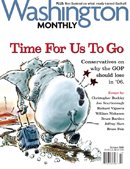
But disgruntled conservatives explicitily calling for a divided government in 2006 by voting for a Democratic majority in Congress? That is news. This week in the Washington Monthly, seven conservatives write in "Time For Us To Go" why the GOP should lose in 2006 .

In the lead off essay "Let's quit while we're behind", Christopher Buckley concludes with this stirring admonition:
"My fellow Republicans, it is time, as Madison said in Federalist 76, to “Hand over the tiller of governance, that others may fuck things up for a change.”
I just cannot imagine how tough it is for a conservative to write a column titled "Bring on Pelosi" as does Bruce Bartlett:
"Those who worry that divided government would compromise our efforts in Iraq shouldn’t be overly concerned. As the minority party, Democrats today are free to criticize our efforts in Iraq without having to offer constructive alternatives. But put them in the majority, and they’ll suddenly have to put up or shut up. Let them defund the war and implement an immediate pullout if that’s what they really think we should do. At least it would force the administration to explain itself better and face some oversight, for which the Republican Congress has essentially abrogated all responsibility." [Update: E.J. Dionne in his Washington Post column today "Democrats Answer Cheney", shows the loyal opposition is finally finding its voice.]
Joe Scarborough pulls no punches in an amusing screed "And we thought Clinton had no self-control":
"This must all be shocking to my Republican friends who still believe our country would be a better place if our party controlled every branch of government as well as every news network, movie studio, and mid-American pulpit. But evidence suggests that divided government may be what Washington needs the most."
Can't you just imagine William Niskanen picking up a guitar and singing a duet with Yoko Ono while sitting on a bed in a Montreal Hotel: "Give divided government a chance"? Um. Nevermind. Neither can I. In the article Niskanen repackages and freshens some of his previous work on divided government.

Thursday, April 27, 2006

Thesis: Divided Government is Better Government
A Lot Better.
Really.

"Facts are stubborn things" - Ronald Reagan

The thesis for this blog is based on a simple documented fact, that our federal government works better and is more fiscally responsible when executive and legislative power is split between the parties.

Niskanen
This fact has been shown conclusively in an article by William A. Niskanen, chairman of the Cato Institute and former acting chairman of President Reagan's Council of Economic Advisers. Quoted below are the facts he outlines in the article. I repeat: These are facts, not opinion from an analysis of every president since Eisenhower. As Niskanen shows and states:

" The rate of growth of real (inflation-adjusted) federal spending is usually lower with divided government.

The table below presents the annual percentage increase in real federal spending by administration, in each case with the percentage increase in the first year of a new administration attributed to fiscal decisions made in the prior administration." 
Administration Years Divided/United Annual % Increase
Eisenhower 8 D 0.4
Kennedy/Johnson 8 U 4.8
Nixon/Ford 8 D 2.5
Carter 4 U 3.7
Reagan 8 D 3.3
Bush 4 D 3.4
Clinton 8 D 0.9

"The only two long periods of fiscal restraint were the Eisenhower administration and the Clinton administration, during both of which the opposition party controlled Congress. Conversely, the only long period of unusual fiscal expansion was the Kennedy/Johnson administration, which brought us both the Great Society and the Vietnam War with the support of the same party in Congress. The annual increase in real federal spending during the current Bush administration, by the way, has been 4.4 percent -- not a happy state of affairs, given the war and a renewed majority of the president's party in both chambers of Congress."
- A Case for Divided Government by William Niskanen, May 7, 2003
Vedder
In another article with the same title as this blog, Richard Vedder (Professor of Economics at Ohio University and author), analyzed gridlock vs. non-gridlock government from 1971-1997 and arrived at a similar conclusion:


"When looking at three measure of economic well-being during the gridlock and non-gridlock years, without exception, the record is superior in the years of gridlock. The median unemployment rate was almost 15 percent lower in the years of split control than in the years when one party (in this case, the Democrats) had complete control. The stock market in the typical year rose nearly three times faster than when power was divided. Even inflation, nominally controlled by the supposedly independent Federal Reserve System, was lower in a typical gridlock year." 
This chart, from the same article summarizes his findings:


Gridlock Years


Non-Gridlock Years
Median Unemployment Rate


5.6%


6.5%
Inflation Rate
(% Change, CPI)


4.4


7.8
Annual % Change, Dow-Jones
Industrial Average


12.1


4.3
SOURCE: U.S. Bureau of Labor Statistics, Council of Economic Advisers, author'’s calculations.
These are not new articles and this is not breaking news. But, as an analysis of historical fact, their conclusions are as fresh and relevant today as when they were written. Certainly nothing has transpired in the single party, undivided, non-gridlock, no veto, no fillibuster government of the last six years that would counter the conclusions in these articles. In that time we have seen nothing but increasing federal spending, creation of new bureaucracies, breathtaking record deficits, and government growth that rivals LBJ's Great Society.

"A" is "A"
Facts are Facts. Truth is Truth. At some point, if you value the objectives of limited government and fiscal responsibility over party loyalty, you must stop listening to what politicians say and vote based on what they do. The logical vote, to meet these objectives, is a vote for divided government. In 2006, that means voting Democratic. If the Democrats take Congress and look like they will maintain control in 2008, it also means voting Republican for President in 2008. You can still support voting for Republican candidates in the mid-term 2006 election, you just cannot pretend that you are supporting anything except increasing government spending, increasing the size of the federal government, and increasing the federal deficit during the last two years of this administration if you do. If you pull that Republican lever in November, I hope you will look in the mirror and say "I am asking for increasing government spending, increasing the power of the Federal government, and increasing the Federal deficit." I can assure you, if we continue with single party control of the federal government, you will get exactly what you are asking for.

Questions, Questions:
  • Can this knowledge of how our federal government behaves be parlayed into a voting strategy and a voting block?
  • Can a small voting block shift the balance back to more fiscally responsible government, to better government, to divided government?