Showing posts sorted by relevance for query "now is the time". Sort by date Show all posts

Monday, November 22, 2010

Monday Midterm Miscellany

This was to be the Friday Flotsam feature, wherein the Dividist takes a stroll down the metaphorical beach of the DWSUWF blog and takes note of the detritus that has washed ashore and cluttered his little island of rationality in the great big blogospheric ocean. Even though it is not Friday, we'll do it anyway. The beach is a mess.

We are surrounded with the flotsam and jetsam of the midterm election cruise ship that sailed past a few weeks ago and is now little more than a dot on the horizon. Left behind - a variety of midterm topics the Dividist intended to blog about, but now serving as a distraction to the lame duck session, START treaty, foreign policy, tax cuts, the 2012 Presidential election season, and more looming memes.

ITEM - Blog news and annoying blogger affectations.
The Dividist has belatedly begun the process of cleaning up the sidebars, removing 2010 campaign contribution badges, and rearranging gadgets that were relevant to the midterms, but less interesting now. The Dividist is also working with some of the new Blogger templates, thinks the old blog is long overdue for a makeover, and will be looking to spruce the place up over the holidays. Stay tuned.

Finally your loyal blogger noticed that he has been referring to himself in the third person with increasing frequency of late, using the Dividist® moniker he recently shelled out good money to register as a trademark. The Dividist finds this habit annoying on other blogs, and is unsure why he thinks The Reader would think any differently about this blog. The Dividist hopes this is just a phase he is going through and will drop the affectation soon.

ITEM - Good Predictions, Bad Predictions and the end of the "100 Year Rule".

The Dividist is in the habit of making election predictions, and 2010 was no exception. Days after the 2006 midterm restored divided government, he assessed his 2006 prognostications (more right than wrong), misquoted Ayn Rand, and looked forward to 2008. Similarly, after the divided government candidate lost the presidential election in 2008 he looked forward to 2010 and 2012 with fear, loathing and some more predictions. Time to face the music.

Net net, although the Dividist predicted GOP pickups, he concluded there was no way for the GOP to restore divided government in 2010, thinking they simply were in too deep a hole to crawl out in one election cycle. Variations of that same prediction were repeated on this blog in the 10 in 10 series without much change until recently. These bad predictions were influenced by his fidelity to the "100 Year Rule" - as, up to 2010, it was a reliable historical precedent that the House never flipped party control unless the Senate flipped first or concurrently. It was a rule that had never been violated since the US began directly electing Senators almost 100 years ago.

As they say, precedents are made to be broken and happily the Dividist was wrong. We now have divided government and a divided congress as a consequence of the GOP retaking majority control of the House. It's all good.
The "100 year rule" will never be mentioned again. Another homily that is on the verge of being retired is "All Politics is Local". For the last three cycles, "All Politics is National" has been a better rule of thumb.

In the future, I suggest The Reader pay more attention to the Dividist's co-blogger Tully's predictions. He has a better track record.


ITEM - Michael Reynolds owes the Dividist a bottle of 15 year old Laphroiag

He has already contacted me via e-mail, and I'm sure that he is good for it. But - in light of his other poor prognostications - the Dividist feels justified in crowing about this well documented winning wager.


ITEM - Divided Government meme was a far more popular blog topic in the 2010 election than in '08 or '06.
In each of the last three elections, there has been a spike in blog postings about divided government as election day approaches. This effect was magnified dramatically in 2010. The Dividist has used Nielson's BlogPulse trend search tool to measure blogospheric interest in each of the last three elections. This is a great little tool that returns a graph showing the percentage of all blog posts in the entire blogospheric universe mentioning any search term over time.

In 2006, Divided Government posts peaked at .007% of all posts or 7 out of 100,000 posts on the peak day (NOTE - this is out of the universe of all blog posts, not just politics - including emo Japanese teen girl fashion diaries and pron blogs - just sayin... its a small percentage of a big universe). In 2008 divided government posts peaked at slightly less, or about .0065% (6.5 posts per 100,000) shortly before the election. Assuming the blogosphere is itself is expanding (I think a safe assumption), that would still indicate an absolute increase in blog posts on the subject, although slightly less as a relative percentage of all posts. In 2010 divided government posts peaked at around .014% or 14 posts per 100,000 - more than a doubling of blogging interest over the prior two cycles. Make of that what you will.

ITEM - California is financially fracked, and the Democrats are now completely in charge. What could go wrong?
The Dividist has been careful to only advocate a divided government voting heuristic at the federal level where there is substantial historical evidence and scholarship to support the rationale. The Dividist does not know if the same dynamic works at a state level. With a state as big as California and a bicameral legislature similar to the federal, he suspects it does. In any case, we are about to find out. With Ahnold in Sacramento, we had a quasi-Republican governor to balance the heavily Democratic legislature. No more. The Dividist is clearly out of step with a majority of his fellow Californians, who are perfectly content to have the Democrats run everything in Sacramento and to be represented in Washington by a Senator who is simply an embarrassment to the state.

Jerry Brown is our Governor-elect. San Francisco Mayor Gavin Newsom is Lt. Governor-elect. The legislature is a blue as it ever was and the entire state government is now as blue as it gets. Despite being one the most highly taxed states in the union, the state is facing the biggest financial crisis in it's history, in no small part due to union featherbedding and pension deals cut for state workers who are - shock - big contributors to California Democrats.

Brown promised in the campaign that there would be no new taxes unless approved by the voters. That is good, unless he was lying. What are the odds? Californians also passed propositions that prevent Sacramento from raiding local municipality revenues, prevents them from raising taxes unilaterally by calling them fees, but permits the budget to be passed on a majority (vs. 2/3 supermajority) vote. That pretty much only leaves big spending cuts to solve our financial problems and requires only a simple majority of Democrats to pass them. The California Democratic legislature now has the opportunity to fix the problems that their fiscal irresponsibility created. They have all the keys to power. There is no one else to blame. There are no excuses. Okay California Democrats - you created the problem- you own the problem - now fix the problem.

ITEM - The Tea Party Giveth and Tea Party Taketh Away -or- Funny, you don't look libertarianish.
The Dividist does not think anyone can deny that the energy and enthusiasm of the Tea Party movement was the fuel that drove Republican success in the House of Representatives. However, The Dividist also does not think anyone can deny that, given what happened in the House, the GOP underperformed in the Senate. Weak Tea Party supported candidates in Delaware, Colorado, and Nevada probably did cost the GOP control of the Senate. If the Senate finished 51-49, there was a reasonable possibility that Joe Lieberman and Ben Nelson could have flipped parties to give the GOP control of the Senate. At 53-47, that possibility is off the table.

That said, the Dividist is very excited about the Tea Party supported Rand Paul win. For the first time, there will be a libertarianish voice in the Senate.

The Dividist views Senator-elect Rand Paul in the same category as Senator Bernie Sanders. Sanders is a self described socialist, representing a small minority of the electorate, but the people of Vermont choose to give this ideology a voice in the Senate. The people of Kentucky have now given the libertarian-leaning a voice in the Senate, and for that the Dividist is grateful. The Dividist is considering switching from single malt scotch to Kentucky bourbon in his honor.

The left appears to be particularly unhappy about Paul, but they should not be. Rand Paul will be as much a thorn in the side of Republicans as Democrats. When it comes time to cut spending – Rand Paul will not hesitate to put Defense spending and our overextended and wildly expensive global military footprint on the table. The Dividist may even convert to Aqua Buddhism.


ITEM - Republicans are in position to take the Senate Majority in 2012. Unless they don't.
Much has been made of the structural advantage the Republicans will have in the 2012 Senate races, a point the Dividist has been making since 2008. Of the 33 Senate races up for consideration 23 seats are currently held by Democrats. Moreover, many of those Democrats are among the putative moderate/conservative class of Democratic Senators that won narrow races in red states, on the strength of the 2006 Democratic wave. In that class are Webb in Virginia, McCaskill in Missouri and Tester in Montana. The complete list:

2012 Democratic Senate Incumbents

  • Dianne Feinstein of California
  • Tom Carper of Delaware
  • Bill Nelson of Florida
  • Daniel Akaka of Hawaii
  • Ben Cardin of Maryland
  • Debbie Stabenow of Michigan
  • Amy Klobuchar of Minnesota
  • Claire McCaskill of Missouri
  • Jon Tester of Montana
  • Ben Nelson of Nebraska
  • Bob Menendez of New Jersey
  • Jeff Bingaman of New Mexico
  • Kirsten Gillibrand of New York
  • Kent Conrad of North Dakota
  • Sherrod Brown of Ohio
  • Bob Casey, Jr. of Pennsylvania
  • Sheldon Whitehouse of Rhode Island
  • Jim Webb of Virginia
  • Maria Cantwell of Washington
  • Joe Manchin of West Virginia
  • Herb Kohl of Wisconsin
  • Joe Lieberman of Connecticut
  • Bernie Sanders of Vermont

2012 Republican Senate Incumbents

  • Jon Kyl of Arizona
  • Richard Lugar of Indiana
  • Olympia Snowe of Maine
  • Scott Brown of Massachusetts
  • Roger Wicker of Mississippi
  • John Ensign of Nevada
  • Bob Corker of Tennessee
  • Kay Bailey Hutchison of Texas
  • Orrin Hatch of Utah
  • John Barrasso of Wyoming

It is hard to overstate how important the Delaware, Colorado, Washington, California and Nevada wins were for the Dems in 2010. The more seats they put in the bank this cycle, the better the chances of surviving likely 2012 losses. Although the odds are still against them, it is certainly conceivable that with an improved economy, some serious course corrections by the administration, and the possibility of even more help from the GOP (by nominating candidates as bad as Angle and O’Donnell) they can limit their net losses to 3 seats in 2012 and retain the Senate majority.

Webb, McCaskill and Tester can still carry the day in 2012 by taking a consistent and strong fiscal conservative voting record into the election and showing independence from the Democratic leadership over the next two years. Representative Jason Altmire in Pennsylvania is a model for Democrats like these who want to be re-elected. He also arrived in Congress on the 2006 wave, winning in a Republican district. Since then he has won re-election twice more and survived the 2010 GOP wave. He did not vote for Obamacare or Cap & Trade, and never stops talking about restraining spending and fiscal responsibility. Let the Democratic Senators who have eyes to see and ears to hear, see, hear and understand. Amen.

Another factor that is not getting as much attention, is the GOP can also lose 2-3 seats in 2012. It is axiomatic that in a wave election like 2010, the surging party retains all incumbent seats. There is no reason to believe that 2012 will be a wave election like 2010, which puts GOP seats also at risk. Certainly it is an open question whether Scott Brown can hold his seat in Massachusetts. It is also a realistic possibility the GOP/Tea Party will help out again by running more clowns in Republican primaries who will then lose against Democratic incumbents. There is already talk of primary challenges for Olympia Snowe and Orrin Hatch. Realistically, the numbers are stacked heavily against the Democrats, but the 2010 Senate Republican performance has opened the door a crack for the Democrats to squeeze through and retain the Senate in 2012.


ITEM - The Dividist will be changing teams again for 2012

There are three ways that our brand spanking new divided government can continue past the 2012 election.
  1. The Democrats could retain the Senate majority. The Dividist considers this unlikely since 23 of the 33 seats up for reelection are held by Democrats, many of them swept in on the 2006 Democratic wave. Possible, but as noted above, they’ll be on defense and structurally have a much tougher row to hoe than in 2010.
  2. The Democrats could lose the Senate and retake the House. The Dividist thinks this is extremely unlikely, given the depth of the hole they have dug for themselves in the House.
  3. Barack Obama could be re-elected. In all cases (excepting an improbable Dem 2012 wave retaking the House and retaining the Senate), the easiest vote to ensure divided government past 2012 will be to vote against the GOP presidential candidate and re-elect Barack Obama. That is the way The Dividist sees it now, and if nothing changes that will be the way The Dividist votes. [Caveat - there is one wild card that bears watching.]

The last time the Dividist changed teams was after the Democrats swept Congress in 2006 and it became clear that the only way to keep the government divided was to elect a Republican President in 2008. It took the Dividist until December of the following year before he was confident enough in his forecast of the political winds for 2008 to prepare himself mentally and formalize the change.

Changing teams in support of a political objective is, of course, incomprehensible to partisans who are psychologically incapable of voting for anyone outside of the their preferred party for President, Senate, or House of Representatives. Partisans generally subscribe to some variation of the “My party is on the side of angels and the other party is the spawn of satan.” school of politics. Their vote at the federal level votes is as predictable as sunrise and sunset and they represent the vast majority of the electorate.

At least 70% of the electorate and probably closer to 80%+ vote as partisans, regardless of whether they choose to label themselves by their party of preference or as an independent. Political Scientists show conclusively that most self-identified "Independents" are closet partisan voters.

Not that there is anything wrong with that. Some of the Dividist's best friends are partisans. He thinks the correct way to to think of Partisan Dead Weight (PDW) is as ballast - so long they stay roughly balanced on the right and left, they provide stability for our ship of state. It is because of them that a relative sliver of the electorate who are true independents, who will really swing their vote at a federal level between the major parties, can dramatically change the complexion and direction of our government.

UPDATED: Fixed typos, added and repaired links.

Divided and Balanced.™
Now that is fair.


Monday, November 17, 2008

Monday Miscellany - Special Bear Market Blues Edition

The blog has been a bit neglected over over the last week or so. I have been mesmerized by the continuing economic train wreck and stock market derailment happening right before my eyes. When I could tear myself from CNBC, I found a few items from around the sphere you might enjoy find informative:

ITEM - Chicken Little was right.
This video is getting a lot of play around the blogosphere. If you have not seen it, or ever wondered why no one saw this financial crisis coming, it is well worth a few minutes of your time. It is not that no one saw it coming. It is just that no one listened when Peter Schiff patiently explained that the sky was falling over these last three years (Hat tip to Justin at Donklephant):


Peter Schiff is a regular contributor to CNBC and Fox Business News, was a financial adviser to Ron Paul's presidential campaign, and is President of Euro-Pacific Capital. In case you were thinking, "Gee, It is too bad that no one was listening to him..." well, it is not too late. We can listen to him now. From his most recent economic commentary:
"With the Big Three auto makers now in a plainly visible death spiral, the automotive bailout debate is kicking into overdrive. The disagreement hinges on whether a bailout is necessary to support an important industry or whether the unprofitable dinosaurs of the past should be allowed to fail as America focuses on an information-age, service sector, and alternative energy future. As usual, both sides have it wrong. The government should let the Big Three fail not because we no longer need an auto industry, but because we desperately do. What we do not need is the bloated, inefficient auto industry that we have today. By allowing the Big Three to fail, their capacity will be turned over to new owners who will be able to acquire the means of production at fire sale prices and hire workers at globally competitive wages. The result will be a more efficient auto industry making cars that people around the world actually want to buy at prices they can afford. Such auto makers could conceivably be profitable and could become the cornerstone of a manufacturing renaissance in the United States. In contrast, Ford, Chrysler and GM are never ending money pits that threaten to swallow a good deal of our economy."

ITEM: About that debt swallowing our economy...
The next time you see pundits arguing for massive new federal spending and borrowing to stimulate the economy, and justifying it on the basis that government debt is still less (as a percentage of GDP) than it was under FDR, consider this graph. Hayman Advisors calls it "the most frightening chart we have seen...
"... is one that compares total credit market debt to U.S. GDP. The average of this ratio over the last 100 years has been around 155%. The ration peaked first heading into the Great Depression at 260% (after then falling back to 130%) but has now risen to an unprecedented 350%."
Lance at QandO quotes Henry Blodgett's explanation:
"From the early 1920s through 1985, the average level of debt-to-GDP in this country was 155%. The highest peak in history (until the recent debt boom) was in the early 1930s, when debt-to-GDP soared to 260% of GDP. In the 1930s, the ratio then cratered to 130%, and it remained close to that level for another half century.In 1985, we started to borrow, and last year, when we got finished borrowing, we had borrowed 350% of GDP. To get back to that 155%, we need to get rid of more than $25 trillion of debt... The banks have written off $650 billion so far. So we suppose that's a start."
Think again about what Peter Schiff was saying about the debt that led to this crisis. Look again at that chart. Consider the solutions being pushed through Congress to stimulate the economy, bail out the big three auto makers, and subsidize keeping people in their homes. We have a problem that was created by too much government spending and lax monetary policy encouraging easy credit that precipitated too much debt, with a market distorted by the catalyst of massive government intervention to meet the social goals of permitting unqualified borrowers buy homes they cannot afford. And the solution being promoted? More government spending, loose monetary policy to provide easier debt, and much more market distortion from massive government intervention to meet social goals of propping up failed companies and keeping unqualified borrowers in homes they cannot afford. This strikes me as - what is the technical term? - batshit insane.

ITEM: The President-elect inspires confidence.
Steve Kroft conducted a great interview with the new first family on 60 Minutes last night. Obama and Michelle come across as genuine, warm, intelligent and confidence inspiring. It made you feel like the country really made the right choice. Well, it did until the President-elect said this:
Kroft: "Where is all the money going to come from to do all of these things? And is there a point where just going to the Treasury Department and printing more of it ceases to be an option?" Mr. Obama: "Well, look, I think what’s interesting about the time that we’re in right now is that you actually have a consensus among conservative Republican-leaning economists and liberal left-leaning economists. And the consensus is this: that we have to do whatever it takes to get this economy moving again, that we’re gonna have to spend money now to stimulate the economy. And that we shouldn’t worry about the deficit next year or even the year after. That short term, the most important thing is that we avoid a deepening recession."
Well Mr. President, you might consider whether it is prudent to continue digging furiously, when we are already deep in a hole over our head. But I guess it is best not to think about that right now. After all, it won't be us, but our children and grandchildren that be repaying China for the money we are continuing to borrow to fund all this new spending.

  Item: Corporate Welfare and outsourced government monopoly is not the same as a Free Market

Among the most annoying assertions to found in a blogosphere chock-full of mindless claims, are pundits and bloggers declaring that the current economic clusterfork is an example of the failure of free markets. Roderick Long takes this nonsense head-on in the lead essay for this month's excellent series at Cato Unbound: In "Corporations vs the Markets - or -Whip Conflation Now" Long takes Conservatives, Liberals and Libertarians to task for the sloppy linguistic conflation of big business, corporate welfare, and "private-public partnerships" with a free market. Of the three, I find his indictment of Republicans and the Right most damning:
"If libertarians’ left-wing opponents have conflated free markets with pro-business intervention, libertarians’ right-wing opponents have done all they can to foster precisely this confusion; for there is a widespread tendency for conservatives to cloak corporatist policies in free-market rhetoric. This is how conservative politicians in their presumptuous Adam Smith neckties have managed to get themselves perceived—perhaps have even managed to perceive themselves—as proponents of tax cuts, spending cuts, and unhampered competition despite endlessly raising taxes, raising spending, and promoting “government-business partnerships.” Consider the conservative virtue-term “privatization,” which has two distinct, indeed opposed, meanings. On the one hand, it can mean returning some service or industry from the monopolistic government sector to the competitive private sector—getting government out of it; this would be the libertarian meaning. On the other hand, it can mean “contracting out,” i.e., granting to some private firm a monopoly privilege in the provision some service previously provided by government directly. There is nothing free-market about privatization in this latter sense, since the monopoly power is merely transferred from one set of hands to another; this is corporatism, or pro-business intervention, not laissez-faire. (To be sure, there may be competition in the bidding for such monopoly contracts, but competition to establish a legal monopoly is no more genuine market competition than voting—one last time—to establish a dictator is genuine democracy.) Of these two meanings, the corporatist meaning may actually be older, dating back to fascist economic policies in Nazi Germany; but it was the libertarian meaning that was primarily intended when the term (coined independently, as the reverse of “nationalization”) first achieved widespread usage in recent decades. Yet conservatives have largely co-opted the term, turning it once again toward the corporatist sense."
It is only when the term "free market" is severed from any historical definition or conventional meaning that the current economic crisis can be explained as a government rescue of a "free market" failure. To solve a "free market" problem that was created by too much government spending, too much government debt, too much easy government sponsored credit, and a market distorted by massive government intervention (along with a large helping of corporate criminal fraud that slipped through the regulatory framework) we are now given to understand that we need to increase government spending, government debt, and create more market distortions with more government intervention. Yeah, that should work. I feel better already. 

 ITEM - Carnivalingus
Some recent collections of high quality blogging punditry which I have neglected to highlight:
UPDATED: Fixed typos, added links


Divided and Balanced.™ Now that is fair.

Monday, August 06, 2007

Now is the time for one good man to come to the aid of his party.

I read Kyle Michaelis' posts at the New Nebraska Network for local Nebraska perspective on my preferred presidential candidate - Chuck Hagel. Kyle is a Democrat, and not - shall we say - politically aligned with Hagel's conservative ideology. Still, he usually has an interesting perspective, and can't help but display an occasional grudging, back handed admiration for Hagel in his posts. His two most recent posts focused on Hagel's presidential prospects: Chuck Hagel's Identity Crisis and "Signs of Life in "Hagel for President??". Kyle's assessment:
"It's certainly possible, however, that the Republican establishment for which Novak speaks is starting to wake to just how dire a situation they face in 2008 - to the point that they'd welcome a candidate like Hagel who could never truly be called an "anti-War" candidate but who might be able to pass himself off as "anti-Bush"...despite his being Bush's most consistent supporter in the U.S. Senate. Assuming such an "anti-Bush" candidate could survive a primary, that would be a pretty strong credential to carry in to the general election when two-thirds of the country actively disapproves of Bush's job performance."
I could take issues with a couple of Kyle's points, most notably his assertion that Hagel could not be called an "anti-war" candidate. He certainly could, and is, and should. He actually has more credibility in that regard than two of the three leading Democratic presidential candidates Hillary Clinton and John Edwards. However, I completely agree with Kyle's major point with this one modification -

The next President will not simply be anti-Bush as Kyle outlines. The next president, whether Republican or Democrat, will be "The AntiBush". The electorate always grows weary of two-term presidents and tends to gravitate toward their optical opposite. That electoral sense is magnified ten-fold with this administration. There is such a high degree of antipathy, exhaustion, and loathing for this President and this administration, that the electorate will reach for a perceived polar opposite like a drowning man reaching for a bit of floating debris. I suspect that this is the underlying reason for Clinton's strength in the Democratic party. Clinton/Bush opposition is hard-wired in the names themselves. You can see it any Republican/Democratic partisan argument which inevitably devolves to "Oh yeah? Well Bush did this!" - "Oh yeah? Well Clinton did that!" - "Oh yeah? Well Bush did this!" - "Oh yeah? Well Clinton did that!" ad nauseum. Hillary Clinton is the Democratic Party AntiBush.

Republicans will also nominate an AntiBush. No less a Republican luminary than Newt Gingrich has said that Republicans will have to run against Bush to succeed. While we are going to see a number of "born-again" anti-Bush Republicans before the primary season is over, there is only one credible candidate who can fill the shoes of The AntiBush. We are not talking about Senate votes here. We are talking about perception and optics:
  • Bush is inarticulate, Chuck Hagel is a powerful and coherent speaker.
  • Bush is proudly anti-intellectual, Hagel is an intellectual.
  • Bush is a failed businessman, Hagel is a successful entrepreneur.
  • Bush is a "decider" that manages by delegation and stays out of the details, Hagel is an idea man that can and has formulated policy and legislation.
  • Bush is perceived as shallow and partisan, Hagel exudes gravitas and integrity, and has demonstrated his willingness to buck his own party.
  • Bush is perceived as incompetent, Hagel is perceived as hyper-competent.
  • Bush avoided service in Vietnam and has a questionable military record. Hagel is a Vietnam combat veteran and is a bona fide war hero.
  • Bush is a "neo-conservative"/"compassionate conservative" ideological mess. Hagel is a rock solid conservative in the Reagan/Goldwater tradition.
Richard Nixon used to invoke a "silent majority" that would emerge in elections to support his policies. To a large degree, he was right. The "silent majority" was there, and supported him, right up until the time he betrayed them and their conservative sensibilities. I can offer no supporting documentation, but I believe there really is an "embarrassed majority" out there, both within the Republican Party and the electorate at large. The "embarrassed majority" voted for Bush, regrets it, and has yet to be heard from in a meaningful way. Perhaps the "none of the above" preference in a recent AP poll of Republicans is indicative of the "embarrassed majority" that will rally behind a Hagel candidacy.

I have no idea what Chuck Hagel will do about running for President. I do know what he should do. He should run. He should run as a Republican. He should run as a Republican that can restore the party to the bedrock conservative tradition of Ronald Reagan and Barry Goldwater. He should run as a Republican that can restore the fusionist alliance between fiscal and social conservatives that is pre-requisite to any Republican electoral success. He should run as an anti-war Republican. He should run as The AntiBush.

I'm a fan of Chris Mathews Hardball and watch it regularly. They are currently running a promotion soliciting viewers to send them homemade campaign videos. I checked out the ones they had posted, and decided they are pretty lame. So I says to myself - "Self - you can do lame campaign videos with the best of them." This is my contribution:

Now is the time...


Hagel's staff has not asked me, but I have some free advice for them. There are three themes/messages that a "Hagel for President" campaign should focus on and hammer over and over again.
  1. "It's the war, stupid." - Hagel is the only credible anti-war Republican (except for Ron Paul - but the problem with Ron Paul is that he is Ron Paul).
  2. Hagel is The AntiBush - (See above)
  3. Hagel is a real conservative. - Unlike Bush, Cheney, or most of the current crop of Republican candidates.
This video hits on the first two of the three. I know, I know - two themes in one video is one too many. That is why this video is too long at two minutes. Hey - this is strictly amateur hour - you get what you pay for.

If Hagel gets in the race, I 'll put together another video that focuses on the third theme, and the large difference between him and the faux /politically expedient/fickle conservatism of the other leading candidates. Stay tuned.

Saturday, November 04, 2006

Bartender! - Another Rum & Mac. Make it a double.

We are back at the Repeating History Bar, and the drink of the day is once again the Rum & Mac on the rocks.

I am updating and reposting this, as it is even more relevant now than when I originally (and incorrectly) stated on Labor day that Rumsfeld's resignation/firing was imminent. The point of this post was that Rumsfeld has presided over such breathtaking incompetence in the prosecution of the Iraq occupation, that the Republicans could not maintain a majority in Congress if he retained his post. Now, here we are, two months later, Rumsfeld is still in his post, and the Republicans are days away from losing at least one house of Congress. I was wrong about the resignation timing, but right about the consequences.

On a compaign swing this week, President Bush stated that "he wanted Defense Secretary Donald H. Rumsfeld, the top architect of the war... to remain with him until the end of his presidency". With that statement, George W. Bush pounded the last nail in the coffin of three Republican Senate candidates who have called for Rumsfeld to go: Mike Dewine of Ohio, Tom Kean in NJ, Cynthia Theilen in Hawaii.

His statement reinforces the key point of this post. George W. Bush practices a private sector hands-off management style that (when implemented correctly) demands accountability from and replacement of direct reports that fail to meet agreed objectives. Problem being, despite his frequent empty rhetoric about accountability, this President has not held Donald Rumsfeld accountable for his failure in Iraq. This simply passes all understanding, and is another reason why it is important that a divided government/Democratic congress be elected on Tuesday.

On Monday, November 6, an editorial will appear in the "must read" newspapers of our military - the Army Times, Air Force Times, Navy Times and Marine Corps Times. It begins with this quote ...
"So long as our government requires the backing of an aroused and informed public opinion ... it is necessary to tell the hard bruising truth." - Marguerite Higgins
... and ends with this admonition:
"Rumsfeld has lost credibility with the uniformed leadership, with the troops, with Congress and with the public at large. His strategy has failed, and his ability to lead is compromised. And although the blame for our failures in Iraq rests with the secretary, it will be the troops who bear its brunt. This is not about the midterm elections. Regardless of which party wins Nov. 7, the time has come, Mr. President, to face the hard bruising truth: Donald Rumsfeld must go."
What more need be said? We need a Congress that will accept the responsibility that the executive branch has abandoned, and impose the oversight and accountability on Rumsfeld and the execution of this war that the executive branch has failed to implement.

The original Labor Day post:

Robert McNamara (Secretary of Defense '61-'68) from "The Fog of War":
"I had this enormous respect and affection, loyalty, to both Kennedy and Johnson. But at the end, Johnson and I found ourselves poles apart... And I said to a very close and dear friend of mine, Kay Graham, the former publisher of the Washington Post:"Even to this day, Kay, I don't know whether I quit or was fired?" She said, "You're out of your mind. Of course you were fired." ... Something had to give. There was a rumor that I was facing a mental breakdown. I was under such pressure and stress. I don't think that was the case at all. But it was a really traumatic departure. That's the way it ended. Except for one thing: he awarded me the Medal of Freedom in a very beautiful ceremony at the White House."
Let's see, a President caught between the "rock" of growing unpopularity of a costly war, and the "hard place" of affection and loyalty for the Secretary of Defense / architect of that war, and completely convinced of the correctness of his own administration's actions in that war.

I have seen this movie before, and I remember how it ends.

Rumsfeld is history. It is only a question of time and timing. Rumsfeld resigns as soon as a replacement is identified and agreed. Is it politic to wait until after the mid-terms, or to act now? My guess - He resigns within the week and (since we are already out on a limb, might as well climb out on the small branches) John McCain is the new Secretary of Defense.

The Democrats are ramping up for a Rumsfeld Rip-Fest. A non-binding resolution declaring "No-Confidence" in the Secretary of Defense will be offered by Democrats in Congress on Wednesday. The outrage is being rehearsed and the purple prose is being prepared as we speak. Democrats are salivating to take their pound of Rummy flesh while demonstrating their oratorial skills on you-tube, c-span, and the nightly news (in that order).

Rove and the Republicans know exactly what is coming, and no one has ever accused them of being politically naive. What better way to take the air out of the expanding Democratic political balloon than by announcing Rumsfeld's resignation before the speechifying starts? What better way to respond to all those speeches, than to keep them on the shelf? Paradoxically, the shit-storm around Rumsfeld's recent comments has handed the administration a perfect face saving opportunity to strike a potentially game changing blow in the 2006 political season. Rumsfeld can play the misunderstood, misquoted, patriotic, loyal soldier, taking a bullet for the team, while the media takes the blame. Here is his speech: - "Even though my words have been misreported and misrepresented, I cannot allow my words and my presence to become a distraction, and a detriment to the important work facing the President and the American people in this war against terror." The President expresses his regrets, and appoints a universally respected unassailable warrior in his place. In a couple of weeks, Rumsfeld gets his medal, and we move on.

Will it happen? Just ask yourself - Can the Republicans maintain the majority with two months of continuous Rumsfeld/Iraq War bashing between now and the election? On the other hand, can they possibly pull it out with a "fresh start" and a new voice calling for a new direction on war?

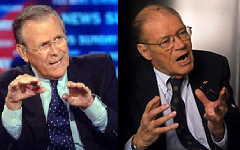
Done Deal.Rum & Mac on the cover of Time magazine.
Coincidently each cover appeared two years before their respective resignations.

Politics are the wrong reason for this move , but it is still the right move for our country. We really need a change. We need new thinking from our leadership on this war and we need it right now. Take this example from Rumsfeld's speech: "The extremists themselves call Iraq the “epicenter” in the War on Terror." This just begs the question (and I mean fully prostrate plaintive begging) of exactly Why did the extremists not think that way, before we occupied the country? But lest I be accused of "moral and intellectual confusion", let us just call this one more instance in the continuing series of what Rumsfeld and other adminstration officials now seem perfectly comfortable saying - to whit: "mistakes were made" in the prosecution of the war.

So let's get to the right reason for getting rid of Rumsfeld. It is understandable in the "fog of war" that "mistakes are made". The American people can accept that. But when the stakes are thousands of American soldiers lives, tens of thousands of civilian Iraqi lives, hundred of billions of dollars, and staring into the abyss of a failed policy, it is not acceptable for there to be no consquences when "mistakes are made". We are not talking about small mistakes or a minor misjudgement here:
This is a breathtakingly large mistake. This is not, as Rumsfeld said in his Tuesday speech simply a matter of "As the nature of the threat and the conflict in Iraq has changed over these past several years, so have the tactics and the deployments. " This was a big-time, world class screw-up, and someone has to be accountable and take the fall.

Bush and Cheney are elected, so barring impeachment, that only leaves the Donald. The change can be justified purely on the failure of tactics/strategy which I do not need to further belabor here. Anton Kaiser, retired U.S. Army Lieutenant Colonel and Vietnam vet, does a much better job than I can explaining "Why Rumsfeld Should Be Fired For not learning the lessons of previous conflicts."

There is another reason, and it has to do with the President's management style. His leadership has been likened to a private sector CEO . This quote summarizes his style as well as any "Bush's 10 common-sense leadership lessons: Hire smart, build trust, talk straight, and leave aides alone..."

This is a classic private sector management style. If you get the right team in place, it is highly effective. I can speak from personal experience, having managed large and small teams most of my professional career. My greatest success in business was using this style when I had a great team working for me. They made me look like a genius and left plenty of time for golf and pontificating on how to win in business.

The problem centers on the word "accountability", a word that GWB uses frequently, but does not seeem to apply to his direct reports. With that management style, "say what you'll do, do what you say" is the mantra. It is incumbent to have clear agreed objectives, and if the objectives are not met, immediate replacement is expected. If you, as the leader, are not going to get deep in the details yourself, then your only tool for managing performance is changing personnel when agreed objectives are not met. If you do not, then you have abrogated your leadership responsibility.

I am not going to go into details of "coulda, shoulda, woulda" in Iraq. That particular dead horse is being continually beaten every day throughout the blogosphere. George Will explains why "Regarding Iraq, there will not soon be an Eisenhower moment. " (i.e. just stop the war - as in Korea). My point is simple. Regardless of the specifics of how we got here, regardless of how long we need to stay, it is absolutely clear, that we are not now where we expected to be in Iraq, and the same guys that did the planning and then executed the plan that got us here are still in charge.

Accountability demands that Bush replace Rumsfeld. Sometimes change for the sake of change is the right answer. Bush put Rumsfeld in the pilot seat of a plane that took off from New York and was flying to Paris, but instead, landed in San Francisco. The fact that he is still flying the plane, is a reflection of a boss that does not understand the meaning of the word accountibility.

Since the President does not understand this principle of accountability, it must be applied another way:

Divided and Balanced.™ Now that is fair.

Just Vote Divided.


Friday, January 03, 2014

Friday Flotsam
"Warmists in Paradise" Edition

Scientists demonstrating climate change, or Antarctic weather,
or the heartbreak of cellulite, or something.*

Welcome to Friday Flotsam, an occasional feature serving as an end-of-week blog catch-all. It seems apropos to use this vehicle to  collect stories and photos associated with the aborted Australasian Antarctic Expedition (AAE) that captured social and mainstream media attention this week.  So without further ado, time for the Dividist to stroll down our metaphorical beach ice floe and take note of the detritus that has washed ashore and cluttered this little island ice-locked bay of rationality in the great big frozen blogospheric ocean.

Monday, June 15, 2009

Carnival of Divided Government - Duo et Trîcênsimus -
Special "No Special Day" Edition

Welcome to the 32nd edition of the Carnival of Divided Government- The duo et trîcênsimus June 15 Edition. DWSUWF has posted many special editions of this carnival over the last few years, including the recent Special St. Patrick's Day edition, Special Chinese New Year Editon, Special Bad Attitude Election edition, Special Halloween edition, etc. Today we post the "No Special Day" edition , as we are more than a bit late for the originally planned "Special Memorial Day" edition. This is best. Our carnival is a bit too cynical and flippant for as somber a holiday as Memorial Day. Of course, as this is the first "No Special Day" edition in over two years, this edition is more special than all the others.

As explained in those earlier editions, we have adopted Latin ordinal numeration to impart a patina of gravitas reflecting the historical importance of the series. In this the Carnival of Divided Government duo et trîcênsimus (XXXII), as in all of the CODGOV series, we select volunteers and draftees from the blogosphere and main stream media writing on the single topic of government divided between the major parties (leaving it to the reader to sort out volunteers from draftees). Consistent with this topic, the primary criteria for acceptance in the carnival is to explicitly use the words and/or concept of "divided government" in submitted posts. A criteria that, to our endless befuddlement, is ignored by many of the bloggers submitting posts, which sadly results in DWSUWF reluctantly ignoring their fine submissions.

Carnival

We begin with Michael Kinsley and an op-ed in the Washington Post - "Change - You asked for it":
"High-church moderates like to claim that a government with the power split between the two parties is desirable. They even claim sometimes that the voters consciously choose divided government, or that they are sending a message that they want sensible compromise and are tired of partisan bickering, etc., etc. Moderistos do not explain how a particular voter would go about doing these things. (How would you even know which way to split your ticket to make sure that you're not just canceling out the votes of a fellow divided-government enthusiast?)"
Interesting. Apparently DWSUWF is a "high-church moderate." I don't even know what that means. More to the point Michael - while I have no idea whether many (or any) voters "consciously choose" divided government, I know they should. And it is just not that hard to figure out how to vote for divided government.

This particular "moderisto" divided government advocate has been explaining how to vote for divided federal government for a number of years now. It is really quite easy. In 2004, the divided government vote was obvious. It was a vote for John Kerry and failed. In 2006, the divided government vote was obvious. It was a straight vote for Democratic party legislators and succeeded. In 2008, the divided government vote was obvious. It was a vote for John McCain and failed. In 2010 the divided government vote will be a straight vote for Republican legislators and will likely fail to achieve that goal, but will hopefully close the gap in preparation for 2012. In 2012, the divided government vote will be for Republican Senators, and/or the Republican nominee for President. It very well may succeed, with Republicans retaking either the White House, or (more likely) the Senate, with the Dems retaining control of the House of Representatives (and maybe the presidency).

None of this is meant to imply that the divided government vote will always be obvious. Indeed, in 2007 DWSUWF addressed exactly this question - What if there is no obvious "divided government" vote? The updated answer:
If the "divided government vote" is not obvious, if reasonable people can argue about what the correct "divided government" vote should be, then there simply is no "divided government" vote for that election. In that circumstance, the moderate/libertarian divided government voting block would go "free agent." There are several easily identifiable situations where it will be completely obvious that there is absolutely no divided government vote. As a hypothetical example: Although the Democrats structural advantage in the Senate race in 2010 make it extremely unlikely that the Republicans can take either house, if the GOP were by some miracle able to retake the Senate, and the Democrats hold the House of Representatives, we would go into 2012 with a divided Congress that is likely to stay that way. This means the presidential vote in 2012 would have no divided government preference (assuming that historical incumbent advantages hold.) It simply does not matter which party the president belongs to, as the congress and the government would still be divided. In that case, the moderate/libertarian/dividist vote becomes "free agent" with a counter-intuitive preference for incumbents.
Whether we can succeed in restoring the greater fiscal responsibility and better governance that comes with divided government will depend on many factors. A critical factor will be whether "moderistos" of good conscience understand why it is important, and vote to make it happen. At least this blogger will continue to do what he can to promote the divided government voting heuristic. Hope this clears it up for you Michael.

Some Republicans have already picked up the gauntlet, recognizing and promoting what will likely be the best argument to vote Republican in 2010 and 2012. Pat Toomey is a Republican running for teh Senate in Pennsylvania. I have no idea whether he has any real prospect of succeeding, but I sure like what he is saying in this Harvard Crimson guest editorial, picked up by the Morning Call and linked by The Centrist - "History tells us one party rule often leads to excesses.":
"In the present age, we have experienced again the consequences of unchecked, one-party dominance. From 2001-2007, Republicans controlled both houses of Congress and the White House. At the height of its power, following the 2004 elections, Republicans had a 55-seat Senate majority and a 232-seat House majority. Some party leaders got carried away and pursued policies that grew their own power at the expense of American taxpayers. Their unlimited power led to runaway spending, an explosion in obscenely wasteful and parochial earmarks, a lack of transparency, and once again corruption that sent several Congress members to court and some to prison... Over the past five months, the Democratic monopoly has expanded the federal government by historic proportions. It began with further taxpayer-funded bailouts of Wall Street and the auto companies, then extended the bailout fever to the housing industry. After campaigning on a promise to end the Republicans' tenure of irresponsibility, full Democratic control in Washington has produced policies that reward rampant irresponsible behavior and penalize innocent and responsible taxpayers who are forced to foot the bill. Still, there's more. A unified Democratic government passed a partisan $787 billion stimulus bill and another $410 billion spending bill. After promising to end the Republican tenure of pork-barrel spending, these massive bills included titanic lists of pork projects. The projected budget deficit for the fiscal year 2009 grew to $1.8 trillion, or a shocking and nearly unprecedented 12.3 percent of our gross domestic product. They then proceeded to pass a new record-breaking $3.6 trillion budget for the upcoming year. Unchecked power pushes parties to excess regardless of which party is in power."
Too true. But unless a meaningful percentage of the voters ( 5-10%) start voting based on what politicians do as opposed to what they say (even if said politician is really really good at crafting and delivering what they say), we are still going to suffer the abuses, fiscal irresponsibility, bad governance and excesses endemic to single party rule.

The view from the Ivory Tower

Academics across the political spectrum have taken note of the apparent lack of any constitutional or legislative constraint on Obama's exercise of executive power under single party Democratic rule. Unsurprisingly, the left-leaning are much more sanguine about the Obama unitary executive, despite it being identical in overreach and carrying the same constitutional risk as the Bush unitary executive. Case in point, Sandy Levinson, who is beating the drum for fundamental constitutional changes to constrain the executive branch (among other perceived deficiencies) and blogs about his choice for president at Balkinization with the hand wringing post "Further notes on a constitutional dictatorship":
"..when presidents are not faced with "hostile majorities" in Congress, they can increasingly count--especially if Republican--on the lemming-like loyalty of congressional majorities who are especially delighted to provide not an ounce of the oversight that the naive might believe attach to a separation-of-powers system. And, of course, even when George W. Bush was faced with divided government in 2007-2009, he was still able to exercise quasi-dictatorial powers with regard to military and foreign policy. But enough of Bush bashing. After all, the President who seems determined not to hold any high-ranking member of that Administration accountable for disgracing the country and making us less safe to boot by adopting torture as a national policy is Barack Obama, to whose campaign I contributed and for whom I happily voted (and whose presidency, overall, still leaves me delighted). But surely we should recognize that the American version of "constitutional dictatorship" is built into our system and not simply a function of character. "
It strikes me as odd that Professor Levinson still manages only the most perfunctory expressions of concern at the identical exercise of quasi-dictatorial powers when it is this administration issuing edicts as opposed to the last. And as far as the "lemming-like" congress, I am failing to see the distinction that Levinson discerns between the "lemming-like" current congress and the "lemming-like" Republican congress under GWB. I can only surmise the good professor feels it is reasonable to be "delighted" with a "constitutional dictator", as long as he is in the right party.

Professor John Buck, blogging at Economic Perspectives, displays some frightening graphics on our collective accelerating debt, but offers some mushy thinking when he questions "The virtues of politcal dissension?":
"A glance at the annual change in the U.S. public debt since 1940 suggests the abandonment of fiscal responsibility can more easily be blamed on the ascension of supply-side economic doctrines with the election of Ronald Reagan in 1980 and the popularity of tax cuts, rather than the lack of divided government from 2001-2006. Using the Welches´ questionable logic, one could just as easily have argued the opposite point - that divided government is detrimental to the economy. In the recessions of the early 1980s, the White House and Congress were controlled by different parties. The same can be said for the 1990-1991 recession. The 1992 elections when Bill Clinton won the presidency and Democrats gained control of the House and Senate initiated a decade of prosperity and economic growth. So which is it? I think the answer is there is no correlation between economic prosperity and whether the U.S federal government is divided."
Like any good partisan, the professor does not permit facts to get in the way of a grand sweeping conclusion that confirms his partisan bias. There is a clear correlation between divided government and reduced rate of spending increases and growth of federal government. This has been documented by economists like Niskanen and Slivinski among others. I actually thought the correlation might have been broken when Obama took office, and indeed it would have if Obama had lived up to his moderate campaign rhetoric. While the rate of federal spending increases under the last two years of divided government in the Bush administration were less than the previous six years of profligate spending by the single party Republican government, it certainly was still an easy target to beat if Obama chose to demonstrate any inkling of fiscal responsibility. He did not. Instead he chose to steamroll the Democratic House of Representatives stimulus pork barrel spending plan through Congress and the wildly irresponsible massive deficit increases of the Democratic budget, saddling the country with back breaking debt that cannot be repaid without devaluing the currency. His disingenuous rhetoric about halving the deficit and advocating "paygo" is laughable after forcing through a budget that quadruples the budget under a suspension of "paygo". But he gets a free pass from the professor. After all, as the professor concludes in his post, it is really not about facts or policy, but "What matters is the INDIVIDUALS in positions of power...". In other words, everything is ok, as long as Obama does it. Even if it is the exact same or worse policy as George W Bush.

At the Library of Economics and Liberty, Professor Arnold Kling reaches a depressing conclusion in his post "Why I fear a one party state.":
"I am not upset with political trends because I want Republicans to win. I am upset because I foresee a one-party state. Even if neither party is particularly libertarian, gridlock and competitive checks and balances are better for libertarians... as hard as it is for many people to admit it, the political equilibrium of competitive balance is gone for the next decade. For now, the only two elements of the political system are Progressive Corporatism and The Resistance. And the latter does not amount to much yet."
FWIW professor, you can count DWSUWF in The Resistance. It still does not amount to much. Yet.

Professor Kling's co-blogger at Econlog - Professor Bryan Caplan - is willing to put money on his somewhat less pessimistic prognosis in his post "One Party Democaracy is not coming.":
"There is also some evidence that unified government is less libertarian than divided government (see here and here for starters). I should add, though, that the effect is not huge, and Singapore is a striking counter-example. Nevertheless, I disagree with Arnold's claim that one-party democracy is likely to happen in the U.S. He assures us that, "it is quite easy for a one-party government to emerge when there are ethnic blocs and a large public sector relative to the private sector."
Small comfort, but a comfort nevertheless.

For additional comfort we might look to Jennifer Rubin writing at Commentary who looks at a Gallup poll and infers that "Independents Seem to Like the “No” Crowd":
"It might be that independent voters think back fondly on the days of divided government, when gridlock protected them from political extremism and the passage of every bad idea that popped onto the majority party’s agenda. It may be that all that spending and debt really has rubbed them the wrong way. Or maybe all that “We won, lock out the Republicans” stuff isn’t what they had in mind."
Flap at FolloseusFlaps Dental Blog looks at a more recent Gallup poll and comes to a similar conclusion in his post "Political Party Affiliation Now Tied – 11 Point Swing Towards GOP":
"Quite an interesting trend if this poll is not an outlier. Interestingly, the same thing happened after Bill Clinton was elected President. In 1994, the first election after Clinton’s 1992 election, the GOP captured the House majority for the first time in over 40 years. Is the reason that American voters prefer divided government with no one party in complete control or has there been a Democrat, Obama overload?"
The Republicans likely are too deep in a hole to climb out in the mid-terms, but if they can narrow the gap it will bring us closer to a divided government in 2012. However, it would be very helpful for the GOP to follow the first rule of holes - stop digging.

Here comes the Judge

Divided government occurs when one party does not exercise control of both the executive and legislative branches. As observed by Professor Levinson, constitutional separation of powers break down when "lemming-like" majority Congressional Democrats abrogate their constitutional oversight responsibility over a Democratic President, as is happening now, just as when "lemming-like" majority Congressional Republicans abrogated their oversight responsibilities under President Bush. Without divided government, only the Judicial branch offers any hope of imposing constitutional constraints on the the power of the presidency.

After eight years of Bush judicial nominations, the silver lining under the dark cloud of our current single party government was the prospect of balancing appointments to the judiciary in general and the Supreme Court in particular. As I've said before, my fervent hope is that Obama will appoint judges who will declare many of his administration's actions on civil liberties unconstitutional - particularly in the area of habeus corpus, search and seizure, surveillance, and detentions without trial. To that end, based on what I have seen thus far in the MSM, DWSUWF supports the Sonia Sotomayor nomination to the Supreme Court.

The nomination has prompted some disparate divided government musing across the sphere.

According to David Stras writing in SCOTUS Blog, absent moderating influences like divided government, Obama has a virtually free hand in this selection. Such are "The politics of the Sotomayor nomination":
"As I have outlined in my essay in the Northwestern University Law Review, the traditional indicators of political constraint in this process–such as the presence of divided government, a short time until the end of a President’s Term, the preferences of the median and filibuster pivots of the Senate, the approval ratings of the President, and the criticality of a particular nomination to the composition of a court–all pointed in favor of a relatively unconstrained choice for President Obama... it is extraordinarily likely that Judge Sotomayor will be confirmed in time for the first Monday in October."
The man that Judge Sotomayor is likely to replace on the court, Justice David Souter, had some cautionary comments worth considering in a recent speech. I found his comments particularly resonant when considering the young Obamites delighted with the unconstrained power being wielded so freely by their favorite "constitutional dictator". As reported by the Washington Times:
"Supreme Court Justice David H. Souter on Wednesday warned that America's civic core is floundering in an address to the nation's judicial leaders, including two women considered potential successors for the retiring justice. Mr. Souter said the nation's troubles in educating citizens about the importance of democratic principles and the philosophy of divided government are a threat to democracy. "It is being lost," he said Wednesday afternoon at Georgetown Law School. "It is lost if it is not understood."

Finally, frequent carnival contributor, humorist and limericist Madeleine Begun Kane also weighs in on the nomination with "Karl's Roving Standards" posted at Mad Kane's Political Madness, saying, "While this doesn't use the phrase "divided government" it's very much about its effect on U.S. Supreme Court nominations." Hmmm.... Ok Mad... Lets see:

Karl’s Roving Standards
By Madeleine Begun

Kane Rove’s memory’s certainly short.
Back when dealing with names for the Court,
He said Dems must not nix
Any Bush judgeship picks
Based on views that they failed to support.

But now that the tables are turned,
He says Dem nominees must be spurned
If Republicans think
That their politics stink.
Consistency? Karl? Unconcerned!
Madeleine is a wonderful political humorist and I love her work, even when I disagree with her politics. However, whenever a partisan accuses another partisan of hypocrisy, as the talented Ms. Kane does here, the riposte is always absurdly easy to craft - just flip-flop the argument or in this case - the verse:
Citizen Kane's Court
by mw

Kane’s memory is equally short.
Back when dealing with names for the Court,
She demanded Dems nix
Any Bush judgeship picks
Based on views that she failed to support.

But now that the tables are turned,
She feels no nominee should be spurned
as long as Madeleine is feeling
their politics are appealing.
Consistency? Mads? Unconcerned!
Finally, Bobo at The Bobo Files had some nice things to say about our efforts here and some thoughtful comments on the problems with our two party system in his post "Not all great minds should think alike.":
"I’ve been following Divided We Stand, United We Fall for quite some time now - he contributes to The BoBo Carnival of Politics frequently. The premise of his blog is that we should keep the Federal government divided. We should in no way ever allow a supermajority in the government as it will cause this great nation to fall, and fail. No time like now has this ever been proven to be more correct... If you are either a Republican or a Democrat and you have found that your party no longer represents your values - the best solution now is to become an independent... The solution is to shed the parties and vote as an Independent or find one of the “third-parties” out their that is actually closer to your own values. The Democrats and the Republicans are both taking America down the same path of destruction and none of them have a backbone any longer. The two-party system is corrupt... It’s time for we regular everyday Joe Schmoe Americans to rise up and let D.C., local, and state politicians know that we want our country back. If our votes don’t matter to them any longer they will no longer have our financial support either. We will show them with our votes at the ballot box and we’ll reject everything they stand for. We need to make them fear us."
Agreed. An interesting element here, is that in our partisan polarized political environment it will only take a relatively small percentage of true independents voting consciously and consistently for divided government to make a big difference. Something for disillusioned Republicans and Democrats alike to consider.

Miscellany

Traditionally, we conclude this Carnival by including one "off-topic" submission, as a grudging acknowledgment and proxy for the many off-topic submissions received. Off-topic in this context meaning - no mentions of "divided government" or gridlock. For this issue we offer Allison Bricker reading the MIAC report and asking "Does Supporting the Constitution Make Me a Terrorist?" posted at The Smoking Argus, saying:
"During the course of the previous administration, both officials and their old-media shills demonized individuals who dared speak out against the Bush Doctrine as unPatriotic, unAmerican, and/or traitors. Now we are told by socialist scribes6 that dissenting against the “economic terrorism” id est the central bank manipulated credit crisis, is also unpatriotic. If we are no longer allowed to question or criticize the government’s domestic or foreign policies without being painted as homegrown radicals, is there any semblance left at all of our republic? Should I instead just pledge blind allegiance to President Obama and be content with my “right” to criticize a group of B-list celebrities or no talent wannabee singers on “Dancing with the Stars” or “American Idol” respectively?"
Not going to happen. Not for Allison. Not for me.

And with that we conclude this edition. Thanks for stopping by, and thanks for all of the submissions (on-topic or not).

As previously announced - since this carnival is focused on the topic of Divided Government, and seeing how voters spectacularly rejected the idea in the last election, and with no real prospect of restoring divided government before 2012, we have put this carnival on a reduced publication schedule over the next year. Instead of monthly, we'll go quarterly or - you know - whenever I feel like it.

Look for the next edition of The Carnival of Divided Government XXXIII - Special "Be Late for Something Day" Edition on September 5th. Which I anticipate being late and actually publishing on Labor Day - September 7. As we head in to the end of year, and in anticipation of the 2010 mid-terms, I expect to restore the monthly CODGOV publication schedule. In the meantime, submit your blog article at carnival of divided government using our carnival submission form.

Divided and Balanced.™
Now that is fair.