Monday, August 16, 2010

The Carnival of Divided Government
Triginta Undêvîgintî (XXXIX)
Summer of Our Discontent Edition

Welcome to the 39th edition of the Carnival of Divided Government - The Special Summer of Our Discontent Edition.
Pass the Prozac

With the primaries wrapping up and Labor Day fast approaching, the mid-term election lollapalooza is about to kick into high gear, but few seem happy about it. This year's extravaganza features a Democratic administration kicking it's base, liberals bitterly complaining about the Democratic Party, Tea Party Conservatives attacking establishment Republicans, and Ivory Tower conservatives decrying the hoi-polloi that energize the Republican base. Independents and libertarians have decided the only thing worse than voting for the GOP, is leaving the Democrats with all the keys to the castle. Surely....

Now is the summer of our discontent
Made inglorious winter by this "post-partisan" pretender
And all the clouds that sullied our representative house
In the deep bosom of the speaker lay buried.
- not William Shakespeare

Carnival of Divided Government

As explained in earlier editions, we have adopted Latin ordinal numeration to impart a patina of gravitas reflecting the historical importance of the series. In this the Carnival of Divided Government Triginta Duodêvîgintî (XXXIX), as in all of the CODGOV editions, we select volunteers and draftees from the blogosphere and main stream media writing on the single topic of government divided between the major parties (leaving it to the reader to sort out volunteers from draftees). Consistent with this topic, the primary criteria for acceptance in the carnival is to explicitly use the words and/or concept of "divided government" in submitted posts. A criteria that, to our endless befuddlement, is ignored by many of the bloggers submitting posts, which sadly results in The Dividist reluctantly ignoring their fine submissions.

First up, Michael Gershon writing at the Washington Post analyzes the Democrat's tactics for the midterms and finds them lacking in "Democrats tactics worsen their problems":
"Democrats see the House slipping away, their Senate majority threatened and a president now too divisive to profitably appear in many districts. So how have national Democrats decided to respond? With a series of tactics that make their worst problems worse.

First is the depiction of Republicans as the "party of no," populated by obstructionists blocking needed measures to create jobs and improve the economy. Vice President Biden recently applied this critique to the stimulus package. "There's a lot of people [who] at the time argued it was too small," he said. If it had not been for Republican opposition, "I think it would have been bigger." No doubt it would have been.

This is Biden's response to American economic anxiety: If Democrats had even greater control in Washington -- even larger influence than holding the presidency and both houses of Congress -- they would have spent more than $862 billion on the stimulus. Rather than allaying the fiscal concerns of independents, Biden is actively feeding these fears -- thereby making the case for the moderating effects of divided government."
Exactly. "It's the spending, stupid."

David Harsanyi of Reason Magazine agrees, finding the Democratic Party tactic of painting Republican candidates as crazy extremists to be a bit absurd considering their record of the last two year. He asks the question "Who's the Radical":
"First, the GOP should concede that it does have a few quirky candidates running around the country who lack the political sophistication of, say, an Alan Grayson or a Maxine Waters. Are these Republican oddballs a bit batty? For sure. But unlike, say, the "stimulus" legislation, a plan to uncover the Hawaiian bunker with the president's Indonesian passport probably won't cost taxpayers $1 trillion and millions of jobs. What's worse, after all, suffocating the economy or being a bit cautious? Also, please keep this in mind: Nationalizing health care is not radical. Tripling the budget deficit in two years isn't, either. Republicans also can—if they stick to free-market rhetoric and stay away from any insinuation of armed insurrection—continue to be seen as the more moderate party. "
David correctly identities the operative question - "What's Worse?" - Electing a few incompetent and potentially batty Republican legislators to the mix? - Or - Permit One Party Rule by the Democrats to continue batshit insane out-of-control levels of government spending and debt? Clearly, the moderating influence of divided government is the more rational choice.

Billy Hollis at Questions and Observations does not think it matters whether Republicans or Democrats are behind the wheel as we drive headlong over the cliff - "The Republicans Are Lost: A Continuing Saga":
"For establishment Republicans, the name of the game is not leading the country. It’s gaining and holding onto power. That, of course, is why so many of us see so little difference between the parties – the Democrats have the exact same goal. The time is almost certainly coming when that game makes our economic and political system so unstable that establishment politicians get their playing field yanked out from under them...

Until then, enjoy the football game this November, and cheer for your team as you watch the election returns, but understand that we won’t get any difference that really matters. Yes, Obama’s hard left ideology will be blunted, and I also prefer divided government to what we have now. But the big goal is reversal, and we’re just not yet in bad enough shape for that to happen. A GOP victory this fall just means a small delaying action against the coming reckoning."
Billy is a bit too pessimistic - even for me. Sure, we don't know if our injured patient is going to survive. But the wounds will not have a chance to heal unless we first slow or stop the bleeding. Divided Government is a tourniquet. Let's apply the tourniquet in 2010, then we can focus on curing the patient.

Mark Thompson, a member in good standing in the Coalition of the Divided, strikes a similar note of disgust with the current incarnation of the GOP in a comment on his own comment which was commenting on another comment on his post at The League Ordinary Gentlemen - "While Engaging in Spittle-Flecked Rants":
"I’m under no illusions that the Democrats are firm believers in my understanding of limited government. But if you want me to think of the GOP as anything other than a foil in a blessedly divided government, then the GOP will have to explain exactly how it intends to limit government. Otherwise, I’ll just continue to look at the years 2000-2008 (not to mention 1981-1992, and definitely not to mention Wage and Price Controls Nixon) and at the refusal to touch Medicare, and at the insistence on increasing the size of the defense budget and at the insistence that the federal government has the right to arbitrarily violate property rights of politically unpopular groups and at the insistence that we should, like, totally start a new war against Iran, and at the refusal to find ways to pay for any of this whatsoever and think: they have not learned, they really have not learned."
I agree with everything that Mark says about the GOP, but the simple fact remains - voting for a "foil in a blessedly divided government" is a good enough reason to vote Republican in 2010.

Karl in the Hot Air Green Room nicely distilled both the problem with and the polling evidence against the Democratic election strategy succeeding in 2010, while also noting "Dems still blaming Bush, everyone else is moving on":
"The Democrats’ message of “We May Be Incompetent, But They’re Crazy” may work in provable cases (and perhaps depress indie/moderate turnout) but not in general. Some voters seeking a divided government won’t care if the GOP candidate is “crazy,” “extreme,” etc. Others want to believe things can get better, and will convince themselves the GOP is a suitable alternative. "
How absurd is the Democratic claim the Republicans are " unfit to lead" by pointing to fiscal irresponsibility with unfunded profligate spending and fighting two wars resulting in doubling the budget deficit over eight years, wehn they then ask voters to ignore their one party rule with even greater unfunded profligate spending and expanded war efforts tripling the budget deficit in two years. This is delusional thinking.

Scott Galupo, writing at U.S. News Politics & Policy invokes Ross Douthat, and concludes the mental dysfunction is not with Republicans or Democrats, but with the voters - asserting that "Vacillating Voters Lean GOP? They'll Like Obama Again in 2012":

"The generous interpretation is that voters subconsciously function like a Keynesian thermostat: ensuring that federal lawmakers are neither too hot nor too cold. George Will has made this argument for years. Americans, he says, actually prefer divided government, which is in keeping with a Madisonian system’s purposefully slow-moving constitutional machinery. I think I used to believe that. But then I look around: Are voters, who possess astonishingly little civic knowledge, really that canny? Or are elections driven by short-term, what-have-you-done-for-me-lately factors like disposable income and unemployment?"
The answer is "yes". Voters are that canny, and elections are driven by factors like disposable income and unemployment. As Scott notes, the hypothesis that voters subconsciously vote for divided government has been around for a while. However, the intellectual foundation for that hypothesis comes not from George Will, but political scientists like Morris Fiorina, David Mayhew, and economists like William Niskanen. The one contribution to the dialogue contributed by your humble blogger (in fact the raison d'etre for this blog) is that the independent, moderate, libertarianish swing vote in the middle should consciously embrace a divided government voting heuristic. Contrary to Scott's thesis - voters who choose to vote this way will be rocks of intellectual consistency and rationality by voting for Republicans in 2010, and if the GOP takes either house of Congress, voting for Barack Obama in 2012.

With all this talk of conscious and sub-conscious voters, batty candidates, insane policy, delusions, and crazy, spittle-flecked rants. I am beginning to think we could use some professional help around here. Fortunately....

The Psychoanalyst is In at Shrink Wrapped Blog and has diagnosed the problem - "STUPID POLITICAL TRICKS: REPUBLICAN EDITION":
"Both Democrats and Republicans have failed us in the last 10 years. They have failed on securing our borders and bringing order and rudimentary fairness to the immigration mess; they have failed to bring our fiscal house in order; they have failed to articulate and define the major struggles of our generation between freedom and tyranny. It is likely that in November we will be left with a divided government. Paralysis is certainly preferable to the further damaging of our country's institutions and erosion of our freedoms that are part of a one party government, but will also leave us poorly able to respond to emerging problems. I suppose that is the best we can hope for at this point."
Certainly divided government is the best we can hope for out of the 2010 election, but why so dour Doctor? In point of fact, David Mayhew has shown empirically and convincingly that in the modern era, there is no discernible difference in legislative productivity during times of divided versus one party rule. A far more significant factor in our governments ability to solve problems is something Mayhew calls "pervasive public mood" to solve the problem. We are getting there. And when we do get there - a divided government will ensure a better solution when all parties have a seat at the table.

Perhaps the good doctor can take comfort when candidates characterized as "extreme" look forward to solving one of our biggest problems in a bi-partisan manner under a divided government - for example:

Mark Levy interviewed über-conservative Senate hopeful Pat Toomey for AP and the story was picked up by the MSM: "Toomey calls for cooperation on debt":
"Buy-in from both parties will be needed to reform huge programs, and there’s no way one party can ram through the kind of change that the country needs to deal with a record-high $13 trillion national debt, he said. “It probably will happen under divided government, to be honest. When one party has complete control, it’s tempting to just ignore the other guys,” Toomey said. But, he continued, “when both parties have a seat at the table, then you sometimes get some real progress. I think that’s the environment we could be moving into. I think Republicans are going to make huge gains this fall. And after that happens, hopefully there’s an opportunity for real bipartisan progress with President Obama."
I don't understand why would anyone expect Democrats (or Republicans) controlling both the legislative and executive branch to ever cooperate or compromise on anything meaningful with other party if they don't have to. The simple reality is that with a super-majority in the Senate, control of the White House, and a large plurality in the House, only Democrats could obstruct the Democratic Party agenda.

Ed Morrissey quotes Byron York and schools Al Franken on congressional constitutional responsibilities, asking - "Why does Franken fear oversight?":
"In fact, what York describes is exactly why divided government is as popular among independents as it is. That’s not a Constitutional function, of course, as the Constitution makes no mention of political parties. They designed the federal government with three coequal and competing branches that would guard their prerogatives jealously in order to prevent a tyranny with an over powerful executive, or mob rule through an over powerful Congress. That effort is predicated on both branches watching the other, but as York points out, neither party does it well (or at all) when they control both ends of Pennsylvania Avenue. The best way to make the balancing act successful has been to ensure that a President faces a Congress controlled by the opposing party.
This is similar to the point made by Norman Ornstein (historian and author of "Broken Branch") on Hardball in 2006, when we were living under the yoke of Republican One Party Rule. It is pretty simple really - if you want effective congressional oversight, at least one house of Congress must be held by a different party than the president.

Speaking of hypocrisy and short memories, Steve Benen at the Washington Monthlyhas a question -"WILL VOTERS RESPOND TO A PRO-GRIDLOCK MESSAGE?":
"As Democratic strategists continue to push various campaign narratives to undercut Republicans ("Party of No," "Bush Republicans," "BP Republicans"), the congressional minority has a few ideas of its own.
GOP leaders are expanding their calls for repeal of the new health care law into a broader campaign theme that electing Republicans will provide the "check and balance" needed to parry Democrats and the Obama administration on an array of topics, with few specifics attached. [...] Republicans hope to make the case to independent voters in particular that casting a ballot for the GOP is the way to restore balance and rein in Washington.
Funny, these folks didn't seem to think "checks and balances" were necessary when there was a Republican Congress and Republican White House through most of the Bush/Cheney era."
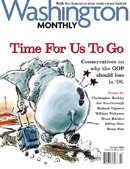
That is not the really funny part, Steve. The funny part is that you either have a short memory or do not read the magazine that you write for. Some prominent conservatives and Republicans were so unhappy with the Bush administration that they were calling for Democratic victory in the midterms and restoration of divided government. I know this, because I posted highlights from the cover story of the Washington Monthly article entitled "Time for us to go." Apparently, memory is fleeting at the Washington Monthly. Steve's article also begs the question - What happened to the Democrats who thought divided government was a good idea in 2006? Well, at least one of them still thinks it is a good idea. That would be me.

Miscellany

Traditionally, we conclude this Carnival by including one "off-topic" submission, as a grudging acknowledgment and proxy for the many off-topic submissions received. Off-topic in this context meaning - no mentions of "divided government" or gridlock.

For this edition we again offer Madeleine Begun Kane (who practically owns this spot) as she presents Open Limerick To Robert Gibbs and President Obama posted at Mad Kane's Political Madness.

Open Limerick To Robert Gibbs and President Obama
By Madeleine Begun Kane

Mr. Gibbs is thin-skinned, it appears.
From the left, he wants only big cheers.
But lefties just seek
A Dem Prez who ain’t weak.
White House courage is deep in arrears.

This verse is for Robert Gibbs’ boss.
Ignoring the left is your loss.
And a loss for the nation.
Our former elation
Is gone with your liberal gloss.

I found the ham-handed Gibbs/Axelrod/Rahm attempt at Clintonian triangulation to be a topic of great amusement and posted about it both here and at Donklephant. Madeleine 's limerick inspired me to pen a verse of my own:
Limerick for the Lackey Left
by The Dividist

Said Gibbs “The left is on drugs.”
Rahm agrees: “Just pull out the rug!”
“They’ve nowhere to go...
They’re retarded you know...
“In the end they’ll come back to ‘O’”
With that, we''ll wrap up this edition. Thanks for stopping by, and thanks for all of the submissions (on-topic or not).

Look for the next edition of The Carnival of Divided Government Quadrâgintâ (XL) - Special Labor Day/ Fight Procrastination Day Edition a week or so late on 09-10-2010. Submit your blog article at carnival of divided government using our carnival submission form.

Divided and Balanced.™
Now that is fair.


Carnival of Divided Government

Tuesday, August 10, 2010

Robert Gibbs gives me an excuse to use my Obama morphing into Bush graphic again.

This is kind of fun...

First - Press Secretary Robert Gibbs tees off into the left rough:

"I hear these people saying he's like George Bush. Those people ought to be drug tested," Gibbs said. "I mean, it's crazy."

Glenn Greenwald takes it personally, almost as if Gibbs is aiming directly at him:

"Robert Gibbs -- in one of the most petulant, self-pitying outbursts seen from a top political official in recent memory, half derived from a paranoid Richard Nixon rant and the other half from a Sean Hannity/Sarah Palin caricature of The Far Left -- is here to tell you that the real reason you're dissatisfied with the President is because you're a fringe, ideological, Leftist extremist ingrate who needs drug counseling...

The Democrats have been concerned about a lack of enthusiasm on the part of their base headed into the midterm elections. These sorts of rabid, caricatured, Fox-News-copying attacks on the Left will undoubtedly help generate more enthusiasm -- more loud clapping -- for the Democrats. I know I'm eager to go canvass and clap for Democrats after reading Gibbs' noble, inspiring vision. If it were Gibbs' goal to be as petulant and self-pitying as possible, what could he have done differently?...

I hope there are enough drug testing facilities to accommodate Talking Points Memo reporters, Charlie Savage, the lawyers from EFF, Bob Herbert, Anthony Romero, Russ Feingold, and The New York Times Editorial Board. I don't know anyone who asserts that Obama is the same as Bush -- I don't believe that and never asserted that -- but if anyone needs to be "drug tested," it would be those denying that many of Bush's most controversial policies and actions have been embraced in full by Barack Obama."
Ok - Gibbs really is aiming at Greenwald.

Finally, the voice of Reason - Matt Welch weighs in:
"And though the existence of progressive-left criticism of Obama has been one of the few heartening things about political discourse these past 19 miserable months, I wish more lefties were making the George W. Bush comparison on things like bailouts and spending binges and military surges and WoT detentions and entitlement expansion and Old Europe-tweaking and drug raids and obscenity prosecutions and general bullshittery."
Hey Matt - I'm doing my part.

Although - strictly speaking - I guess I am not a lefty now.

But I was in 2006, and hope to be again in 2012. Does that count?

UPDATE:
Mister Gibbs sheepishly "walked back" his earlier statement, describing it as "inartful".

My question is not why his liberal base is frustrated, that is pretty obvious. My question is what exactly was Gibbs trying to do? The initial rant was not "off the cuff". Lets get real. Gibbs is a Press Secretary. He serves up exactly nothing that is not first chewed, digested and excreted by Axelrod and Rahm. Then I read this in his artful walk back from the interview:
“In November, America will get to choose between going back to the failed policies that got us into this mess, or moving forward with the policies that are leading us out.”
Now I get it. They want to run against GWB again in 2010 because – you know – it worked last time. I mean - Bush was not running then... Bush is not running now... What's the difference?

But they really can’t run against Bush if the best and brightest in their base keep saying that Obama is acting just like Bush.

This was all about getting them to stop making that comparison. At least until after the election.


cross-posted at Donklephant

Divided and Balanced.™
Now that is fair.

Monday, August 09, 2010

Prop 8, James Madison and Majority Rule

Image ripped from Marko Ilic H/T Rojos

In the wake of Judge Vaughn Walker finding California's Prop 8 to be unconstitutional, we are treated to the predictable spectacle of hypocrisy on parade from politicos across the political spectrum including Newt Gingrich and Barack Obama.

The most compelling arguments against Judge Walker's ruling are premised on the notion that it violated majority rule. The argument takes a variety of forms: that a court overreaches when it substitutes its judgment for the clearly expressed judgment of a majority of voters; that it would be tactically better for same sex marriage proponents if was legalized by an electoral or legislative majority at either a state or federal level rather than judicial fiat; that it disrespects constitutional sanctity and founder's intent for majority rule. The argument is getting serious consideration across the blogosphere - some examples include The Crossed Pond, Ordinary Gentlemen, Andrew Sullivan, Allahpundit, Balloon Juice, Ann Althouse, Volokh Conspiracy, and others.

I am sympathetic to the preference for individual rights being protected by a popular majority and/or legislature as opposed to judicial means. Who would not? That said, I don’t think there is any basis for saying it is a decision that should not have been made by a judge. Let me hasten to state that I am not making a legal argument, as I am not qualified to do so, let us call this a constitutional/philosophical observation.

Our Constitution implicitly and explicitly establishes something of a hierarchy of rights and powers. Federal powers are specifically enumerated, with the power not delegated to the United States government by the Constitution reserved to the States. This clearly indicates a general preference for state's rights and powers. The preference for the superiority of majority rule can also be gleaned in the order that the branches of government are enumerated in the articles of the Constitution. First the democratic people’s House, then the republican Senate, then the executive (selected by a non-majoritarian electoral college), then the unelected judiciary. All would argue for the founder's obvious preference for and superiority of democratic majority decisions, and the state's exercise of power to that of the federal government.

But – then there is the Bill of Rights, without which the Constitution would never have been ratified. The enumeration of rights in the first 10 amendments is informed by a self-evident truth that all individuals are imbued with inalienable rights to life, liberty and pursuit of happiness - rights that are inalienable by kings, rights that are inalienable by majority rule. These rights are at the pinnacle of and/or transcend the entire hierarchy of preference of power found in the Constitution. The fundamental assertion of the Bill of Rights is that no power may abridge these rights – including a democratic majority at either the state or federal level. All branches of the federal government should regard protection of these rights against encroachment - regardless of source - as a primary responsibility.

Who better to speak to the limits of majority rule, than the architect of the Constitution - James Madison? In Federalist #10 he speaks directly to protecting rights from the majority:

“When a majority is included in a faction, the form of popular government, on the other hand, enables it to sacrifice to its ruling passion or interest both the public good and the rights of other citizens. To secure the public good and private rights against the danger of such a faction, and at the same time to preserve the spirit and the form of popular government, is then the great object to which our inquiries are directed. Let me add that it is the great desideratum by which this form of government can be rescued from the opprobrium under which it has so long labored, and be recommended to the esteem and adoption of mankind.

By what means is this object attainable? Evidently by one of two only. Either the existence of the same passion or interest in a majority at the same time must be prevented, or the majority, having such coexistent passion or interest, must be rendered, by their number and local situation, unable to concert and carry into effect schemes of oppression.”

And again, in his speech at the Constitutional Convention introducing the Bill of Rights for consideration, Madison is clear about the limits of majority rule:

“But whatever may be the form which the several States have adopted in making declarations in favor of particular rights, the great object in view is to limit and qualify the powers of Government, by excepting out of the grant of power those cases in which the Government ought not to act, or to act only in a particular mode. They point these exceptions sometimes against the abuse of the Executive power, sometimes against the Legislative, and, in some cases, against the community itself; or, in other words, against the majority in favor of the minority.

In our Government it is, perhaps, less necessary to guard against the abuse in the Executive Department than any other; because it is not the stronger branch of the system, but the weaker: It therefore must be leveled against the Legislative, for it is the most powerful, and most likely to be abused, because it is under the least control. Hence, so far as a declaration of rights can tend to prevent the exercise of undue power, it cannot be doubted but such declaration is proper. But I confess that I do conceive, that in a Government modified like this of the United States, the great danger lies rather in the abuse of the community than in the Legislative body. The prescriptions in favor of liberty ought to be leveled against that quarter where the greatest danger lies, namely, that which possesses the highest prerogative of power. But this is not found in either the Executive or Legislative departments of Government, but in the body of the people, operating by the majority against the minority.“


So what should happen when the majority acts against a minority, as in Proposition 8? Particularly when we see the executive branch make a craven political decision to not act in support of the minority, and legislators at both the federal and state level unwilling to act in contradiction to the majority view? In such a case, it seems obvious that the judiciary is the last firewall to protect our liberty, and it is only the judiciary that can preserve our rights against the will of the majority. In such a case, not only is judicial action acceptable, it is necessary, even when it means substituting judicial fiat for democratic majority or legislative action. Self evident inalienable individual rights should trump the majority every time.

I suppose that one can argue that same sex marriage does not fall into the category of a self evident inalienable right to pursue happiness. This is where we probably cross the line from a constitutional argument to a legal argument. But on the broader question - whether a judge should substitute their judgment for the judgment of a majority? Yes they should. I was pleased with Judge Walker’s decision, as I saw Prop 8 as a clear attempt by the majority to impinge on the rights of a minority. Judge Vaughn Walker did his job and did it well.

Now if only our Congress would do their job, reassert their constitutional authority as a co-equal branch of government and begin to reel back in the ever expanding role of the Unitary Executive and our Imperial Presidency, then we might return to the founder's intent of an executive branch that "is not the stronger branch of the system, but the weaker" as also asserted by James Madison.


Divided and Balanced.™
Now that is fair.


Wednesday, August 04, 2010

CRS: "The precise number of new entities that will ultimately be created pursuant to PPACA [Obamacare] is currently unknowable"


This updated chart of "Your New Health Care System" got a lot of play around the right-o-sphere. The chart is, of course, a partisan Republican attack on the Obamacare hairball that was steamrolled on a partisan Democratic vote over a loud but legislatively impotent Republican minority. However - to paraphrase a favorite quote ("Just because you are paranoid, doesn't mean they are not out to get you") - just because it is partisan, does not mean it is not true. This one has the ring of truth and garnered accidental support from the non-partisan Congressional Research Service.

The CRS Report "New Entities Created Pursuant to the Patient Protection and Affordable Care Act" is apparently intended to defuse charts like the one at the top of the post, but actually details an even more frightening state of affairs:
"This report describes dozens of new governmental organizations or advisory bodies that are mentioned in PPACA, but does not include other types of entities that were created by the legislation (e.g., various demonstration projects, grants, trust funds, programs, systems, formulas, guidelines, risk pools, websites, ratings areas, model agreements, or protocols). A table in the Appendix is organized in terms of entities (1) that were created by PPACA itself (e.g., through statutory language stating that an organization is “established” or “created”); (2) that PPACA requires the President to establish (e.g., “the President shall establish”); (3) that PPACA requires the Secretary of the Department of Health and Human Services (HHS) to establish (e.g., “the Secretary shall establish”); (4) that PPACA requires some other organization to establish; and (5) that PPACA authorizes to be established....

The precise number of new entities that will ultimately be created pursuant to PPACA is currently unknowable
.. The legislation sometimes indicates when and where certain entities are to be established, how members are to be appointed, the amount and timing of appropriations, whether certain general management laws are applicable, and when the entities will cease to exist. In other cases, however, PPACA is silent with regard to these and other issues. The degree of specificity in these provisions may have implications for congressional control and, conversely, the amount of discretion that agencies will have in the implementation of the legislation. PPACA significantly increased the appointment responsibilities of the Comptroller General of the United States, and it is unclear how the Government Accountability Office (GAO) will be able to independently audit entities whose members are appointed by the head of GAO."
The report was released in early July, but the MSM and blogosphere are just now beginning to pick up on the ramifications of what it says about our new Health Care law of the land.

Politico: Health reform's bureaucratic spawn
"Don’t bother trying to count up the number of agencies, boards and commissions created under the new health care law. Estimating the number is “impossible,” a recent Congressional Research Service report says, and a true count “unknowable.” The reasons for the uncertainty are many, according to CRS’s Curtis W. Copeland, the author of the report “New Entities Created Pursuant to the Patient Protection and Affordable Care Act.” The provisions of the law that create the new entities vary dramatically in specificity. The law says a lot about some of them and a little about many, and merely mentions a few. Some have been authorized without any instructions on who is to appoint whom, when that might happen and who will pay."
CNN: Cafferty File
"A sprawling bureaucratic giant - nobody knows how big it will be. That seems to be the result of President Obama's new health care law. According to Politico, a recent report says it's "impossible" to estimate the number of agencies, boards and commissions created by the new law. The Congressional Research Service report points to many reasons for this. First off, the parts of the law that create new bodies vary drastically. In some cases – the law gives lots of details... in other cases, barely a mention. Also, the law authorizes some new entities... without saying who will do the appointing, or when it will happen. And all this means some agencies could wait indefinitely for staff and funding... while others could multiply... creating quote "an indeterminate number of new organizations." So far this is shaping up to be exactly what the critics were afraid it would be... How will the government manage our health care if it's "impossible" to know the number of agencies, boards and commissions created by the new health care law?"

Ed Morrisey at Hot Air: ObamaCare: The Infinite Bureaucracy Act
"CRS wanted to say that there wasn’t enough certainty in the number of agencies, panels, and committees to put them into flowcharts with connecting lines. Like Nancy Pelosi once argued, the CRS report says that we can’t know what’s in ObamaCare until the government rolls it out . That in itself is a big, big problem. It seems clear that Congress just authorized a self-perpetuating bureaucracy, one that can expand on its own and make determinations far outside of the boundaries Democrats promised during the ObamaCare debate. And if that’s true, then it is equally true that the claims made on the cost of administering ObamaCare had no real basis in fact. How can one estimate a cost for a bureaucracy that is entirely undefined in size and scope?"
Washington Examiner: Obamacare is just the beginning
"Just in case anybody missed Copeland's point, Barbash noted that "implicit in the report is a message not to take too seriously the elaborate charts and seemingly precise numbers peddled by Republican critics that are designed to show the law's many bureaucratic tentacles." But folks who actually read the Copeland report and scan those two scary GOP charts are quite likely to reach the contrary conclusion. In fact, one might even think the GOP critics were being too easy on Obamacare... Copeland looked at only part of the picture. The rest of the picture -- those demonstration projects, grants, trust funds, programs, systems, formulas, guidelines, risk pools, etc. -- will result in at least as much, if not much more, bureaucratic expansion. So, while the precise number of new government bureaus and bureaucrats created by Obamacare can't be known now, what is known beyond any shadow of a doubt is that there will be more, much more, government."
Some Democrats have taken comfort in a recent tracking poll indicating that opposition to Obamacare has marginally decreased. I’d put that in the same category of self-delusion as “America is a center-left country”,”demographic realignment means a permanent Democratic majority", and “a Republican cannot win Ted Kennedy’s seat”. This is legislation that only looks good if you blur your vision and avert your eyes. The closer you look, the uglier it gets.

Make no mistake - the GOP will make sure everyone gets a good long rub-your-nose-in-it look between now and November. Every GOP candidate will be taking shots at Obamacare, and that is one slow fat rabbit to hunt. When you look at the chart and read the CRS report - the campaign ads write themselves. Since no Democratic Party candidate has any real idea of what is in the hairball they voted for – well – lets see what happens when GOP ads start putting it on the air 7×24 and they have to keep explaining the details to the voters.

The administration is not taking this lying down - in another triumph for "framing" over content, they've recruited Andy Griffith to lead the charge with a misleading, taxpayer funded, possibly illegal, pre-emptive advertising strike. After all, if you can't trust the Sheriff of Maybury - who can you trust?

UPDATE:
Results just in on a somewhat more reliable Obamacare sentiment poll taken on Tuesday - As goes Missouri - so goes the nation?

Divided and Balanced.™
Now that is fair.


Friday, July 30, 2010

ACLU: If you liked the Bush/Cheney Unitary Executive, you'll love the bigger and badder Obama Unitary Executive

This week the ACLU released a disturbing, but depressingly unsurprising report documenting the permanent enshrinement of the Bush/Cheney definition of the Unitary Executive by the Obama administration. With the tacit acceptance of the lapdog Democratic Congress, the balance of power between executive and other branches continues to shift heavily to the executive. The report is unsurprising because it was clear to anyone paying attention in the first few weeks of the Obama administration, that his campaign rhetoric of rolling back the Bush/Cheney power grab was just that - empty campaign rhetoric.

The ACLU report "Establishing a New Normal" is summarized here, and the full report linked here [PDF]. The report assesses the civil rights record of the first 18 months of the Obama administration across several civil rights categories and is well worth the read.

Excerpted here - a few of the report highlights lowlights:

TRANSPARENCY
"...the administration has fought to keep secret hundreds of records relating to the Bush administration’s rendition, detention, and interrogation policies. To take just a few of many possible examples, it has fought to keep secret a directive in which President Bush authorized the CIA to establish secret prisons overseas; the Combatant Status Review Transcripts in which former CIA prisoners describe the abuse they suffered in the CIA’s secret prisons... the administration has also fought to withhold information about prisoners held at Bagram Air Base in Afghanistan. Indeed, the Obama administration has released less information about prisoners held at Bagram Air Base than the Bush administration released about prisoners held at Guantánamo."

TORTURE AND ACCOUNTABILITY
"The truth is that the Obama administration has gradually become an obstacle to accountability for torture. It is not simply that, as discussed above, the administration has fought to keep secret some of the documents that would allow the public to better understand how the torture program was conceived, developed, and implemented. It has also sought to extinguish lawsuits brought by torture survivors—denying them recognition as victims, compensation for their injuries, and even the opportunity to present their cases."

DETENTION
"Of far greater significance than the administration’s failure to meet its own one-year deadline is its embrace of the theory underlying the Guantánamo detention regime: that the Executive Branch can detain militarily—without charge or trial—terrorism suspects captured far from a conventional battlefield... we fear that if a precedent is established that terrorism suspects can be held without trial within the United States, this administration and future administrations will be tempted to bypass routinely the constitutional restraints of the criminal justice system in favor of indefinite military detention. This is a danger that far exceeds the disappointment of seeing the Guantánamo prison stay open past the one-year deadline. To be sure, Guantánamo should be closed, but not at the cost of enshrining the principle of indefinite detention in a global war without end."

TARGETED KILLING
"President Obama has authorized a program that contemplates the killing of suspected terrorists—including U.S. citizens —located far away from zones of actual armed conflict. If accurately described, this program violates international law and, at least insofar as it affects U.S. citizens, it is also unconstitutional... the government has failed to prove the lawfulness of imprisoning individual Guantánamo detainees in some three quarters of the cases cases that have been reviewed by the federal courts thus far, even though the government had years to gather and analyze evidence for those cases and had itself determined that those prisoners were detainable. This experience should lead the administration—and all Americans—to reject out of hand a program that would invest the CIA or the U.S. military with the unchecked authority to impose an extrajudicial death sentence on U.S. citizens and others found far from any actual battlefield."

MILITARY COMMISSIONS
"The administration’s embrace of military commission trials at Guantánamo, albeit with procedural improvements, has been a major disappointment. Instead of calling a permanent halt to the failed effort to create an entirely new court system for Guantánamo detainees, President Obama encouraged an effort to redraft the legislation creating the commissions and signed that bill into law... the existence of a second-class system of justice with a poor track record and no international legitimacy undermines the entire enterprise of prosecuting terrorism suspects. So long as the federal government can choose between two systems of justice, one of which (the federal criminal courts) is fair and legitimate, while the other (the military commissions) tips the scales in favor of the prosecution, both systems will be tainted..."

SPEECH AND SURVEILLANCE
"...over the last eighteen months, President Obama’s administration has defended the FISA Amendments Act in the same way that the last administration did so: by insisting that the statute is effectively immune from judicial review. Individuals can challenge the statute’s statute’s constitutionality, the administration has proposed, only if they can prove that their own communications were monitored under the statute; since the administration refuses to disclose whose communications have been monitored, the statute cannot be challenged at all. In some ways, the administration’s defense of the statute is as troubling as the statute itself. The Obama administration has been reluctant to yield any of the expansive surveillance powers claimed by the last administration. It has pushed for the reauthorization of some of the Patriot Act’s most problematic surveillance provisions."

WATCH LISTS
"...rather than reform the watch lists the Obama administration has expanded their use and resisted the introduction of minimal due process safeguards to prevent abuse and protect civil liberties. The Obama administration has added thousands of names to the No Fly List, sweeping up many innocent individuals. As a result, U.S. citizens and lawful permanent residents have been stranded abroad, unable to return to the United States. Others are unable to visit family on the opposite end of the country or abroad. Individuals on the list are not told why they are on the list and thus have no meaningful opportunity to object or to rebut the government’s allegations. The result is an unconstitutional scheme under which an individual’s right to travel and, in some cases, a citizen’s ability to return to the United States, is under the complete control of entirely unaccountable bureaucrats relying on secret evidence and using secret standards."

CONCLUSION
"...if the Obama administration does not effect a fundamental break with the Bush administration’s policies on detention, accountability, and other issues, but instead creates a lasting legal architecture in support of those policies, then it will have ratified, rather than rejected, the dangerous notion that America is in a permanent state of emergency and that core liberties must be surrendered forever."
It is easy to point to the mind-numbing hypocrisy of the liberals and Democrats who railed with righteous indignation about the Bush/Cheney expansion of executive power, only to be complicit in our loss of liberty now. Their deafening silence, mild criticism, or rationalizations of the Obama administration's continued expansion of executive power and consequent institutionalization of the Bush/Cheney Unitary Executive speaks volumes. To be sure there are principled voices on the left that have consistently and clearly pointed to this Obama administration failure - notably Glenn Greenwald, and Jane Hamsher, among others:

The Daily Show With Jon StewartMon - Thurs 11p / 10c
Respect My Authoritah
www.thedailyshow.com
Daily Show Full EpisodesPolitical HumorTea Party


These voices are too few on the left.The first two years of the Obama administration represent a badly squandered opportunity to undo the damage done by the previous.

Much worse than the routine partisan hypocrisy, is the the complete abrogation of constitutional, checks, balances, and oversight responsibilities by our Senators and Representatives in Congress.

What happened to the soaring rhetoric of Senator Patrick Leahy - who campaigned passionately and relentlessy for the restoration of constitutional Habeas Corpus protections in 2006?

SEN. PATRICK LEAHY: "It grieves me to think that three decades in this body that I stand here in the Senate, knowing that we’re thinking of doing this. It is so wrong. It is unconstitutional. It is un-American. It is designed to ensure the Bush-Cheney administration will never again be embarrassed by a United States Supreme Court decision reviewing its unlawful abuses of power. The Supreme Court said, 'You abused your power.' He said, 'Ha, we'll fix that. We have a rubber stamp, a rubber stamp, Congress, that will just set that aside and give us power that nobody, no king or anybody else set foot in this land, ever thought of having."
In 2007 this blog again supported the Leahy follow-on effort to restore Habeas Corpus:
"The gutting of the Great Writ of Habeas Corpus is the most notable outstanding assault on civil liberties. Senators Leahy and Spector have just introduced legislation to restore the right without ambiguity and DWSUWF recommends signing the petition to support their efforts. "
If you click on the petition linked in this quote you'll note the referenced campaign on the Leahy website no longer exits, replaced with a milquetoast request to send a letter to your senator requesting support. I guess it is just not as high a priority for Leahy if a Democrat has "power that nobody, no king or anybody else set foot in this land, ever thought of having." I expect Democrats will not be as sanguine about the expanded and institutionalized power of the Obama Unitary Executive when and if a Mitt Romney or Sarah Palin steps behind the wheel of this supercharged presidential machine.

The ACLU report focuses on civil liberties, but the accelerating accretion of executive power over our economic liberties has been equally egregious. I won't belabor the point in this post, but will simply point out the obvious. Regardless of what one thinks of the merits or politics of the legislation, it is beyond argument that Obamacare and Financial Regulation as passed, dramatically increase the power held by the executive branch. Congress granted a charter and vast power to faceless bureaucrats in the executive branch with the unfettered latitude to create and enforce broad new regulations over the healthcare and financial industry. Beyond these laws, even when operating without a firm legal foundation, this administration has also repeatedly demonstrated an eager willingness to push the the boundaries of presidential power.

You'd think, even allowing for partisanship, there would be enough institutional loyalty among our legislators to try to maintain some semblance of balance between the supposedly co-equal legislative and executive branches of government. It is simply not happening. In times of Single Party Rule (as we've had for eight of the last ten years) it is Party Über Alles, and the constitutional checks and balances envisioned by the founders between the executive and legislative branch just fade away. This was true with Republicans in 2000-2006, and it is true with Democrats now.

At the rate that the Senate and House have ceded power to the executive branch over the last decade, combined with the boot-licking deference most legislators offer to an executive of the same party, the legislature might as well vote itself out of existence. Perhaps they could be functionally replaced by a LegOlist e-mail listserv.

The only restraint on executive power today is the judiciary. This is why I have supported and will continue to support Obama nominations to the Supreme Court. My fervent hope is that the new justices will help form a SCOTUS majority that will pull hard on the reigns of the executive branch, declare many of the Bush/Obama administration actions (civil and economic) unconstitutional, and restore some semblance of the rule of law.

Regardless of what you may think of the political leanings of ACLU, they are fighting the good fight for our constitutional protections in the courts and they are doing it regardless of the party in power. They deserve our support. Beyond the courts, the only other way to restrain the extraordinary economic overreach and fiscal irresponsibility of this executive branch is to vote Republican in 2010 and divide this government.

Divided and Balanced.™
Now that is fair.


Sunday, July 25, 2010

Support Prop 19 - Marijuana prohibition hypocrisy is an expensive indulgence Californians can no longer afford.

Ripped from Tom Meyer

Joseph McNamara, former San Jose Police Chief, makes the case the for Prop 19 in the Sunday San Francisco Chronicle:

"I've seen the prohibition's terrible impact at close range. Like an increasing number of law enforcers, I have learned that most bad things about marijuana - especially the violence made inevitable by an obscenely profitable black market - are caused by the prohibition, not by the plant...

Experience and research show that the United States has among the world's harshest marijuana laws, yet our consumption rate leads the world and is twice that of the Netherlands, where cannabis sales to adults have been allowed for decades. Prohibition doesn't keep marijuana away from young people...

No one can dispute that marijuana already is widely available. At least 1 in 10 Californians consumed it in the past year, despite expensive government efforts. The November ballot's Proposition 19: The Regulate, Control and Tax Cannabis Act of 2010 acknowledges this reality and enables us to manage the cannabis market. Furthermore, taxing legal cannabis sales will provide steady funding for local governments that may help avoid layoffs of police and teachers...

When we stop wasting resources on processing hundreds of thousands of low-level possession cases, we'll be able to focus on keeping impaired drivers off the road, to concentrate on violent crime and on making people feel they and their children are safe from random gang and drug-related shootings. At work, employers will retain their rights to fire employees whose drug or alcohol use affects their productivity...

That perhaps brings up the most significant and least considered cost of criminalizing marijuana - turning people into criminals for behavior of which we disapprove, even though it doesn't take others' property or endanger their safety. It is worth remembering that our last three presidents, Bill Clinton, George W. Bush and Barack Obama, would have been stigmatized for life and never would have become presidents if they had been in the wrong place at the wrong time and been busted for pot during their reckless youthful days. Countless other Americans weren't so lucky. California voters have an opportunity in November to return reason to our state by decriminalizing adult use of marijuana."
For all practical purposes (except taxation and regulation) marijuana is already a de factco legal intoxicant in this state. It is also the biggest cash crop in the state. Decades and billions wasted on criminal enforcement has done exactly nothing to reduce or restrict it's use. More decades and billions spent on criminal enforcement will do exactly nothing except to waste more resources that are better spent elsewhere.

Yes, legalization will bring some problems. They are social and health problems, not criminal problems. They are manageable. Tax the weed and put programs in place to deal with social and health issues. Save our enforcement, judicial, and penal resources for dealing with real criminals.

Let's try something new in California.

Let's treat this issue honestly and like adults.

Let's treat one another like adults who can be trusted to be responsible for our own lives, as long as we do not harm one another.

Let's pass Prop 19.

Divided and Balanced.™
Now that is fair.


Saturday, July 24, 2010

Do you ever wonder how the rest of the world views our 2012 presidential selection process?


As I've noted before - the future of mainstream news is Taiwanese animation. This piece from NMA News in Taiwan explains our 2012 Presidential election pregame warm-ups to a Chinese audience.


What is truly frightening... Without understanding one word of Chinese, I completely understand every single frame in this story.

Tuesday, July 13, 2010

Gridlock Is Good

UPDATED: 15-July-10

Doyle McManus at the LA Times considers the challenges the GOP must face to press their advantage in November, and the challenges facing the country should they prevail and restore divided government:

A post-November congressional outlook: partisan gridlock
"But there's at least one potential problem for the Republicans: They haven't settled on a unified national message yet — and a quiet civil war is brewing over what, if anything, it should say. In one camp are House conservatives, led by Rep. Eric Cantor (R-Va.), the House minority whip, who argue that Republicans won in 1994 because the Contract with America laid out by then-Rep. Newt Gingrich (R-Ga.) articulated a coherent message around which candidates and voters could rally... Republicans, reportedly including Senate Minority Leader Mitch McConnell (R-Ky.), worry about finding a tent large enough to include all GOP viewpoints. Trying to come up with a single platform, they believe, could be divisive, and the party should simply embrace a few broad issues such as cutting taxes and spending. We're already winning, they argue; why get too specific and give Democrats a clearer target to shoot at?"
While messaging is important, McManus overstates the significance of the problem. There is simply not a tent big enough to encompass the full spectrum of policy positions held by those opposed to our One Party Democratic Rule, including: fiscal conservatives; social conservatives; Republican partisans; libertarians; independents; and the tea party movement. But there does not need to be a unanimity of policy preferences for the GOP to prevail. All they need in November is a common objective and general agreement that a key issue takes precedence over all others. My take -
  • The objective is restoring balance and restraint in our federal government.
  • The key issue is restraining the insane growth of spending and curtailing the fiscal irresponsibility exhibited by the Democrats and this administration.
The Tea Party movement is a microcosm of the opposition coalition, willfully misunderstood and mis-characterized by Democratic Party partisans. So far, the Tea Party has shown considerable political acumen and understand that social issues must take a back seat to economic issues in this election. In a nutshell - "It's the spending, stupid" - (Thank you again James Carville).

Wednesday, July 07, 2010

Investors Love Divided Government -
Perception is Reality

The correlation (or not) of divided government, market performance, election expectations and investor psychology has been a recurring theme on DWSUWF since the beginning of this blog (see 2006, 2007, 2008 , 2009).

In yesterday's post, I quoted a couple of articles speculating on how markets might react should the Republicans retake either the House or Senate majority in the 2010 midterms. This was my comment on the articles:
"I am reluctant to link longer term market behavior to any policy or partisan mix in Washington. I've not seen any studies that show a believable, statistically significant correlation between long term market direction and Republican, Democratic, or divided governments. That said - in the short term it is less important whether there really is a correlation so much as whether investors believe there is a correlation. My sense is that most investors believe the stock market will benefit from Republicans taking control of either the House or Senate in the fall. With that expectation, a rising market could very well be a self-fulfilling prophecy."
Today, the Dow Jones rebounded 274 points, leaving many analysts scratching their heads after the unrelenting doom and gloom of the past few weeks. CNBC preempted Jim Cramer's show to broadcast a one hour special analyzing the day's market action. In this excerpt Ron Insana echoes that sentiment:


Money quote:
"All of a sudden there are some reports coming out saying the politicians are underestimating the possibility the Republicans take either one or both house of Congress. If that political uncertainty disappears and you get a Democratic President and a Republican Congress - that is the best combination for stock prices. It might also clear up the uncertainty that will allow corporations to hire people." - Ron Insana

Indeed it might. And like in the 2006 mid-terms - perhaps happy days will be here again (at least as far as the market is concerned).

The full unedited clip from CNBC is linked here.

Postscript:
Yes - Amanda Drury did, in fact, turn to the panel and ask "Double-D or not Double-D? What do you think?" I thought Insana was going to lose it.

Divided and Balanced.™
Now that is fair.